
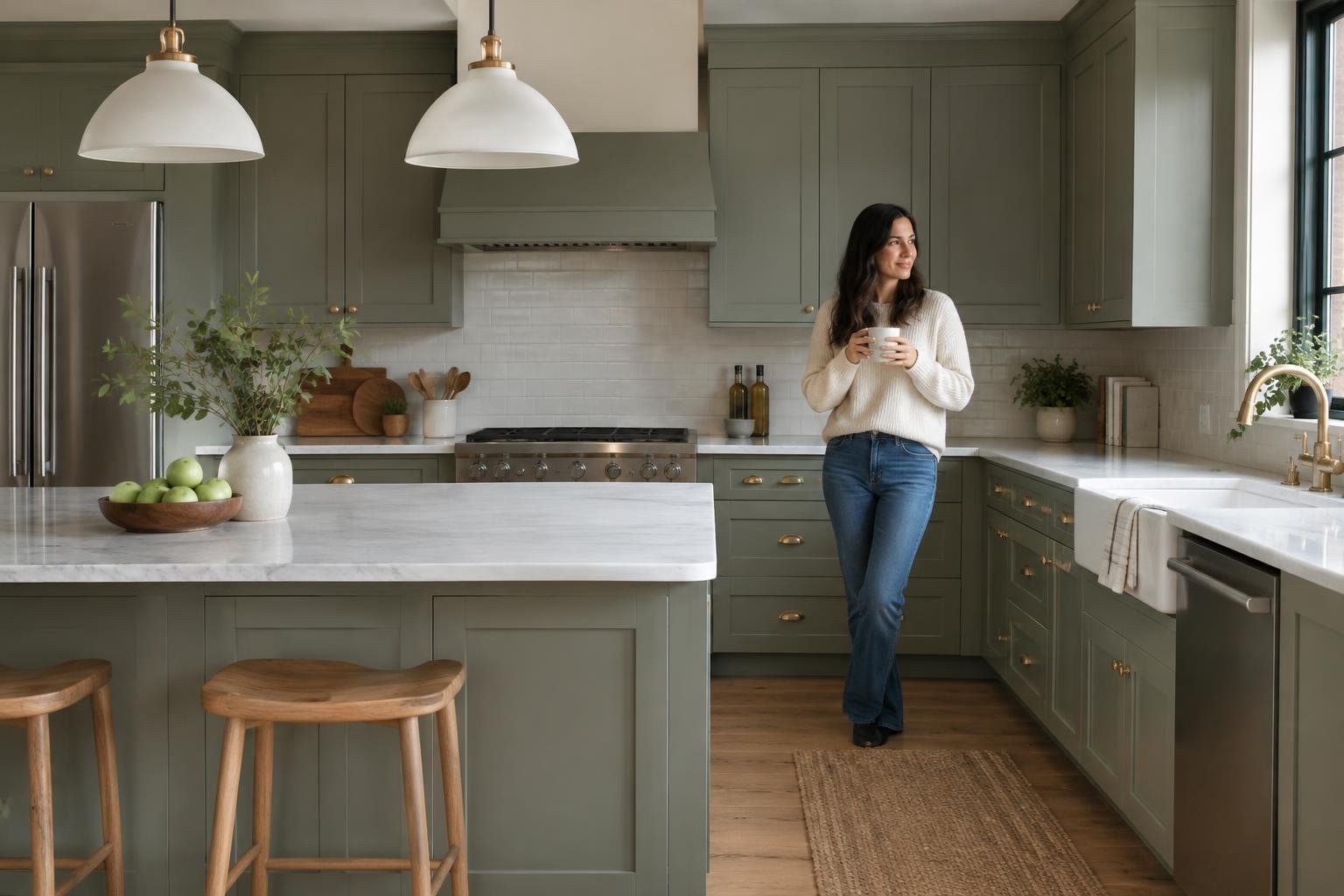
Green kitchen cabinets can make a room feel calm and natural, or turn cabinetry into its main design feature. The color alone does not determine whether the choice will work. Consider how the shade looks beside your counters, flooring, backsplash, and lighting, then compare cabinet construction, delivery, and installation details. This guide covers the decisions that matter before you order, from testing color samples to evaluating quotes and timelines.
Quick answer: what to know about green kitchen cabinets
Green is not one fixed look. Soft sage can read as quiet and light, while olive or a deeper earthy green makes cabinetry more visually prominent. Product listings show a range that includes soft sage, matte olive, and Oxford green. Design examples also show green used on a built-in, across cabinetry, and in combination with different wall colors.
That range is useful, but online photos are only a starting point. Images may show different lighting, surrounding materials, and color settings than your kitchen. Ask how the finish is represented in the product listing and, where possible, see a physical sample before finalizing the order.
Think of the cabinet color as one part of a coordinated set: cabinets, counters, backsplash, flooring, wall color, lighting, and hardware. If several elements are still undecided, avoid locking in the cabinet shade until you can review the main finishes together.
When green cabinetry makes sense, and when to pause
Green cabinets may be a good fit if you want a colored kitchen rather than an all-neutral scheme, if you already have green details you want to connect to, or if you are looking for a way to make a built-in or cabinet run stand out. A design example uses a cozy green on a step-back built-in, showing that the color does not have to cover every cabinet to have an effect.
They may be less suitable if you have not settled on your counters and backsplash, dislike making color decisions that are difficult to reverse, or are choosing from a screen image without checking a sample. That does not mean you need to avoid green. It means the choice deserves a little more coordination before purchase.
Start by deciding whether you want green to be the main visual feature or one color among several. That decision helps narrow the shade, the amount of cabinetry to color, and the finishes to compare.
Green kitchen cabinet costs: what to compare
Prices vary by product and project scope; there is no single price for green kitchen cabinets. Compare itemized quotes for the products and work you need rather than relying on a color-based price expectation.
Ask each seller or installer to state what is included. Separate the cabinet order from delivery, assembly if applicable, installation, and any additional remodeling work. Also confirm whether the quote includes all cabinet pieces needed to complete the planned layout, such as fillers or finished panels, if those are part of your design.
Compare like with like. A quote for a ready-to-assemble product is not directly comparable with one for an assembled product unless you understand what assembly, delivery, and installation services each includes. Request the exact product line, finish, cabinet list, and scope in writing.
- Ask for a line-item cabinet list and the specified finish.
- Confirm delivery terms and whether assembly is included.
- Identify installation and any separate labor charges.
- Have every provider price the same layout and product scope.
Factors that affect the project
The project scope depends on the cabinet selection and the work included with it. Green cabinet listings include ready-to-assemble and assembled formats, and product specifications can differ. Confirm the exact product, finish, cabinet list, and configuration before comparing estimates.
Delivery, assembly, and installation can also affect what a quote covers. Ask providers to identify which services are included, list any separate charges, and explain exclusions. Compare proposals for the same cabinet selection and scope so the totals are meaningful.
Timing is another factor to verify. One product listing says fully assembled cabinets are ready to ship in 7–10 days, but that listing-specific estimate is not a delivery or installation date. Confirm current timing for the product you choose and clarify what each date means.
Options and tradeoffs: where and how to use green
Green cabinets can be used across a kitchen, concentrated on a smaller built-in or run, or combined with a contrasting wall color. Design examples show green cabinetry with a different green on the walls, green cabinetry alongside white oak floating shelves, and a single green built-in within a larger room. These examples are inspiration, not a requirement to copy a particular palette.
| Approach | Why consider it | What to check |
|---|---|---|
| Green across the cabinetry | Makes the cabinet color a clear part of the room’s identity. | Review the shade beside all major finishes and in the room’s lighting. |
| Green on a limited section | Introduces color without making every cabinet green. | Plan how the green section relates to adjacent cabinets and built-ins. |
| Green with a second color | Creates a layered palette; examples include green cabinets with a different green wall color. | Check that the colors work together in your space, not only in a photograph. |
For door style, a product listing describes a classic Shaker door with a matching drawer front. Use a sample or detailed product information to judge the actual profile and finish. A door style is a visual choice; it does not, by itself, tell you how a cabinet is constructed.
How to choose a green shade and coordinate finishes
Choose a shade by looking at the fixed finishes that are staying in the room. Put the cabinet sample beside the countertop, backsplash, flooring, and any visible wood. If those selections are not made yet, use temporary samples or finish references to test possible combinations before placing a cabinet order.
Decide how much contrast you want. Green with neutral finishes can keep the cabinet color in focus; mixing green with another color creates a more layered look, as seen in published design examples. Neither approach is automatically better. The right decision is the one that makes sense with the finishes you will actually live with.
Pay attention to the way a color changes across a room. Examine a sample near the location where the cabinets will go, and view it at different times of day. If you are considering a dark or saturated shade, think carefully about how much of the room will carry that color. If you prefer a subtler effect, compare softer greens or use the color on a more limited portion of the cabinetry.
Record the exact product and finish name for each sample you compare. Similar descriptions such as “sage” or “olive” are not a substitute for confirming the specific product color.
Compare cabinet formats and product specifications
Start with the cabinet format that matches how you want to buy. Listings offer ready-to-assemble and assembled options. These labels describe how the cabinets are supplied, but do not establish that one option is automatically better quality or better value.
| Option | What to confirm | Useful comparison |
|---|---|---|
| Ready to assemble | What components are supplied, who assembles the cabinets, and whether assembly is included in the quote. | Compare the full cost and responsibility for assembly, delivery, and installation. |
| Assembled | Which cabinets are assembled, how they are delivered, and what handling and installation are included. | Check the exact cabinet list and the current product-specific shipping estimate. |
A product listing advertises all-wood boxes, while another describes a Shaker door and matching drawer front. Treat those as product-specific descriptions. Verify the construction and finish of the specific cabinets you are considering rather than assuming every green option shares the same specifications.
Ask for written details about cabinet construction, finish, hardware, included pieces, and warranty. If the seller cannot identify the product and its specifications clearly, wait to compare until those details are available.
How the buying and project process works
Think of the process as a sequence of decisions: choose the color direction, check it against the room, define the cabinet selection, compare complete quotes, confirm delivery and installation responsibilities, and review the final order before committing. This helps prevent a favorable color impression from overshadowing practical purchase details.
- Set the design direction. Decide whether green will cover the full cabinet set or appear on a smaller section.
- Compare samples and finishes. Check the color against countertops, backsplash, flooring, walls, and wood tones.
- Identify the exact product. Record the finish, door style, cabinet list, and product format.
- Compare written proposals. Make sure each proposal covers the same product and identifies delivery, assembly, and installation.
- Confirm timing and responsibilities. Ask who will coordinate delivery, assembly, installation, and resolution of missing or damaged items.
- Review before ordering. Check that the final written order matches the selections and scope you approved.
This process applies whether you are selecting ready-to-assemble or assembled cabinets. The details differ by product, so use the product listing and written order as the basis for your decision.
What to expect: shipping, delivery, and timing
Timing depends on the specific product and the work included in the project. A product listing states that fully assembled cabinets are ready to ship in 7–10 days. Treat that as a listing-specific statement to verify, not a promise of delivery on a particular date or completion of the whole kitchen project.
Ask for separate estimates for order processing, shipping, delivery, assembly if needed, and installation. Confirm whether a date means “ready to ship,” “leaves the seller,” or “arrives at the project.” Ask what happens if a cabinet is delayed or arrives with a problem.
Before setting a project schedule, confirm who is responsible for receiving and checking the order and when the kitchen area needs to be ready. If other work is planned, establish the order of responsibilities with the people doing that work rather than assuming cabinet delivery and installation dates are interchangeable.
How to choose a qualified cabinet provider
Choose a seller or installer based on a clear scope and reliable communication, not only on the cabinet color or the lowest quoted amount. Ask for the exact product name, finish, cabinet list, delivery terms, and responsibilities in writing. For installation, ask who performs the work and who handles questions or problems after delivery.
- Can you identify the exact cabinets, finish, and door style in the proposal?
- Does the quote include assembly, delivery, and installation, or are they separate?
- Who checks the order and addresses missing or damaged items?
- What is the current expected shipping and delivery timing for this product?
- What warranty applies, and where are its terms provided?
- Can I review examples of relevant work or speak with references?
- How are changes to the product or scope documented and priced?
For installation or related work, verify applicable licensing and insurance for your location and the type of work being done. Requirements vary, so confirm them locally. Do not rely on a verbal assurance when written product, scope, schedule, and warranty information can be provided.
Permits, warranties, and safety questions
Do not assume a cabinet purchase includes every part of a kitchen project. Confirm whether the agreement covers only the cabinets or also assembly, delivery, installation, removal, or other work. Ask the provider to describe the work they are responsible for and identify any work that is outside the agreement.
Check product and installation warranty terms before signing. Confirm what is covered, how long the coverage applies, whom to contact, and whether different parts of the purchase have different terms. Keep the final product description, order, quote, and warranty information together.
Rules for permits and regulated work vary by location and project. If the plan involves changes beyond cabinet selection and installation, ask the responsible provider what local requirements may apply and verify them with the appropriate local authority. Do not take on electrical, plumbing, structural, or other work that requires qualifications you do not have.
Ways to save without creating avoidable problems
You can control spending without choosing a cabinet based on color alone. First decide how much of the kitchen should be green, then compare products that meet your needs. Green can be used on a built-in or paired with other finishes, so a full-room color commitment is not the only way to use it.
- Compare ready-to-assemble and assembled products using the total quote, not the format label alone.
- Keep the cabinet scope consistent while comparing sellers.
- Ask which services are included before paying separately for assembly, delivery, or installation.
- Use samples to avoid committing to a color that does not work with the finishes you plan to keep.
- Ask for a complete written order and confirm it before purchase.
Do not reduce cost by skipping checks that protect the project: verifying the product, confirming the cabinet list, understanding delivery, or clarifying who handles installation and problems. A lower initial quote is not a meaningful comparison if important tasks have been excluded.
One product listing advertises free shipping over $3,000. Treat shipping offers as specific to that seller, order, and current terms. Verify eligibility and the total delivered cost directly before relying on an offer.
Mistakes, red flags, and a pre-order checklist
Common selection problems begin when a shopper chooses from a photograph, treats a product description as universal, or compares proposals with different scopes. Use this checklist before ordering:
- Have I checked the shade against the finishes that will stay in the kitchen?
- Have I decided whether green belongs on all cabinets or only a selected area?
- Do I know the exact product, finish, cabinet list, and door style?
- Have I confirmed whether the cabinets are ready to assemble or assembled?
- Does the quote state delivery, assembly, installation, and any exclusions?
- Have I verified the current shipping estimate and any promotional terms?
- Do I know how warranty questions, missing pieces, and delivery problems will be handled?
Be cautious if a provider will not identify the product, avoids putting the scope in writing, or gives a timing statement without clarifying what the date means. Pause and get the details clarified before comparing bids or paying a deposit.
Green cabinetry can be part of a quiet, coordinated palette or a more colorful design. Decide the intended effect first, then use the checklist to make sure the product and project details support it.
Explore cabinet options
If you are comparing shades or cabinet formats, explore Cabinet Supply for cabinet options and ideas for your project. Review product details carefully, then bring your preferred color, rough scope, questions, and budget priorities to the next conversation with a cabinet professional.
Frequently asked questions
What shade of green is best for kitchen cabinets?
Popular directions include soft sage, olive, and deeper earthy greens. The best choice depends on your room’s light, fixed finishes, and the mood you want. View a sample in the kitchen before ordering.
Do green cabinets work in a small kitchen?
Yes. Green cabinets can work in a small kitchen, but the overall effect depends on shade, light, and how much cabinetry is visible. Consider using green on a smaller cabinet run or island if you want a more limited color statement.
What colors go with green kitchen cabinets?
Green cabinets can pair with white, cream, wood, or other carefully coordinated colors. Compare the cabinet sample with your countertop, backsplash, flooring, and wall color together rather than selecting each finish in isolation.
Are green kitchen cabinets available assembled or ready to assemble?
Product listings include both ready-to-assemble and assembled green cabinet options. Compare the exact cabinet dimensions, construction, included parts, delivery terms, and installation plan before choosing.
How much do green kitchen cabinets cost?
There is no single price for green cabinets. The total depends on the products and scope you select. Compare complete written estimates that identify cabinets, accessories, delivery, installation, and any separate work.
How long does it take to get green kitchen cabinets?
A product listing states that fully assembled cabinets are ready to ship in 7–10 days. That is a listing-specific shipping statement, not a guaranteed delivery or full-project completion date. Confirm current timing with the seller.
People Also Ask
Should I choose green cabinets before my countertops and backsplash?
If your countertops and backsplash are not settled, avoid locking in the cabinet shade until you can review the main finishes together. Use samples or finish references to test combinations before ordering.
Do green cabinets come in Shaker style?
One product listing describes a classic Shaker door with a matching drawer front. Compare the actual sample and cabinet specifications before ordering.
What cabinet details should I confirm before buying green cabinets?
Check the product’s construction, finish, included components, cabinet list, and format. Listings may describe features such as all-wood boxes or a Shaker door with a matching drawer front, so verify that the details apply to the exact cabinets you plan to order.
How do I choose a green cabinet color that matches my kitchen?
Use a sample to compare the cabinet color against the countertop, backsplash, floor, wall color, and nearby wood tones. Green can be used across all cabinetry or introduced on a smaller area for a more restrained effect.
Can green kitchen cabinets be used on only part of a kitchen?
Yes. Green can be used across the cabinetry or limited to a smaller built-in or cabinet run. Consider how that section relates to adjacent cabinets and finishes.
How can I compare quotes for green kitchen cabinets?
Compare quotes for the same product line, finish, cabinet list, and project scope. Check whether assembly, delivery, and installation are included or charged separately so the totals are meaningful.
Green kitchen cabinets can be a restrained backdrop or the defining color in a room. The right result depends on choosing a shade that works with your light and finishes, then comparing cabinet construction, layout, price, delivery, and installation as carefully as appearance. Review actual samples and complete project quotes before committing.
Your next step
Explore cabinet options at CabinetSupply.com for your next project.
Last reviewed and updated November 2, 2026 by the CabinetSupply Editorial Team.
Sources
- Buy Green Kitchen Cabinets | Sage, Olive & Oxford Green | CabinetSelect.com
- Green – Kitchen Cabinets – The Home Depot
- 29 Designer-Approved Green Kitchen Cabinet Ideas for 2025
- 37 Green Kitchen Cabinet Ideas That Will Make You Want to Give Your All-White Kitchen a Colorful Makeover
- Green Kitchen Cabinets | Sage & Verdant | Home Decorators
- 75 Kitchen with Green Cabinets Ideas You'll Love – October, 2026 | Houzz
- 37 Green Kitchen Cabinet Ideas for a Fresh Start in 2025
- Green Kitchen Cabinets – Modern & Affordable – IKEA
- Kitchen Cabinet Colors: How to Choose the Right Shade for Your Home