
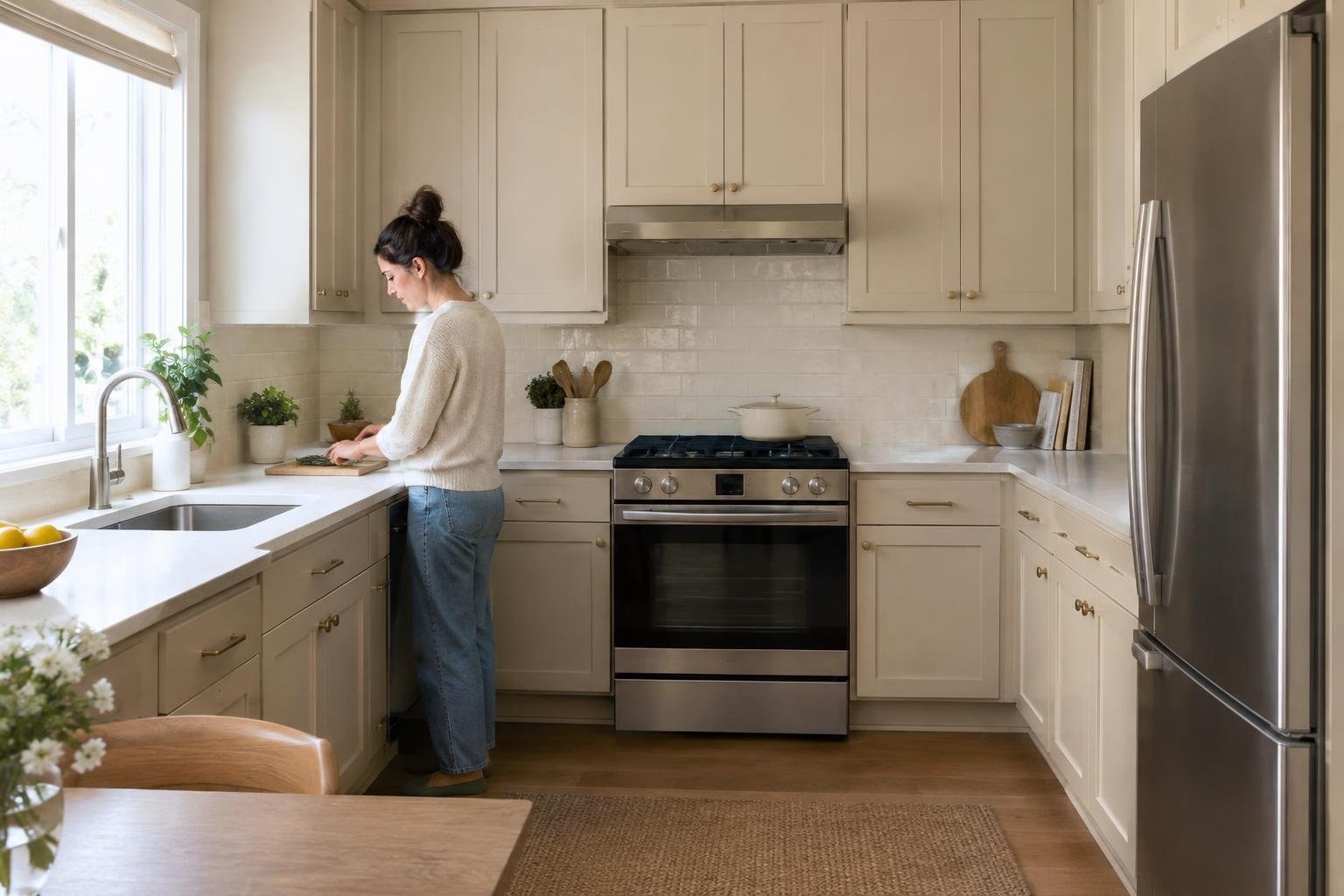
Beige kitchen cabinets offer a warm neutral alternative to stark white, but “beige” is not one fixed color. A cabinet sample may look creamy, sandy, gray-beige, or noticeably brown depending on the finish and the materials around it. That makes the choice less about finding a popular paint name and more about checking how the cabinet color works with your counters, backsplash, flooring, lighting, and wood tones. This guide explains how to compare beige options, what to include in a project plan and estimate, and how to choose a provider without relying on a photo or color chip alone.
What to know about beige kitchen cabinets
Beige cabinetry is a finish and design choice, not a single cabinet construction type. Beige doors may appear on different cabinet styles and product lines, so compare the actual cabinet specification as well as its color. A Backsplash.com design example shows light beige flat-panel cabinets with white quartz counters and a white glass subway tile backsplash. It is a useful example of a restrained, light palette, not a guarantee that the same combination will look identical in another room.
The decision matters because cabinets occupy a large, visible part of a kitchen. A beige that works beside one countertop may look too brown, too gray, or too yellow beside another. Treat color selection as one part of a coordinated plan that includes the cabinet door, finish, counters, backsplash, floor, lighting, and hardware.
- Choose the cabinet style and construction based on your needs, not color alone.
- Compare real samples with materials that will remain in the room.
- Ask what is included in the cabinet order and installation scope.
When a beige cabinet update may make sense
Beige may be worth considering if white feels too stark, if the current kitchen feels visually cold, or if you want a neutral backdrop that can work with wood and other warm finishes. These are design preferences rather than signs that a kitchen needs replacement. A color refresh alone does not establish that the cabinets, layout, or storage need to change.
Before committing, identify the problem you want to solve. Is the goal a warmer appearance, easier coordination with a new counter, a different cabinet style, more storage, or a changed layout? If the cabinets work for your needs and the issue is mainly their appearance, ask whether a finish update is feasible. If the layout or cabinet interiors are the concern, compare that option with replacement rather than assuming new beige cabinets are necessary.
Make a short brief for a provider: what you dislike, what must stay, what needs to improve, and which materials are already selected. This helps keep the discussion focused on a useful solution instead of color alone.
What the cabinet planning process includes
The process begins with the scope, not the paint swatch. Decide whether you want to change only cabinet doors or finishes, replace some or all cabinets, or alter the kitchen layout. Each scope calls for different measurements, product decisions, and installation planning. Ask the provider to clarify whether design, ordering, delivery, removal, installation, and coordination of other work are included.
- Set priorities. List required storage, layout changes, appliances, and visual goals.
- Document the room. Record cabinet runs, ceiling height, openings, appliances, and visible utility locations for the design conversation.
- Choose the cabinet approach. Compare available sizes, door styles, finishes, construction, and customization.
- Coordinate materials. Review cabinet samples beside counters, backsplash, flooring, and wall color.
- Confirm the written scope. Get responsibilities, exclusions, schedule assumptions, payment terms, and change procedures in writing.
Do not rely on a general color description to define a purchase. The selected product, finish, door style, dimensions, and included accessories should be identified clearly in the order documents.
How to choose a beige that works in your kitchen
Beige ranges from creamy, warm neutrals to shades that sit closer to greige. Color names can help organize choices, but they do not replace viewing a sample in context. Hello Lovely describes a beige candidate that appeared a little too brown when sampled in one kitchen; use that as a reminder to test your preferred finish in your own space rather than relying on a color name or online image.
Request a physical door or finish sample when available. Place it beside the countertop, backsplash, flooring, and wall color. View the group during daylight and under the kitchen’s usual evening lights. Compare the samples together, then look at them separately to see whether the cabinet color still feels right. If a finish is being custom painted, confirm the exact color identification and sheen in writing before production.
Consider the undertone relationship. A beige cabinet may appear warmer beside a cool gray or more subdued next to honey-toned wood. A sample that looks appealing alone may be a poor match for a fixed stone counter. Keep the chosen palette small enough to assess as a whole.
Options for counters, backsplashes, and wood accents
Beige cabinets can work with a range of surrounding finishes, but coordination is more dependable when you compare samples rather than choosing each item separately. A Backsplash.com example shows light beige flat-panel cabinets with white quartz and a white glass subway tile backsplash. The Spruce describes matte beige cabinetry paired with glossy off-white backsplash tile, using a difference in sheen to add visual contrast.
For a calmer look, keep the counter and backsplash close in value and use texture or finish to distinguish them. For more contrast, consider a darker accent or a wood element. Homes & Gardens describes beige upper cabinets paired with honey-toned wood lowers, while COCO LAPINE DESIGN shows beige cabinetry with a beige limestone counter, chrome hardware, and darker accents in lighting and accessories. These are possible directions, not required formulas.
Before ordering, assemble a simple finish board with the cabinet sample, countertop sample, backsplash, floor, hardware, and a wall-color sample. Check whether any one finish pulls the palette unexpectedly cool, yellow, pink, or brown. Confirm that the faucet, lighting, and appliance finishes do not create an accidental mix.
Cabinet types and product options to compare
Beige is available as a design direction across different cabinet offerings; the color alone does not tell you whether a product is stock, semi-custom, custom, ready-to-assemble, framed, or frameless. Ask the seller or provider to identify the cabinet type and explain which sizes, modifications, finishes, and storage features are included. Retail listings show that beige kitchen cabinet products are sold, but availability and specifications should be checked for the particular product being considered.
| Choice to compare | What to ask | Tradeoff to consider |
|---|---|---|
| Ready-to-assemble | What assembly is required, and what support is provided? | Can suit an experienced assembler, but confirm who handles fitting and installation. |
| Stock | Which standard sizes and finishes are available? | Check whether the available dimensions fit the plan without awkward gaps. |
| Semi-custom | Which modifications are available? | Confirm the actual range of changes and any effect on delivery. |
| Custom | What is made to measure, and how are drawings approved? | Clarify design responsibility, specifications, and the order timeline. |
Also compare framed and frameless construction, box materials, drawer hardware, finish, warranty, and installation responsibility. Do not use the beige color as a proxy for cabinet quality.
Cost considerations and what to include in estimates
There is no responsible single price for beige kitchen cabinets without the project scope and applicable market. A color-focused inspiration page or a product listing is not a complete installed project quote. Compare written estimates for the same cabinet quantity, specifications, and work before judging which option costs less.
Ask each provider to separate the cabinet order from related work, where applicable. Clarify whether the estimate includes measurement and design, cabinets and accessories, delivery, removal and disposal, installation, fillers and trim, countertop work, backsplash, plumbing or electrical coordination, wall repair, and any appliance relocation. Ask what is excluded and how additional work is priced.
Cost may change with the amount and type of cabinetry, layout complexity, custom sizing, finish, hardware, storage accessories, demolition, installation, delivery, and work on adjacent surfaces or utilities. Request line items and a clear description of the selected product. If a provider offers an allowance, ask what it covers and what happens if the final selection exceeds it.
Use a comparison sheet rather than a bottom-line number alone. Verify that bids include the same scope, finish, installation responsibility, cleanup, and assumptions. Do not treat a low estimate as comparable until exclusions and change-order rules are understood.
What to expect, including timing and coordination
Project timing depends on product selection, ordering, site preparation, installation scope, and coordination with other kitchen work. Do not accept a generic duration as a promise for your job. Ask for a written sequence that distinguishes the expected product lead time from delivery, removal, installation, countertop coordination, and any follow-up adjustments.
Before signing, ask what decisions must be finalized before the order is released and what changes could affect the schedule. Confirm who will check the measurements, who receives and inspects delivery, and who coordinates installers or other trades. If the kitchen must remain usable during part of the work, discuss access, appliance use, and which areas may be unavailable.
Make sure the plan accounts for the full palette. If the beige cabinet color depends on a particular counter or backsplash, confirm that those selections and their availability fit the project sequence. A late change to color, dimensions, hardware, or adjacent materials can create confusion or additional work. Request schedule updates and document agreed changes in writing.
How to choose a qualified cabinet provider
Choose a provider by comparing project fit and written responsibilities, not by color advice alone. Look for relevant kitchen work in a portfolio, clear product specifications, a detailed estimate, and an understandable process for questions and changes. Ask for references where appropriate and verify licensing and insurance requirements that apply in your area.
Questions to ask include:
- Who measures, designs, orders, delivers, and installs the cabinets?
- What cabinet line, construction, finish, and hardware are specified?
- How will the beige sample be approved and recorded?
- What work is excluded from the quote?
- Who handles damage, missing parts, fit issues, and adjustments?
- What are the payment milestones, schedule assumptions, cleanup terms, and change-order process?
- What warranty applies to the product and installation, and how are claims handled?
Compare answers and scope side by side. A provider who explains limits and responsibilities clearly may be a better fit than one who offers a low total without explaining what it covers.
Permits, qualifications, warranties, and safety
Cabinet color does not determine permit requirements, credentials, or safe work practices. Requirements vary by location and by the work being performed, so confirm applicable rules with the local authority or a qualified professional. A finish-only project and a project involving changed plumbing, electrical, structural, or ventilation work may have different review needs.
Ask the provider whether permits are needed for the proposed scope, who obtains them if required, and which work is performed by qualified trades. Do not ask an unqualified installer to modify electrical, plumbing, structural, or other regulated systems. Keep written records of approvals, product specifications, installation responsibilities, and warranty terms.
Read warranty documents before purchase. Clarify what covers the cabinet product, finish, hardware, and installation; what care is expected; and how to report a problem. Do not assume a warranty covers every type of damage or labor. Have the provider explain exclusions and the process for resolving defects before work begins.
Ways to save without compromising the project
To control the budget safely, preserve decisions that do not prevent the kitchen from working well. Consider keeping the existing layout if it serves your needs, using standard cabinet dimensions where practical, limiting custom modifications, and choosing accessories based on everyday use. Ask the provider to price alternatives separately so you can see what each change does to the scope.
Do not save money by skipping accurate measurement, clear product specifications, suitable installation, or coordination of utilities. Avoid ordering from a color photograph alone. Confirm the actual beige finish, door style, cabinet dimensions, hardware, and included components before approving the order.
If you are comparing new cabinets with a finish update, ask whether the existing cabinets are suitable for refinishing and what preparation would be required. Compare the written scope and expected result, not just the initial price. An apparently inexpensive option can be poor value if it does not address the original problem or leaves essential work out of the estimate.
Prioritize the improvements that matter most to you, then ask for a clear base proposal and optional upgrades. This makes it easier to adjust the plan without sacrificing fit, safety, or a coherent finish palette.
Mistakes, red flags, and a practical checklist
Common planning errors include selecting a beige from a screen, choosing the countertop before seeing it with the cabinets, and assuming a product listing includes delivery or installation. Avoid these with a short approval checklist:
- Confirm the exact cabinet product, finish, door style, dimensions, and hardware.
- Compare samples with counters, backsplash, flooring, wall color, and lighting.
- Check that the planned cabinet sizes and appliance locations work together.
- Clarify responsibility for measurements, delivery, installation, removal, and cleanup.
- Review written exclusions, schedule assumptions, payment terms, and change procedures.
- Record warranty details and who to contact about defects or adjustments.
Red flags include pressure to approve an order before key dimensions and finishes are confirmed, vague answers about installation responsibility, and a quote with a total but no meaningful scope. If two bids differ sharply, ask each provider to identify product differences and excluded work rather than assuming the lower figure is a bargain.
Keep the approved samples, drawings, and order details together. That record helps everyone refer to the same color and scope throughout the project.
Design directions: two-tone, tonal, and contrasting palettes
Beige can be the dominant cabinet color or one part of a layered palette. A two-tone treatment can break up a long wall of cabinetry; Homes & Gardens describes beige upper cabinets with honey-toned wood lowers. COCO LAPINE DESIGN shows beige cabinets with a beige limestone counter, chrome faucet, and black and brown details in lighting and accessories. These examples show possible combinations, but the right balance depends on the finishes in your own space.
To keep a neutral palette from feeling flat, vary texture, sheen, or material thoughtfully. The Spruce describes matte beige cabinets with glossy off-white backsplash tile, creating surface contrast without adding a strong new color. Alternatively, wood accents or a darker detail can provide visual definition. Keep larger, expensive surfaces coordinated first, then select hardware and accessories to support the palette.
Be cautious about copying a complete room image. Photos do not establish the exact paint color or how a finish will appear under your lighting. Use inspiration to identify a direction, then verify the actual product samples and finish specifications before purchase.
Factors that affect your cabinet project
Several choices shape the plan for beige kitchen cabinets. Start with the product and finish: beige cabinets are available as products, but the exact specifications and availability need to be confirmed for the option you are considering. Some cabinet suppliers also offer custom paint programs, so ask whether your preferred shade is available in the selected product or requires a custom finish.
Next, consider how the cabinet shade works with materials that will remain in the kitchen. Beige options range from creamy neutrals to warm greiges, and a sample can look too brown in a particular room. Compare the cabinet sample with your counters, backsplash, flooring, and lighting before approving the finish. Ask the provider to explain how your product, finish, and project scope affect the written estimate and schedule rather than relying on a general price or timeline.
Frequently asked questions
Are beige kitchen cabinets still a good choice?
Beige cabinets can suit many kitchen styles, from simple flat-panel designs to more traditional door profiles. The best fit depends on the door style, finish, surrounding materials, and the room’s lighting. Review samples in your kitchen rather than judging a color from a screen.
How do I choose the right beige for kitchen cabinets?
Start with a physical sample and compare it with your countertop, flooring, backsplash, and wall color in the kitchen. Check it in both daylight and the lighting you use in the evening. Beige can read differently beside cool gray or warm wood tones.
What countertops go with beige kitchen cabinets?
White, cream, and off-white surfaces can create a light, coordinated look; a more noticeable contrast can come from a darker counter, a textured backsplash, or wood accents. Review the whole palette together before settling on materials.
Can I mix beige cabinets with wood cabinets?
Yes. A two-tone plan can use beige on one cabinet group and wood on another to break up a large expanse of cabinetry. Homes & Gardens describes beige upper cabinets paired with honey-toned wood lowers; test samples together because wood color and beige undertones affect the overall effect.
Are painted beige cabinets better than beige wood cabinets?
Painted beige, wood-look finishes, and other cabinet finishes can all create a warm neutral effect, but they differ in appearance and care. Ask the provider what the finish is, how it is cleaned, and what repair options apply to the specific product.
How much do beige kitchen cabinets cost?
There is no single price for beige kitchen cabinets. The total depends on the cabinet selection and project scope, including quantity, layout changes, installation, removal, and related work. Ask for an itemized estimate so you can compare the same scope across providers.
How long does it take to install beige kitchen cabinets?
The color choice itself does not determine the project schedule. Ask the provider to separate product lead time from delivery, preparation, installation, and follow-up adjustments, and to identify what could change the schedule.
Should I repaint my cabinets or replace them?
Refinishing or repainting may be worth exploring if the existing cabinets are suitable for that work and you want to keep the layout. Replacing cabinets may be a better fit when you need a different configuration or different storage. Ask a qualified provider to inspect the cabinets and compare written scopes.
People Also Ask
Does beige paint look different beside gray or cream?
A warm beige can read more yellow or brown beside some cool grays, while a gray-beige may seem cooler beside cream or warm wood. Compare samples side by side with your fixed finishes and view them in your kitchen’s lighting before choosing.
Can beige cabinets make a small kitchen look brighter?
They can contribute to a brighter feel when paired with light finishes. One Backsplash.com example describes light beige cabinets with white quartz and a white glass subway tile backsplash as inviting brightness. The result in a small kitchen also depends on its lighting and other finishes, so compare samples in your space.
What backsplash looks good with beige cabinets?
The Spruce describes matte beige cabinets paired with glossy off-white backsplash tile, creating contrast through finish as well as color. Confirm that the sheen and texture suit the overall palette and are practical for the way you use the kitchen.
What color hardware goes with beige kitchen cabinets?
Black, chrome, and other hardware finishes can all work as deliberate accents. Compare samples against the cabinet finish, faucet, lighting, and appliance details rather than choosing hardware in isolation.
Should I test beige cabinet paint before ordering?
Beige can look different in context: Hello Lovely describes a candidate shade that appeared a little too brown when sampled in one kitchen. Test candidate finishes beside your fixed materials in your own lighting before choosing.
Do beige cabinets work in a modern kitchen?
Yes. Beige can suit a modern kitchen, particularly when paired with simple cabinet profiles and a coordinated palette. The color alone does not define the style; plan around storage, appliances, work surfaces, and clearances, then compare finish samples in your space.
Beige kitchen cabinets can create a warm, understated foundation, but the right result depends on choosing a beige that works in your actual kitchen and coordinating it with counters, backsplash, lighting, floors, and hardware. Compare real samples, define the scope before asking for bids, and make sure the estimate covers the work you expect. When you are ready to explore cabinet choices, Cabinet Supply is a useful next stop.
Your next step
Explore cabinet options at CabinetSupply.com for your next project.
Last reviewed and updated November 2, 2026 by the CabinetSupply Editorial Team.
Sources
- 24+ Beige Kitchen Cabinets ( SOFT & WARM ) – Cabinet Designs
- Chic Beige Kitchen Cabinets: Need Paint Colors? – Hello Lovely
- Beige Kitchen Cabinet Colors – Best Sherwin-Williams® Beige & Warm Neutral Cabinet Paint Colors | Wholesale Cabinet Supply
- 10 beige kitchens that prove this neutral back for 2025 | Homes and Gardens
- Beige – Kitchen Cabinets – The Home Depot
- r/cabinetry on Reddit: Beige kitchen cabinet colors?
- 18 inspiring kitchens with beige kitchen cabinets – COCO LAPINE DESIGN
- 24 Beige Kitchen Cabinets That Make a Change From White
- Kitchen Cabinet Colors: How to Choose the Right Shade for Your Home