
Traditional kitchen cabinets bring visual detail and a familiar, finished feel to a kitchen. Raised-panel doors, shaped edges, beadwork, decorative molding, and wood or painted finishes are all ways to create the look. The style is flexible: it can be formal and ornate or relatively simple. The best choice depends on how much detail suits your room, what storage you need, and how the cabinets fit with counters, appliances, lighting, and the rest of the home. This guide explains what to compare, how to plan the project, and what to ask before you buy.
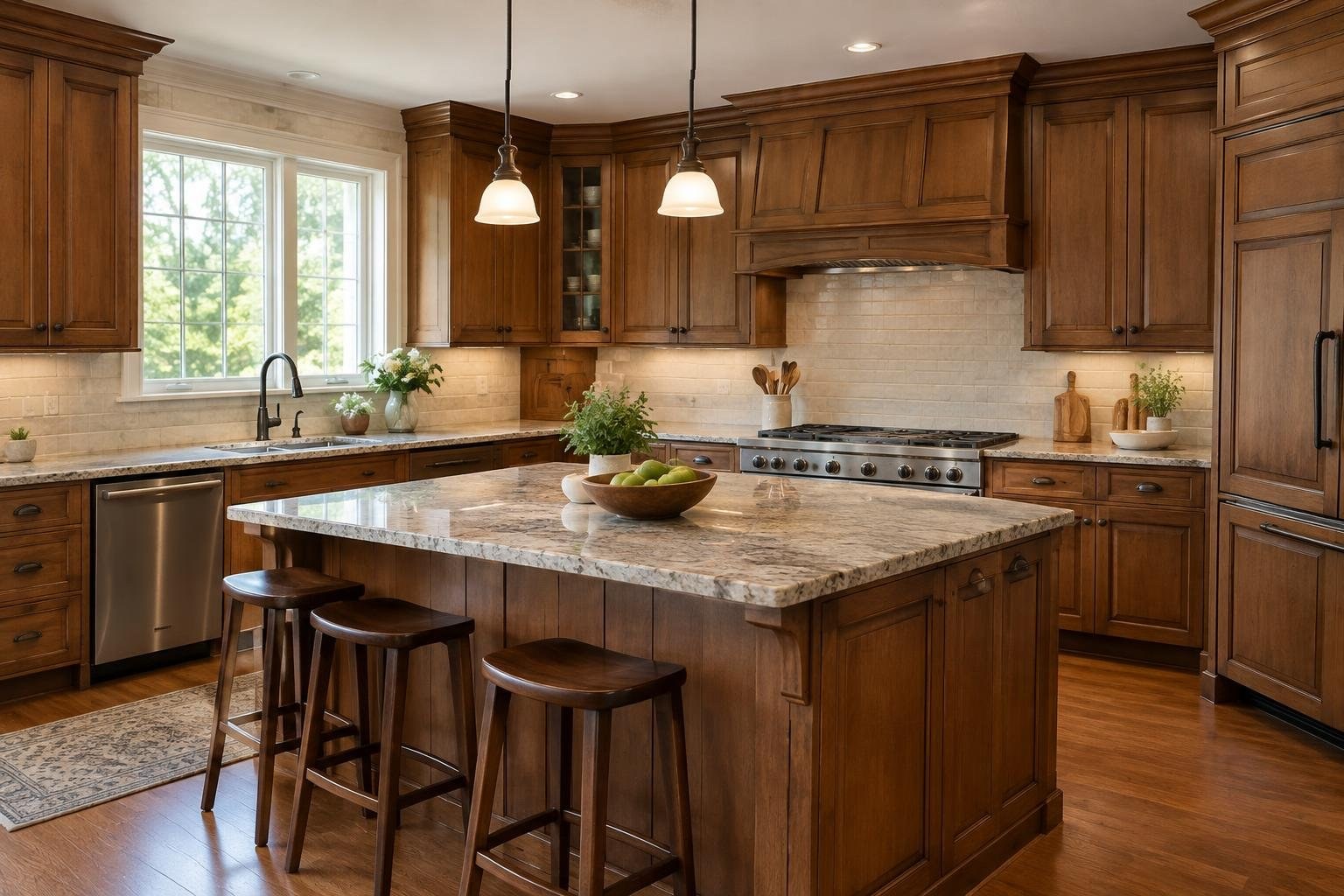
What makes traditional kitchen cabinets different?
Traditional describes a design style, not one exact cabinet construction or price level. The style is associated with decorative motifs, classic proportions, and a richer mix of details and materials. A raised-panel door is a familiar choice; a more elaborate profile or beaded detail can make the look feel more formal. Other traditional kitchens use simpler paneled doors, painted cabinets, or natural wood finishes.
That flexibility matters when planning a real room. A traditional kitchen can be composed of several coordinated choices: cabinet doors, finish, hardware, countertop, backsplash, lighting, and trim. Decide how prominent you want each element to be. If the doors are highly detailed, for example, you may prefer other surfaces and accessories to be less visually busy.
Pictures can help you describe a direction, but they do not show how a particular product will look under your lighting or next to your materials. Ask to see actual door and finish samples, and review them in the kitchen where possible.
What does a traditional cabinet project include?
A cabinet project includes more than selecting a door. It usually involves defining the storage and layout, selecting cabinet sizes and finishes, coordinating the order, preparing the room, installing or arranging installation, and checking the finished work. The exact responsibilities depend on whether you buy cabinets alone or hire a company to design, supply, and install them.
- List what is not working. Note storage problems, awkward access, damaged finishes, and appliances or work areas you hope to change.
- Set a scope. Decide whether you are keeping the current layout, changing cabinet locations, or coordinating a broader kitchen remodel.
- Develop the plan. Confirm cabinet locations and dimensions against walls, doors, windows, appliances, utilities, and other fixed conditions.
- Choose the specification. Record cabinet type, door style, finish, hardware, interior options, fillers, panels, and trim.
- Review the order and work plan. Understand what is supplied, who installs it, what site preparation is included, and which items are excluded.
- Inspect at completion. Check that the delivered and installed cabinets match the approved selections and that operation and finish concerns are recorded for resolution.
For a traditional design, the plan should show where decorative details will appear and how they meet adjacent walls, appliances, and other finishes. A visual concept is not a substitute for a dimensioned cabinet plan and written specification.
When might you need a cabinet update?
Traditional cabinets may be worth considering when the current kitchen feels visually plain, the doors or finishes are worn, or the storage arrangement no longer suits how the household uses the room. A style change can also be part of a larger remodel that updates counters, lighting, appliances, or the kitchen layout.
First identify whether the problem is appearance, function, or both. If storage is inconvenient, a new door style alone will not solve the underlying issue. If the layout and cabinet boxes are acceptable, it may be worth comparing a finish or door update against replacement. If you need different cabinet dimensions, storage, or locations, a broader cabinet project may be a better fit.
Make a short list of daily frustrations: items that are hard to reach, drawers that conflict with nearby doors, insufficient pantry space, or a work area that does not support your routine. Use that list to judge proposed plans, not just the appearance of a sample kitchen.
How much do traditional kitchen cabinets cost?
Traditional is a design category, not a fixed price. Without a defined layout, cabinet schedule, finish, and installation scope, a single price would not be useful. Request an itemized written estimate and compare the same work and product specifications across proposals.
Check whether the quote covers the cabinet boxes and doors, finish, hardware, interior accessories, fillers, panels, trim, delivery, installation, removal of old cabinets, and disposal. Confirm how the estimate treats countertops, backsplash, plumbing, electrical work, appliance moves, wall or floor repairs, and permits if applicable. These items may be handled by separate providers or excluded, so clarify responsibility rather than assuming they are included.
Ask which parts of the estimate are fixed and what could change after site verification or demolition. A low initial number can be difficult to compare if it leaves out installation, finishing details, or related work that another bid includes.
- Compare the cabinet line, construction, dimensions, finish, and included accessories.
- Ask for separate amounts or clear descriptions for product, delivery, installation, and related work.
- Review exclusions, allowances, change procedures, and payment milestones before committing.
Which factors affect the project budget?
Project cost and complexity depend on the choices and conditions in the specific kitchen. Use a written scope to show how these factors affect the proposals you receive:
- Cabinet type and construction: stock, semi-custom, custom, ready-to-assemble, framed, or frameless options can differ in available sizes, modifications, and assembly responsibilities.
- Door and finish choices: panel profiles, decorative detail, painted or wood finishes, and matching trim all affect the specification.
- Quantity and layout: the number and sizes of cabinets, corners, tall units, islands, and unusual wall conditions shape the order.
- Storage and hardware: drawer configurations, pullouts, organizers, hinges, and other selected features can change the product package.
- Site and labor scope: removal, delivery access, installation, leveling, fitting, and repairs may be included or priced separately.
- Related renovation work: countertops, appliances, flooring, plumbing, electrical work, and wall repairs may add separate costs.
These are categories to investigate, not a universal ranking. Ask each provider to explain the cost implications of your own selections and identify what the estimate does not cover.
Which cabinet options and door styles should you compare?
Choose among cabinet options by separating style from construction and service. A traditional door profile can appear on different cabinet lines, so do not assume that a decorative look tells you how a box is built or what is included.
| Option | What to compare | May suit | Tradeoff to investigate |
|---|---|---|---|
| Ready-to-assemble (RTA) | Assembly instructions, included hardware, delivery, and who assembles and installs | Buyers who can coordinate assembly or installation | Assembly and fit responsibilities must be clear |
| Stock | Available sizes, finishes, trim, and how the plan handles gaps | Layouts that work with the offered dimensions | Less ability to tailor the plan to unusual spaces |
| Semi-custom | Available size or feature changes, order details, and timing assumptions | Projects needing some adjustment beyond standard choices | Confirm which changes are offered and their cost |
| Custom | Drawings, specifications, finish samples, approvals, and change process | Plans that call for a specific fit or design detail | Review the scope, approvals, and schedule carefully |
Also compare framed and frameless construction by reviewing samples and written specifications from the cabinet line. Ask how the selected style handles door and drawer fronts, exposed ends, fillers, and adjacent appliances. Terms alone do not establish the quality or suitability of a particular product.
Traditional kitchens are shown with different door profiles, colors, and materials, including raised-panel and recessed-panel examples. Treat inspiration images as style references, then verify what the actual cabinet line can supply.
How should you coordinate traditional cabinet design?
Choose a door profile and finish as a coordinated set of decisions. Raised panels and detailed edges can emphasize a formal traditional look; simpler paneled fronts can create a quieter version. Painted colors and natural wood finishes are both used in traditional kitchens.
Review samples beside the countertop, backsplash, flooring, and hardware you are considering. Look at more than color: compare sheen, visible grain, profile depth, and the way light changes the appearance. If you plan to use decorative molding or matching end panels, confirm how those pieces are specified and where they will go.
For a balanced design, decide which elements should draw attention. For instance, detailed doors can be paired with less ornate adjacent finishes, while a restrained cabinet profile leaves room for a more expressive counter or light fixture. Use a complete finish board or coordinated sample group before final approval rather than making each selection in isolation.
Traditional kitchen examples include varied combinations of cabinet color, floor, counter, and layout. They can inspire a palette, but a photographed room does not confirm product availability or suitability for your kitchen.
What should you measure and confirm before ordering?
Accurate room information helps prevent a cabinet plan from colliding with fixed conditions. Have the provider verify measurements and document wall lengths, ceiling height, openings, appliance locations, and visible plumbing, electrical, heating, or ventilation features. Note uneven surfaces or other conditions that could affect fitting.
Review cabinet doors and drawers in their open positions on the plan. Check their relationship to each other, nearby walls, doorways, appliance doors, and walking routes. Confirm the locations and dimensions of the sink, range, refrigerator, and any other large equipment before approving the cabinet order.
If the kitchen layout is changing, identify who is responsible for coordinating countertops, plumbing, electrical work, and appliances. Some work may need a qualified trade professional. Do not assume a cabinet supplier or installer is responsible for work outside the written scope.
Before ordering, ask for a final plan with cabinet sizes, fillers, finished ends, trim, and appliance openings. Have discrepancies resolved in writing before production or delivery begins.
What should you expect during ordering and installation?
Timing depends on the selected cabinet line, customization, order readiness, delivery, site preparation, installation scope, and coordination with other work.
Ask the provider to explain key milestones: final measurement, approval of drawings and finishes, order placement, expected delivery window, removal of existing cabinets, installation, countertop templating or related work, and final adjustments. Confirm what could delay each milestone and how schedule changes will be communicated.
Before demolition, verify that the replacement cabinets and the people needed for associated work are scheduled appropriately. Ask how the kitchen will be protected and what temporary arrangements may be needed if cooking or access will be disrupted. Avoid making irreversible decisions based only on an informal delivery estimate.
How do you choose a qualified cabinet provider?
Compare providers on the completeness and clarity of their plan, not only on the proposed cabinet appearance or total. Request a written estimate that identifies the product line, cabinet dimensions, finish, hardware, installation responsibilities, exclusions, and change process.
Ask questions such as:
- Who measures the site, prepares the cabinet plan, and verifies it before the order?
- Who supplies, delivers, assembles, and installs the cabinets?
- Which removal, repair, trim, filler, and cleanup tasks are included?
- How are changes, damaged items, fit concerns, and unfinished work documented and resolved?
- What schedule and payment milestones are proposed?
- Can the provider share relevant project examples and references?
Where local rules require credentials or licensing for a particular part of the job, verify the appropriate requirements with the relevant local authority. Ask for proof of insurance where appropriate and review the written warranty terms for both cabinets and installation. Understand who to contact if a product or workmanship issue arises.
Take time to compare written proposals. The lowest bid may not represent the same cabinet specification or work scope as a higher bid.
What about permits, warranties, and safety?
Cabinet replacement can touch work beyond the cabinets themselves. Before work begins, clarify whether the project changes plumbing, electrical, ventilation, structural elements, or other regulated parts of the home. Permit needs and credential rules depend on the work and location, so confirm applicable requirements with local officials rather than relying on a general online assumption.
Ask who is responsible for obtaining any required approvals and coordinating qualified trade professionals. Keep the cabinet contract, drawings, product specifications, installation scope, warranty documents, and change approvals together. Review what the warranty covers, its exclusions, how to make a claim, and whether separate terms apply to product and installation.
Follow the installer’s written handling and care directions for the selected product and finish. Keep the work area clear as agreed, and do not attempt electrical, plumbing, or structural work unless you are qualified and authorized to do so.
How can you save money safely?
You can manage cost without choosing blindly or cutting corners that affect fit and function. Start by setting a priority list: identify the storage changes and visible details that matter most, then ask for alternate specifications that preserve those priorities.
- Compare stock or semi-custom choices against a more tailored plan, while checking that the available sizes work for the room.
- Ask for itemized pricing on optional organizers, trim, and hardware so you can decide what to include now.
- Keep the existing layout if it meets your needs and avoids work you do not want, but have a professional assess the scope before assuming that no related work is needed.
- Compare cabinet-only and broader project estimates with the same exclusions and responsibilities clearly stated.
- Check whether a finish or door update is viable before replacing cabinets, while accounting for the condition and limitations of what will remain.
- Finalize measurements, selections, and appliance details before ordering to reduce avoidable changes.
Do not save money by skipping necessary site verification, choosing a cabinet plan that conflicts with appliances, or assigning regulated work to someone without the required qualifications. Ask providers to explain lower-cost alternatives and what tradeoffs they involve.
Explore cabinet options at CabinetSupply.com as you compare styles and specifications for your project.
What mistakes and red flags should you watch for?
Use this checklist before approving an order or installation plan:
- Look past the style label. Confirm the actual cabinet line, box and door specifications, finish, hardware, and included accessories.
- Check the whole layout. Review appliance openings, door and drawer swings, walkways, fillers, and finished ends.
- Compare complete bids. Mark what is included, excluded, supplied by others, and subject to change.
- Confirm the final selections. Match the approved door and finish samples to the written order and drawings.
- Clarify responsibilities. Identify who handles measuring, delivery, assembly, installation, removal, cleanup, and related trades.
- Review timing and payment terms. Make sure milestones and change procedures are documented.
- Understand warranty and resolution steps. Know how to report damage, adjustment needs, or other concerns.
Common avoidable problems include choosing from a photo without reviewing samples, ordering before appliance details are settled, overlooking decorative trim at walls and ceilings, and comparing estimates with different scopes. Pause and resolve unclear measurements, missing line items, or verbal promises before signing.
How should you maintain or update cabinets later?
Care and repair decisions depend on the cabinet material, finish, and the product maker’s instructions. Use the supplied care guidance and ask what products or methods are appropriate for the selected surface. Address spills and damage using those instructions rather than assuming every finish responds the same way.
If existing cabinets are generally suitable but their appearance needs attention, compare refinishing or replacing doors with complete replacement. If the layout or storage is the main problem, ask whether an appearance-only update would leave the underlying issue unresolved. Request separate scopes so you can weigh what each option changes and what remains.
Before approving repair or refacing work, ask how the provider will assess existing conditions, which components will remain, what matching limitations apply, and how the finished result will be described in the contract. A clear scope helps set expectations for both appearance and function.
Frequently asked questions
What are traditional kitchen cabinets?
Traditional kitchen cabinets generally have decorative, classic detailing rather than a strictly minimal appearance. Common choices include raised-panel doors, shaped or beaded details, trim, and natural wood or painted finishes. The exact look can range from restrained to ornate.
Which cabinet door style looks most traditional?
Raised-panel doors are a common traditional choice, especially when paired with detailed profiles or beading. Recessed-panel doors can also suit a traditional kitchen. Compare full-size door samples in your room instead of choosing from a small screen image.
How much do traditional kitchen cabinets cost?
There is no reliable single price for traditional kitchen cabinets without a project scope. Total cost depends on the cabinet line, materials, finish, number of cabinets, layout, modifications, delivery, installation, and any related kitchen work. Compare written estimates with matching inclusions.
Are traditional cabinets suitable for a small kitchen?
Traditional cabinets can work in a small kitchen, but the amount of trim, door detail, and visual contrast should be considered carefully. Measure the room and review samples and drawings to judge how the details work with the available space and storage plan.
Can traditional kitchen cabinets be painted?
Yes. Traditional styling can use painted finishes as well as natural wood. Soft or classic painted colors and wood finishes are both used for this look; coordinate the cabinet sample with the countertop, backsplash, flooring, and lighting before making a final selection.
Can I update existing cabinets instead of replacing them?
Possibly, but the answer depends on the existing cabinet condition, the new layout, and the finish you want. Before deciding, compare the cost and scope of refinishing or replacing doors with a full cabinet replacement estimate. Ask what preparation and repairs each proposal includes.
People Also Ask
How can I balance traditional cabinets with other kitchen finishes?
Choose which elements should draw attention. Pair detailed cabinet doors with less ornate adjacent finishes, or use a restrained cabinet profile with a more expressive counter or light fixture. Review coordinated samples together before making final selections.
How do I choose traditional cabinets for my kitchen?
Start with the door profile and finish, then compare cabinet samples with your counters, flooring, backsplash, and hardware. Check that the selected details suit the room and the amount of visual complexity you want.
What should a kitchen cabinet estimate include?
Cabinet pricing depends on more than the door style. Ask for a cabinet schedule and written estimate that identify the cabinet line, sizes, finish, accessories, delivery, installation, and exclusions so you can compare like with like.
Are traditional kitchen cabinets more expensive?
Not necessarily. Traditional describes a design direction, not a single price tier. The cabinet construction, customization, finish, order size, and installation scope all affect the project budget.
Can I find traditional cabinets in different price ranges?
They can be. Compare options using the actual door, finish, cabinet construction, and available dimensions, not the style label alone. Ask for samples and specifications before ordering.
What should I check before ordering kitchen cabinets?
Before signing, review the final cabinet plan, appliance locations, measurements, finish selections, included installation work, delivery details, schedule assumptions, warranty information, and process for handling changes or damage.
Traditional kitchen cabinets are defined more by their details and overall composition than by one specific color or material. Raised or recessed panels, decorative trim, warm finishes, and coordinated hardware can create a classic look, but good planning matters just as much: check storage needs, proportions, appliance clearances, construction details, and the full project budget before you commit. Compare complete cabinet specifications and written estimates, then choose an option that fits your kitchen and the level of detail you want.
Your next step
Explore cabinet options at CabinetSupply.com for your next project.
Last reviewed and updated November 2, 2026 by the CabinetSupply Editorial Team.
Sources
- Shop Traditional Kitchen Cabinets Online – Assembled & RTA
- Traditional Kitchen Cabinet Design Style – MasterBrand
- 75 Traditional Kitchen Ideas You'll Love – September, 2026 | Houzz
- Traditional – Kitchen Cabinets – The Home Depot
- Traditional Kitchen Cabinets | Discount Kitchen Cabinets – Quality Kitchens For Less
- Traditional Kitchen Design Ideas | Style Guide | KraftMaid
- Traditional Kitchen Cabinets | CabinetSelect.com
- 25 Traditional Kitchen Cabinet Ideas That Never Go Out of Style
- New Kitchen Cabinets: How to Choose, Plan, and Compare Options
- Kitchen Cabinet Prices: Costs, Options, and How to Compare Estimates