
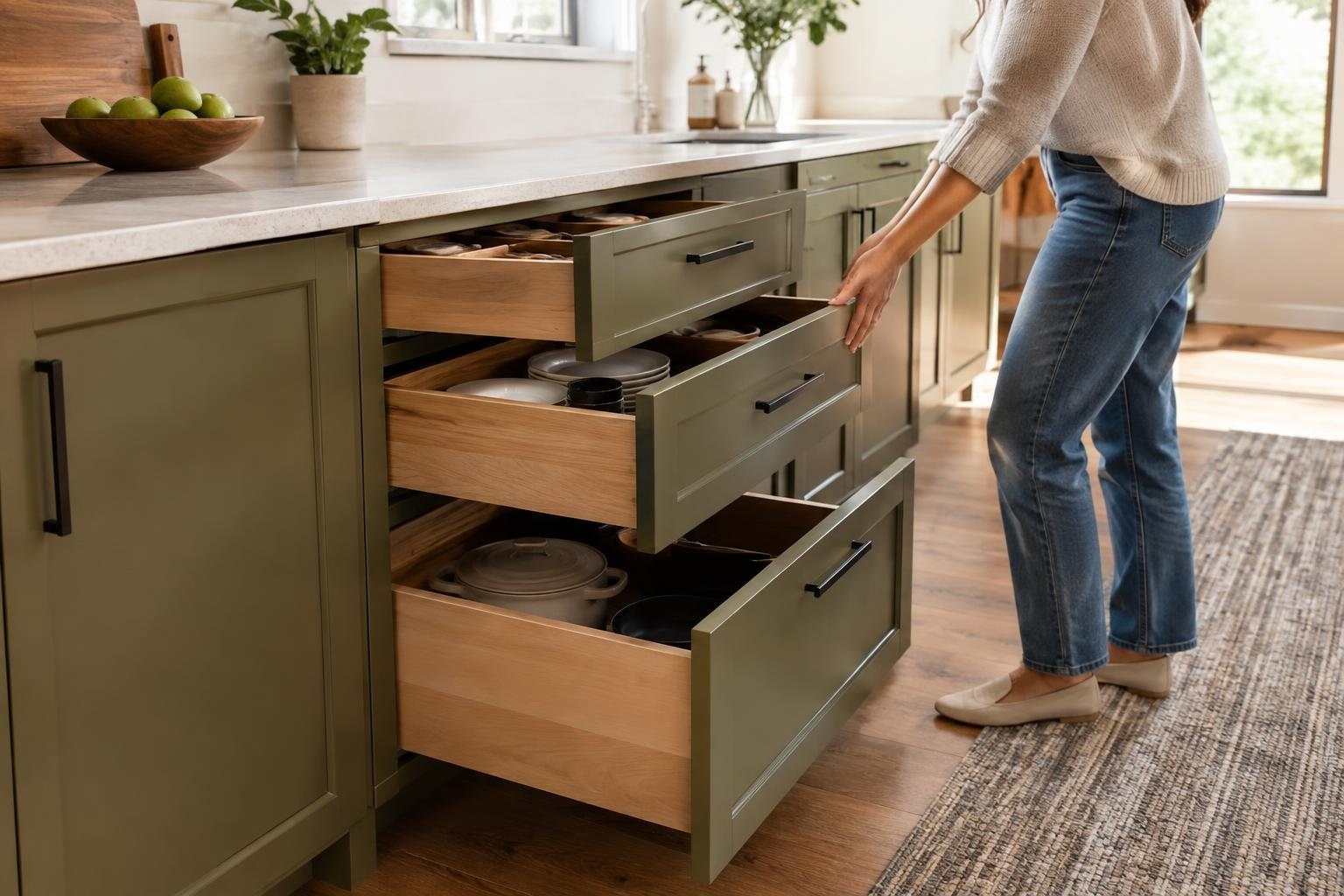
Kitchen cabinets with drawers can put cookware, utensils, and pantry goods in organized compartments that are easier to see and access than items stored at the back of a cabinet. The best design is not simply the kitchen with the most drawers. It is the combination of drawer sizes, cabinet locations, construction, and installation details that suits your space and routines. This guide explains what to compare, how to plan, what can affect your quote, and what to ask before ordering.
What kitchen cabinets with drawers include and how they work
A kitchen cabinet with drawers is a cabinet whose storage is accessed through pull-out compartments rather than only through a hinged door. It may have several stacked drawers, one deep drawer, or a purpose-designed configuration. Retail listings show drawer base cabinets for everyday kitchen items, sink-base options with drawers, and specialized arrangements such as a corner cabinet with three drawers.
Think of the cabinet as one part of a storage plan, not a stand-alone product. The useful question is not just “How many drawers?” Ask what belongs in each drawer, where you will use it, whether it fits, and whether the drawer can open in the completed kitchen.
A practical plan groups items by task. Keep frequently used utensils close to food preparation, cookware near the cooking area, and serving items where they are convenient to the table or island. These are planning suggestions, not fixed rules: adapt them to your own habits and the actual layout.
Before shopping, make a short inventory of the items you want to move into drawers. Note any unusually tall, wide, heavy, or fragile pieces. That list gives you something concrete to check against cabinet and drawer dimensions.
Signs your kitchen could benefit from more drawer storage
Drawer storage may be worth considering when lower cabinets feel difficult to organize, stored items are hard to find, or everyday cookware and utensils are repeatedly moved to reach something else. These signs do not automatically mean you need new cabinets. Sometimes a storage insert, pull-out, or a better arrangement of existing items is enough.
- You cannot see what is stored: Check whether items are hidden behind other objects or piled on shelves.
- Frequently used items are inconvenient: Map where you prepare food, cook, clean, and serve, then notice which items are awkwardly placed.
- Small tools become jumbled: Consider a shallow drawer or an organizer sized for the tools rather than a large, unpartitioned space.
- Pantry goods are difficult to sort: Tall cabinets with drawers are one product approach for storing pantry items; verify that the drawer dimensions suit the goods you actually keep.
- A corner is difficult to use: Compare a corner drawer configuration with other options instead of assuming one design will suit every kitchen.
Do not replace an otherwise serviceable kitchen based on a storage frustration alone. First identify the exact problem, then compare an organizer, cabinet modification, replacement cabinet, or broader remodel as appropriate.
Cost and pricing: what to ask for in a quote
There is no single price for kitchen cabinets with drawers that applies to every project. Product listings and quotes may cover different sizes, quantities, materials, finishes, hardware, delivery, and installation.
Ask for an itemized estimate that makes these items clear:
- Cabinet quantity, dimensions, configuration, and specified product line
- Drawer fronts, drawer boxes, slides, organizers, and other hardware included
- Finish, panels, fillers, toe kicks, and trim included in the order
- Delivery, carrying, assembly, installation, and removal of existing cabinets
- Any separately quoted countertop, plumbing, electrical, wall, or flooring work
- Taxes, payment milestones, change-order process, and exclusions
Compare quotes using the same cabinet count and specifications. A lower total may reflect fewer drawers, a different finish, missing accessories, or less labor in the stated scope. Ask the provider to explain any difference rather than guessing which quote is better value.
For a small addition, compare the cost and disruption of one specialty cabinet with the cost of changing a larger run. For a full kitchen, ask whether the estimate includes all the work you expect from the provider. Keep product and installation pricing distinct when the seller and installer are different parties.
Factors That Affect the Project
Project price and complexity depend on more than the number of drawer fronts. Cabinet dimensions, configuration, selected finish, hardware, quantity, delivery, and who handles installation can all change what is included in a proposal. A corner unit or specialty pantry cabinet may require a different layout than a standard drawer base, so compare the actual product specifications rather than treating all drawer cabinets as interchangeable.
Site conditions matter too. Before a provider finalizes the cabinet plan, disclose the locations of appliances, sink, plumbing, outlets, and any visible irregularities in walls or floors. These details can affect which cabinet sizes fit and which work is needed. Ask the installer to identify assumptions and exclusions in the estimate.
Accessories are another decision point. A cutlery organizer, dividers, or a two-tier insert can help assign places to small items. Confirm whether an organizer is included, optional, or a separate purchase; product listings for drawer accessories show that these components may be specified separately.
Do not choose a wider drawer simply because it looks like more storage. Consider the contents, access, and neighboring cabinet doors and appliances. A configuration that fits the room and the items is more useful than a large drawer that creates a conflict or becomes a catchall.
Options and tradeoffs: drawers, shelves, and specialty cabinets
Drawers, shelves, pull-outs, and specialty cabinets solve different storage problems. A balanced kitchen can use more than one approach.
| Option | Useful for | Check before choosing |
|---|---|---|
| Stacked base drawers | Separating items by size or task | Interior height, usable width, slide details, and contents |
| Cabinet with shelves | Items that need a more open compartment or a different arrangement | Whether items at the back will be easy to reach |
| Pull-out shelf or organizer | Adding access to items stored inside a cabinet | Fit, clearance, included hardware, and installation needs |
| Corner cabinet with drawers | A purpose-designed drawer arrangement for a corner | Dimensions and access in relation to adjoining cabinets |
| Tall pantry drawers | Separating pantry goods in a tall cabinet format | Drawer height and depth for the items to be stored |
Product offerings show that base cabinets with drawers are available for utensils and cookware, that some sink-base designs incorporate drawers, and that corner and pantry drawer configurations are also sold. These examples demonstrate different approaches, not a guarantee that every configuration is available in every line.
Consider a mix: shallow drawers for small tools, deeper drawers for larger items, and shelves or pull-outs where they suit bulky or irregular objects. If you are choosing between standard and specialty cabinets, compare the added organization with the price, dimensions, and any limits on what will fit.
How to evaluate drawer construction and hardware
Judge a drawer cabinet by its specifications and how it is assembled, not by a photograph or feature label alone. Ask for the drawer box material, joinery, bottom construction, slide type, finish, and any stated load guidance. “Soft-close” describes a closing feature; it does not by itself tell you the drawer’s construction or how much weight it is designed to hold.
Check the following before approving a product:
- Drawer dimensions: Request usable interior measurements, not only the outside cabinet width and height.
- Drawer box and bottom: Ask what materials and joinery are used and how the bottom is supported.
- Slides: Confirm the slide type, extension, adjustment method, and any load limit specified by the manufacturer.
- Fronts and finish: Review a physical sample when possible and confirm the finish and color in the order.
- Included components: Identify organizers, handles, soft-close features, and panels as included or optional.
- Written terms: Read the product warranty and find out who handles a damaged part or a fit problem.
Product listings distinguish details such as soft-close slides, dovetail drawer boxes, and drawer dimensions, so compare specifications rather than assuming one feature proves overall quality. Ask the provider to explain unfamiliar terms in plain language and point to the exact specification for the product you are buying.
Planning and measuring before ordering
Plan drawer locations around kitchen tasks and physical constraints. Start with a measured drawing that shows wall lengths, corners, doors, windows, appliances, sink, and visible plumbing or electrical locations. Record ceiling height and note uneven floors or walls for the installer to verify. Provide the same information to everyone preparing a quote.
Then test the proposed arrangement on paper. Mark which drawers you expect to open and check whether doors, handles, appliances, or neighboring drawers could interfere. Confirm clearances with the cabinet professional and appliance specifications before placing an order; do not rely on a general diagram when exact product dimensions are available.
Consider how the countertop and cabinet fronts work together. A drawer needs to open as intended beneath the finished counter, and an island or narrow walkway can affect how people move around an open drawer. Ask the designer or installer to review the full arrangement, including end panels, fillers, and any planned countertop overhang.
For a sink base, verify how the cabinet accommodates the sink and plumbing before assuming its drawers will store the same items as a standard base cabinet. Sink cabinets with drawers are offered in some product ranges, but fit depends on the chosen cabinet and sink arrangement.
Bring measurements to an appointment as a starting point, not as a substitute for the provider’s verification. Agree in writing who takes final measurements and who is responsible for confirming fit before production or delivery.
What to expect: project steps and timing
Expect a sequence of decisions and handoffs rather than a single cabinet purchase. The exact schedule depends on the product, project scope, site readiness, delivery, and the provider’s plan. Ask for dates and responsibilities in writing; do not assume the same timing applies to every cabinet line or kitchen.
- Define the storage problem. List the items you want to store and identify where access is inconvenient.
- Measure and document the room. Record dimensions, appliance locations, openings, and utilities for the design discussion.
- Choose a configuration. Compare drawer widths and heights, cabinet locations, and any specialty units.
- Confirm specifications and quote. Review the product list, finish, accessories, delivery, installation, and exclusions.
- Prepare the site. Confirm who removes old cabinets, handles any necessary utility work, and prepares walls and floors.
- Install and inspect. Review alignment, drawer operation, finish condition, and completion of the agreed scope.
Ask the provider what must be completed before delivery and what could delay installation. If countertops, plumbing, electrical, or appliance work are part of the remodel, confirm the sequence with the responsible professionals. Do not schedule work based on an unconfirmed delivery date.
How to choose a qualified cabinet provider
Choose a provider who can explain the proposed cabinet plan, document the scope, and answer questions about measurement, delivery, installation, and problem resolution. The provider may be a cabinet retailer, designer, remodeler, installer, or a team with several parties. Make clear who is responsible for each part.
Compare providers using the same questions:
- What relevant cabinet or kitchen projects have you completed, and can I review examples?
- Who verifies measurements and confirms the final layout?
- Who orders, receives, and inspects the cabinets?
- Who installs the cabinets, and what work is excluded?
- How will changes, damaged products, and fit issues be handled?
- What schedule, payment milestones, cleanup, and written warranty terms apply?
- Can you provide references and evidence of insurance or any locally required license?
Check references, reviews, and the provider’s project history where available. Compare the written scope and the answers, not just the total. A particularly low bid is not necessarily comparable if it omits installation, removal, panels, delivery, or another item you need.
Before signing, make sure product selections, quantities, finish, accessories, scope, price, payment schedule, and process for changes are recorded. Keep a copy of the final plan and order confirmation for delivery and inspection.
Permits, credentials, warranties, and safety
Permit requirements and contractor licensing rules depend on the location and the work being performed. Ask the local building department or other relevant authority whether your project requires a permit, especially if the remodel changes plumbing, electrical, structural, or other regulated work. Do not assume that ordering cabinets covers those requirements.
Confirm which professionals are responsible for utility work and whether they hold any credentials required in your area. Cabinet installation can involve coordination with plumbing, electrical, countertop, and appliance work. Do not undertake work that you are not qualified or authorized to perform.
Review the cabinet warranty and any separate installation warranty before purchase. Check what is covered, how long coverage lasts, what actions may affect it, and whom to contact if a drawer, finish, or delivered component has a problem. Ask for those terms in writing rather than relying on a verbal summary.
During delivery and installation, keep the work area clear and follow the provider’s instructions for access and household safety. Before accepting completion, test each drawer, inspect visible surfaces, and document any damage or incomplete work promptly using the provider’s stated process.
Ways to control cost without cutting corners
You can manage spending without sacrificing essential fit or safety. Begin by deciding which locations truly need drawers and which can work with shelves or an existing cabinet. A balanced plan may avoid paying for specialty configurations where a simpler option serves the same purpose.
- Prioritize high-use storage: Put the budget toward drawers that solve a daily access or organization problem.
- Limit optional organizers: Compare built-in accessories with add-on organizers and specify what is included.
- Keep the layout practical: Unnecessary changes to appliance or utility locations can add scope; ask for separate pricing if relocation is being considered.
- Compare equivalent quotes: Use the same cabinet count, dimensions, finish, and installation scope for each provider.
- Consider a targeted change: If the main problem is one corner or one storage run, ask whether a focused solution is possible before expanding the project.
- Order accurately: Confirm final dimensions and selections to reduce the risk of avoidable changes or fit problems.
Do not save money by skipping required permits, qualified utility work, appropriate installation, or final measurement verification. A lower initial price is not useful if the cabinet does not fit or essential project work is left undefined.
Mistakes to avoid and a pre-order checklist
Many problems begin when homeowners select a cabinet before checking the room, contents, and complete order details. Use this checklist before committing:
- Have I listed what each drawer is intended to hold?
- Have I checked usable drawer dimensions and product specifications?
- Have appliance, sink, utility, wall, floor, and adjacent-cabinet conditions been shared with the provider?
- Can drawers open without a conflict with doors, handles, or appliances?
- Are accessories, panels, fillers, delivery, installation, removal, and cleanup clearly included or excluded?
- Are the finish, hardware, quantity, and product configuration written into the order?
- Is responsibility for final measurements and fit confirmed?
- Have I checked warranty terms, local permit questions, and any required credentials?
- Do I know how changes, damage, or a delayed delivery will be handled?
Common missteps include buying by appearance alone, assuming all drawer cabinets have the same usable space, forgetting to price accessories, and comparing quotes with different scopes. Another is treating a corner drawer cabinet as a universal fix. A three-drawer corner product is one available design, but its fit and storage value should be checked against the particular kitchen plan.
Pause if a provider will not clarify what is included, who verifies measurements, or how problems will be resolved. Ask for the answer in writing before you approve the order.
Care and troubleshooting after installation
Make routine care follow the cabinet maker’s instructions for the specific finish and hardware. Use the recommended cleaning method, avoid putting away wet items, and wipe spills rather than allowing moisture to sit on cabinet surfaces or drawer components. Do not use an abrasive cleaner or solvent unless the manufacturer says it is appropriate.
Keep drawers organized so contents do not obstruct their movement. If a drawer becomes difficult to open, check whether an item is catching or whether the drawer is overloaded before adjusting hardware. Follow the manufacturer’s load guidance; if the problem persists, contact the installer or product provider rather than forcing the drawer.
Save the product information, warranty, and installation paperwork. Those details help identify the correct part or process if a slide, front, or finish needs attention later.
Frequently asked questions
What should I store in kitchen drawers?
It depends on the cabinet’s design and the items you need to store. Shallow drawers can organize utensils and small tools, while deeper drawers may suit cookware or pantry items. Compare interior dimensions and load guidance rather than judging by the cabinet’s exterior width alone.
Are kitchen drawers better than shelves?
Not necessarily. Drawers can make some items easier to see and reach, but a cabinet with shelves may work better for tall or irregular items, or where a specific drawer configuration does not fit. A mix of drawers, shelves, and pull-outs lets you match storage to the contents.
What should I compare when buying a drawer base cabinet?
Compare the cabinet’s overall dimensions, usable drawer space, drawer layout, hardware, finish, included parts, delivery, and installation responsibility. The least expensive cabinet is not automatically the best fit if its dimensions or included components do not meet your needs.
Are corner cabinets with drawers worth considering?
It can be, if the cabinet is designed for the corner and fits the kitchen plan. A three-drawer corner base is one available option, but compare its dimensions and access with other corner-storage approaches before choosing.
How much do kitchen cabinets with drawers cost?
There is no single project price that applies to every kitchen. Ask for a written, itemized quote that states cabinet quantities, options, delivery, removal, installation, and any separately priced work. Compare quotes with the same scope and specifications.
How long does it take to install kitchen cabinets with drawers?
The schedule depends on the project scope, product availability, delivery, site preparation, installation, and any work that must happen before cabinets go in. Ask each provider for a written schedule and identify which events could change it.
People Also Ask
How do I plan kitchen cabinets with drawers?
Start with the items you use most, then assign them a convenient location and a drawer size that fits. Check interior dimensions, cabinet placement, and whether the drawer can open fully without hitting an appliance or another cabinet.
Should all lower kitchen cabinets have drawers?
They can improve access to some stored items, but a kitchen usually benefits from more than one storage style. Compare drawers with shelves and pull-outs based on the size and shape of the items you need to store.
What is a kitchen corner cabinet with drawers?
A corner drawer cabinet is one way to use a corner, but the right choice depends on available dimensions, neighboring cabinets, and what you plan to store. Review the cabinet’s layout and access before specifying it.
How can I tell if a kitchen drawer cabinet is well made?
Ask the seller or installer to identify the cabinet’s dimensions, drawer construction, glides, included hardware, finish, warranty terms, delivery, and installation scope. Verify that the specifications match the written quote.
How do I compare kitchen cabinet quotes?
Use an itemized written estimate and compare identical cabinet quantities, configurations, finishes, accessories, delivery, and labor. Confirm which work is excluded so a low headline price does not hide costs you expected to be included.
Kitchen cabinets with drawers can make everyday items easier to organize and reach, but the right configuration depends on what you store, the room’s layout, and the cabinet construction. Plan drawer sizes and locations around real kitchen tasks, confirm every measurement and price in writing, and compare the complete cabinet and installation package before deciding. Explore cabinet options at CabinetSupply.com for your next project.
Your next step
Explore cabinet options at CabinetSupply.com for your next project.
Last reviewed and updated October 25, 2026 by the CabinetSupple Editorial Team.
Sources
- Kitchen Base Cabinets and Sink Cabinets – SEKTION – IKEA
- Corner Base Kitchen Cabinet with Drawers – Base Cabinets – KraftMaid
- Kitchen Cabinet With Drawers | Wayfair
- Shop Base Cabinets with Drawers for Practical Storage | Lowe's
- r/kitchen on Reddit: For those with KITCHEN DRAWERS instead or cabinets, what do you like/dislike about it?
- Amazon.com: Base Cabinet With Drawers
- Kitchen Base Cabinets with Drawers | Lanae®
- Amazon.com: Kitchen Cabinets With Drawers