
Cabinet cost per linear foot is a convenient way to start comparing kitchen estimates, but it can also be misleading. One quote may cover cabinets only, while another includes installation or measures upper and lower cabinet runs together. Cabinet type, layout, finish, and included work all matter. This guide explains how to calculate cabinet footage, interpret published price ranges, compare estimates fairly, and identify the questions to ask before placing an order.
Quick answer: What does cabinet cost per linear foot tell you?
Cabinet cost per linear foot divides a cabinet price by the measured length of the cabinetry included in the estimate. The number is useful for comparing similar scopes, but it is not a universal rate. Published figures differ: one cost guide reports a broad installed range of $150 to $500 per linear foot, while another lists stock cabinets at $100 to $400 per linear foot. Those ranges describe different categories and may not include identical work.
For a useful comparison, confirm whether the figure covers cabinets only or includes installation. Also ask how the provider measures upper and lower runs. A per-foot number without those definitions can make a more complete estimate look expensive or an incomplete estimate look like a bargain.
How to calculate cabinet linear footage
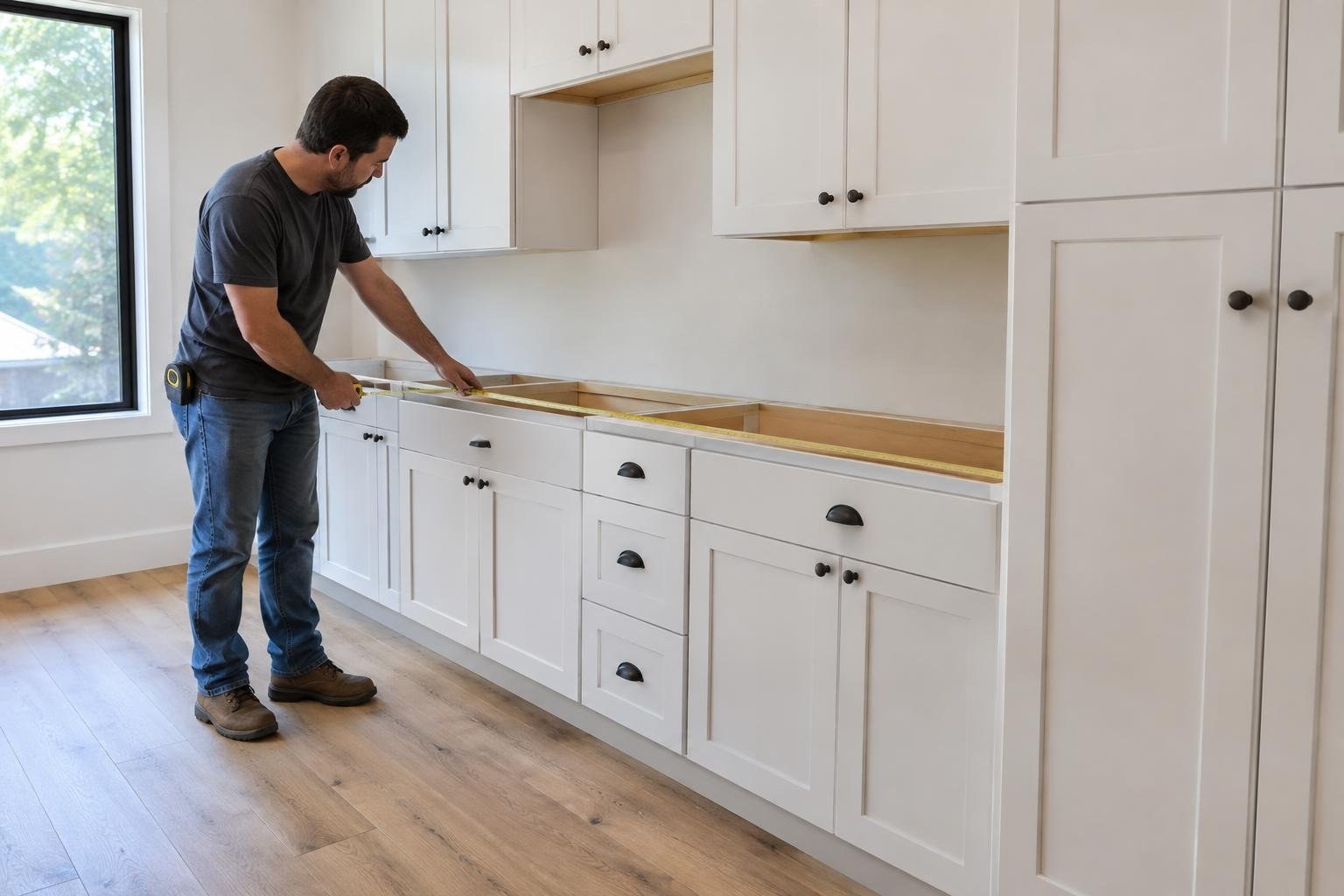
A linear foot is 12 inches measured along a cabinet run. For a kitchen estimate, the provider may measure upper cabinets and base cabinets separately and add those lengths, or may use another clearly defined method. A published estimating guide describes adding the upper and lower measurements to get total linear footage. Because not every quote presents footage the same way, ask for the calculation in writing.
- Break the plan into individual cabinet runs.
- Record the length of each run, distinguishing upper cabinets from base cabinets.
- Identify spaces without cabinets, such as door openings or appliance gaps, rather than counting them as cabinet length.
- Ask the estimator to confirm the final footage and how it is used in the price.
These notes create a basis for discussion, not a substitute for a provider’s verified plan. A small measurement difference can affect the products specified, so confirm dimensions before ordering.
What a cabinet project and estimate may include
Cabinet estimates usually cover some combination of product selection, layout review, measurement, ordering, delivery, assembly, installation, and final adjustments. The actual scope depends on the provider and on whether you are buying cabinets alone or commissioning a more complete project. Per-foot pricing can conceal these differences unless the estimate lists the work clearly.
Ask the provider to show the cabinet plan and identify each cabinet by location, size, and type. Confirm whether fillers, finished end panels, trim, hardware, and modifications are included. If your project includes demolition or changes outside the cabinetry, request a separate description of that work rather than assuming it is part of the cabinet price.
Once you understand the scope, compare estimates line by line. The goal is not simply to find the lowest rate, but to understand what products and services you would receive for the quoted amount.
Signs your project may need new or updated cabinets
Consider replacing or reworking cabinets when the current layout or storage no longer meets your needs, when you are planning a broader kitchen update, or when existing cabinets are damaged enough that repair does not solve the problem. A cost-per-foot estimate is most useful once you know what you want the new cabinetry to accomplish.
Before requesting prices, make a practical list: What is hard to reach? Which items lack a suitable home? Do doors or drawers interfere with nearby openings or appliances? Are you changing the room layout, or keeping the existing cabinet locations? These questions help providers price a defined project instead of guessing at the scope.
Do not treat a high per-foot quote as proof that replacement is necessary, or a low one as proof that a proposal is complete. First decide whether your goal is a changed layout, more storage, a different appearance, or a like-for-like cabinet update. Then ask whether repair, refinishing, or another limited-scope approach is appropriate.
Cabinet cost per linear foot and other price benchmarks
Published cabinet prices are broad reference points, not a quote for your kitchen. For example, one source reports $1,200 to $4,400 for wholesale ready-to-assemble cabinets in a standard 10-by-10 layout, while a separate estimate says custom cabinets for the same nominal space can exceed $15,000 to $25,000. These figures come from different sources and descriptions, so do not assume they include the same products, labor, or project work.
Other published ranges also differ by category and scope. One source gives $150 to $500 per linear foot installed and a total of $4,500 to $15,000, while another lists stock cabinets at $100 to $400 per linear foot. The gap is a reminder to compare definitions and inclusions rather than selecting a budget from one number.
Use a published range to frame early questions, then request a quote based on your actual cabinet plan. Confirm the estimate’s date and the provider’s applicable service area, since costs can change and the research figures are not a localized offer.
Compare RTA, stock, and custom cabinets
The cabinet category is only one part of the price. The estimates supplied show different price levels for stock, ready-to-assemble, and custom products, but do not provide a uniform specification for a direct product-to-product comparison. Custom work may be made to order for specific needs, while stock options follow available sizes and selections. Ask the provider to identify exactly what each category means in the proposal.
| Option | What to verify | Useful comparison question |
|---|---|---|
| Ready-to-assemble (RTA) | Whether assembly, delivery, and installation are included | Is this a product-only price or a completed installation? |
| Stock | Available sizes, finishes, and cabinet list | Which parts of my plan require fillers or changes? |
| Custom | Made-to-order details and full project scope | Which specific design needs justify the custom specification? |
Compare products by their actual specifications and estimate scope, not by category name alone. If a proposal does not explain a term or product, ask for clarification before treating it as equivalent to another quote.
What factors affect cabinet cost per linear foot?
A linear-foot rate is affected by the length being counted, the number and mix of upper and base cabinets, the chosen cabinet category, and the scope of work included. A kitchen with the same total footage as another can still have a different estimate if its cabinet plan or specified options differ.
- Cabinet selection: Ask for the product line, cabinet list, sizes, and finish.
- Measurement method: Verify whether upper and lower runs are counted separately.
- Customization: Identify any made-to-order sizes or design details in the quote.
- Installation scope: Check whether labor is included or priced separately.
- Additional items: Confirm the treatment of delivery, assembly, hardware, trim, panels, and fillers.
- Work outside the cabinet scope: Ask whether demolition, disposal, or related room work is included, excluded, or handled by someone else.
These are comparison prompts, not a promise that every provider prices each item separately. Request clear written inclusions and exclusions so you can understand the total commitment.
What to expect: planning, ordering, and timing
Expect several planning and decision stages: defining the cabinet layout, confirming measurements, choosing products and finishes, reviewing a written estimate, placing the order, coordinating delivery, and arranging assembly or installation if included. The exact sequence varies by provider and project.
Ask when measurements become final, when product selections must be approved, and what happens if a change is needed after approval. Clarify who coordinates delivery and installation, and whether the room must be ready before cabinets arrive. Get important dates and responsibilities in writing.
Build time into your decisions. Rushing a layout review or approving unclear measurements can create avoidable confusion later. A written schedule should explain the next action, the person responsible, and any dependencies that could affect progress.
How to choose a qualified cabinet provider
Choose a cabinet provider by reviewing the clarity of the proposal and how well the provider can explain the plan, not by price alone. Ask for a cabinet schedule or product list that matches the drawing, and make sure you can identify what is being supplied and installed.
- Ask who measures, verifies the plan, orders, delivers, assembles, and installs the cabinets.
- Request written descriptions of the products, finishes, hardware, quantities, and project scope.
- Ask for references or examples of comparable work, and check that the proposed provider’s role is clearly described.
- Review payment stages, change procedures, cleanup, and how concerns will be handled.
- Ask what warranty applies to the products and installation, who provides it, and how to make a claim.
Compare at least two proposals when practical, but first make sure they cover substantially the same work. A lower number may exclude tasks or items included in another quote. The best comparison is a clear one, with responsibilities and exclusions stated in writing.
Permits, credentials, warranties, and safety
Local permit requirements and contractor-credential rules depend on the location and the work involved. Do not assume that a cabinet-only project has the same requirements as a project that changes plumbing, electrical, structural, or other regulated work. Ask the local building department or relevant authority what applies to your scope, and confirm who is responsible for securing any required approvals.
Before work begins, ask the provider to identify the product warranty and any separate installation warranty. Read the coverage, exclusions, duration, and claim process rather than relying on a verbal summary. Keep the final cabinet schedule, estimate, approvals, and change orders together with your project records.
For safety, do not take on electrical, plumbing, structural, or other regulated work unless you are qualified and local rules allow it. Make sure the project plan identifies who is handling any work beyond cabinet supply and installation.
Ways to reduce cost without compromising the project
You can control cost more safely by simplifying the project before ordering, not by removing essential work from an unclear estimate. Decide which cabinet functions matter most, then ask the provider to price alternatives that preserve those priorities. A quote may be easier to compare when products and installation are shown separately, if the provider offers that breakdown.
- Keep the existing layout if it meets your needs, and ask whether a simpler plan can meet your storage goals.
- Compare available cabinet categories and finishes using the same cabinet list and installation scope.
- Prioritize useful storage features rather than selecting every accessory automatically.
- Confirm measurements and selections before approval to reduce the chance of costly changes.
- Ask what work you may reasonably complete yourself, and what requires a qualified installer or other trade professional.
Do not save money by skipping measurement verification, unclear warranty review, safe work practices, or tasks that the project requires. Ask for written alternatives so savings and tradeoffs are visible before you commit.
Common mistakes and an estimate-comparison checklist
Use this checklist before accepting a cabinet estimate:
- Does the quote define what a linear foot means for this project?
- Are upper and lower cabinet runs measured and reported clearly?
- Does the cabinet list match the drawing and your intended layout?
- Are product category, sizes, finish, and included hardware identified?
- Does the price include assembly, delivery, installation, and related details, or are these excluded?
- Are any demolition, disposal, or room-preparation tasks assigned to someone?
- Is there a written schedule and a process for changes?
- Are warranty responsibilities and claim steps clear?
- Have you checked local requirements for any work beyond the cabinet scope?
Red flags include a per-foot price with no measurement definition, a proposal that does not identify the cabinets, unclear installation responsibility, or pressure to approve before questions are answered. Pause and request a revised written estimate when key details are missing.
Explore cabinet options for your project
Per-linear-foot pricing can help you orient an early budget, but a detailed cabinet plan and written scope are more useful for a final decision. Compare the same measurement method, cabinet list, product choices, installation responsibilities, and exclusions. If two bids differ, ask the providers to explain the difference rather than assuming the higher or lower price is automatically better.
For more options as you plan, explore cabinet selections and project ideas at CabinetSupply.com.
Explore cabinet options at CabinetSupply.com for your next project.
Frequently asked questions
What does linear foot mean for kitchen cabinets?
Linear footage is the combined length of the cabinet runs being counted. Some estimates add upper and lower cabinet lengths together, while others describe a single run or use a different scope. Ask the estimator to define the measurement before comparing prices.
How much do kitchen cabinets cost per linear foot?
There is no single price that applies to every kitchen. Published estimates vary by cabinet type and by whether they include installation. For example, one source gives a broad installed range of $150 to $500 per linear foot, while another reports stock cabinets at $100 to $400 per linear foot. Compare the scope and inclusions, not just the number.
Are custom cabinets worth the higher cost?
Not necessarily. A custom quote may include made-to-order sizing or details that a stock quote does not. Compare cabinet construction, finishes, accessories, installation, and other included work before deciding which offers better value.
Are RTA cabinets cheaper per linear foot?
Sometimes. RTA means ready-to-assemble, and the purchase price may not include assembly or installation. Confirm whether the quote covers cabinet components, assembly, delivery, installation, and finishing details before comparing it with an installed price.
How do I calculate cabinet linear footage?
Measure each cabinet run separately, noting where cabinets start and stop. Keep upper and lower runs distinct, and record openings or gaps rather than counting them as cabinetry. Have the cabinet provider verify the plan before ordering.
How long does cabinet installation take?
The research-backed estimates provided do not establish a typical installation duration. Timing depends on the project scope and scheduling. Ask your provider for a written schedule that covers measurement, ordering, delivery, installation, and any work that must happen before or after cabinet installation.
What should a cabinet installation estimate include?
Do not rely on a per-foot price alone. Request an itemized written estimate that defines the measurement method, cabinet products and quantities, installation, delivery, accessories, and exclusions. Ask for changes to be documented before work proceeds.
People Also Ask
Do you count upper and lower cabinets separately for linear feet?
Linear footage is the measured length of cabinet runs. Ask whether the estimate counts upper and lower runs separately and whether openings or gaps are excluded; measurement methods can differ.
Does cabinet cost per linear foot include installation?
An installed price includes installation labor, while a cabinet-only price generally describes the product rather than a completed installation. Verify what each estimate includes before comparing it.
Is cost per linear foot a good way to budget for cabinets?
It can be useful for a rough comparison when both estimates use the same measurement method and include the same work. It is not a dependable stand-alone project budget when scope differs.
Are stock cabinets always less expensive than custom cabinets?
The supplied estimates vary by cabinet category and scope. One source reports stock cabinet pricing, while another gives a broad installed range. Those figures should not be treated as a direct apples-to-apples comparison without checking inclusions.
How can I compare two cabinet bids fairly?
Compare the cabinet list, dimensions, product specifications, finish, accessories, installation, delivery, and exclusions. Ask providers to explain differences in writing so you can compare equivalent scopes.
Can I estimate total cabinet cost by multiplying linear feet by a price?
Do not assume that a small number of linear feet means a low total. Layout complexity, cabinet choices, installation, and other included work can change the estimate. Request a detailed project quote rather than multiplying a rough rate alone.
Cabinet cost per linear foot is a useful starting point, but it is not a complete project price. Compare the same scope, cabinet type, layout, finish, accessories, delivery, installation, and exclusions across written estimates. Confirm measurements and choices before ordering, and ask questions about anything the quote does not clearly explain. When you are ready to explore styles and cabinet options, visit CabinetSupply.com.
Your next step
Explore cabinet options at CabinetSupply.com for your next project.
Last reviewed and updated October 15, 2026 by the CabinetSupple Editorial Team.
Sources
- RTA Cabinet Cost Guide 2026: Real Prices Per Linear Foot
- How Much Do Kitchen Cabinets Cost? (2026 Prices) – HomeGuide
- Average Cost for Kitchen Cabinets – Cabinet Now
- Kitchen Cabinet Cost in 2026 – Average Price, Stock vs Custom, and Hidden Fees
- r/cabinetry on Reddit: Is $220 per linear foot a fair price
- How Much Do Custom Kitchen Cabinets Cost in 2026? A Complete Homeowner’s Guide – Kitchen Search
- 2026 Average Cost of Kitchen Cabinets | New Kitchen Cabinet Prices – HomeAdvisor
- Kitchen Cabinet Renovation Cost Per Linear Foot: 2026 Pricing Guide