
Kitchen cabinet replacement means removing some or all of the existing cabinetry and installing new cabinets. It can address damaged boxes, poor storage, an outdated layout, or a look that no longer suits the room. But full replacement is not the only way to improve a kitchen: if the cabinet boxes are in good condition, replacement doors or a carefully planned partial update may be worth comparing. The right choice depends on what is failing, what you want the kitchen to do, and what the project estimate includes. This guide explains the process, comparison points, budget drivers, planning decisions, installation expectations, and questions to ask before committing.
What Does Kitchen Cabinet Replacement Include?
Kitchen cabinet replacement is the removal of existing cabinetry and installation of new cabinets. Depending on the agreed scope, the work can cover cabinet boxes and interiors as well as shelves, doors, drawers, and hardware. A project may replace every cabinet or focus on a selected run. Decide whether the goal is to improve appearance, storage, layout, or all three before comparing products and proposals.
A typical project involves documenting the existing room, selecting cabinets and accessories, confirming measurements and appliance dimensions, preparing the work area, removing cabinets, and installing and adjusting the new units. Countertops and utility work may be separate parts of a remodel, so establish who is responsible for each task before work starts. Ask for a written description of what is included rather than assuming that “cabinet replacement” covers every related job.
Replacement affects more than the cabinet fronts. New cabinet dimensions can change how appliances fit, how doors and drawers open, and how storage is organized. A provider may also offer alternatives to a full replacement, including adding or removing selected cabinets to suit the existing design.
Signs You May Need Replacement, or Just an Update
Replacement may be worth investigating when cabinet boxes are damaged, storage is poorly arranged, or the existing layout cannot support how you use the kitchen. The research available for this guide does not establish a single test that determines when replacement is necessary, so inspect the kitchen as a whole and ask a qualified provider to assess the conditions before ordering.
- List what frustrates you: difficult-to-reach storage, insufficient cabinet space, or a layout that does not suit your routine.
- Note visible damage or areas that need closer inspection.
- Separate problems with the cabinet boxes from problems limited to doors, drawer fronts, or appearance.
- Decide whether you want to keep the current layout or change cabinet locations.
Cosmetic dissatisfaction alone does not automatically require new cabinet boxes. When boxes are solid, replacement doors may be an option. Conversely, changing only the visible parts will not solve a layout issue. Match the proposed work to the actual problem, and ask the provider to explain what the chosen scope will and will not address.
What Affects Kitchen Cabinet Replacement Cost?
Kitchen cabinet replacement cost varies with cabinet materials, labor, layout, and design goals. Because a dependable estimate also depends on the project’s location, date, and scope, do not treat a general online figure as a quote for your kitchen. Request an itemized proposal based on measured plans and the cabinet specification you are considering.
Ask whether the estimate covers:
- Cabinets, shelves, doors, drawers, and specified hardware
- Measurement, design work, and any layout revisions
- Removal and disposal of existing cabinets
- Delivery, assembly if needed, installation, and adjustments
- Fillers, panels, trim, and finishing details
- Countertop work or coordination with the countertop provider
- Any plumbing, electrical, wall, or floor work, or a clear statement that it is excluded
- Cleanup, applicable taxes, payment schedule, and how changes are priced
Compare like with like. A lower total may omit demolition, delivery, installation, or details another bid includes. Ask providers to identify allowances and exclusions, and confirm the process for approving additional work. Cabinet replacement estimates depend on several project-specific factors rather than one universal price.
Explore cabinet options at CabinetSupply.com for your next project. Comparing the cabinet choices before requesting or reviewing bids can help you discuss a more consistent scope.
Project Factors Beyond the Cabinet Price
The kitchen’s dimensions and the choices you make determine how much work is needed and which cabinets will fit. A straightforward replacement using a similar layout is different from a project that changes cabinet locations, appliances, or room utilities. Establish the intended scope before comparing cabinet prices.
Cabinet quantity, style, and specification
More cabinets or more complex selections can affect the materials and labor in a proposal. Cabinet collections may be available in ready-to-assemble, assembled, semi-custom, and custom formats. Confirm the dimensions and options for the actual cabinets quoted rather than relying on a category name alone.
Layout and related work
Changes around appliances, windows, doors, plumbing, or electrical connections can require coordination beyond installing cabinets. A changed layout may also affect countertops or other finishes. Ask who is responsible for measuring and coordinating each part of the project.
Delivery, removal, and installation
Clarify whether the price includes delivery, assembly, careful removal, disposal, installation, and final adjustments. A cabinet-only price is not the same as a completed-project price. Request separate amounts or clear inclusions so you can see what drives differences between bids.
Full Replacement, Partial Updates, or New Doors?
Compare full replacement with partial changes and replacement doors before deciding. The best route depends on whether the problem is the cabinet boxes, the layout, the visible finish, or a specific storage need.
| Approach | What changes | May suit | Key limitation |
|---|---|---|---|
| Full replacement | Existing cabinets are removed and new cabinets are installed. | A kitchen that needs new cabinetry or a different cabinet layout. | It may involve more scope and coordination than a targeted update. |
| Partial replacement or addition | Selected cabinets are added, removed, or changed. | A specific storage or design need when much of the existing layout remains. | New cabinets must work visually and dimensionally with those that stay. |
| Replacement doors and drawer fronts | Visible fronts are changed while cabinet boxes remain. | Sound boxes and a layout the owner wants to keep. | It does not correct problems with the boxes or the kitchen layout. |
Partial work can include adding cabinets to an existing design, removing cabinets to open a space, or choosing a different cabinet arrangement for a specific need. Replacement doors and drawers are also available as a distinct product category. Ask the provider to check compatibility, finish coordination, and the condition of the parts that will remain.
Ready-to-assemble, assembled, semi-custom, and custom cabinets are also available formats. Compare the actual specification, sizing, assembly responsibility, design flexibility, and delivery arrangements. A label by itself does not tell you whether a product fits your room or project priorities.
How to Plan Measurements and the Cabinet Layout
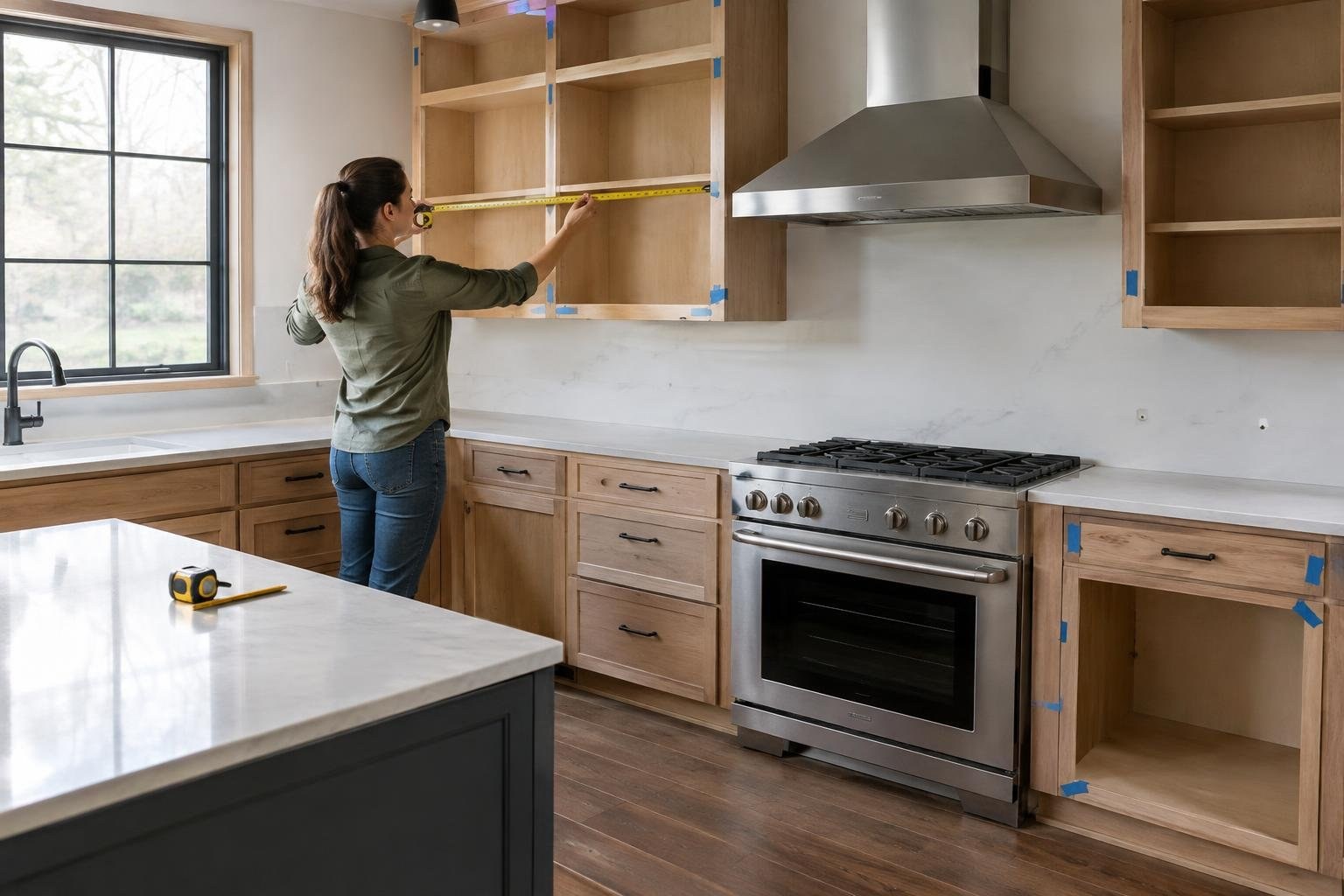
Measurements should be confirmed before cabinets are ordered. Record wall lengths and ceiling height, then note the locations and dimensions of windows, doors, appliances, and existing cabinets. Include plumbing and other fixed features on a floor plan, and identify details that could affect cabinet placement.
New appliances should be selected or their dimensions confirmed early, because appliance sizes can affect cabinet sizing. A scaled floor plan helps homeowners and providers discuss the same layout and prepare more useful bids. Check how the planned cabinets relate to appliance openings and to doors and windows, and confirm that the design accounts for the room’s fixed conditions.
- Draw the room and label each wall.
- Record cabinet runs and the location of doors, windows, and appliances.
- Note ceiling height and plumbing locations.
- Confirm appliance dimensions before finalizing nearby cabinets.
- Ask the provider to verify measurements and the final cabinet plan before placing an order.
Do not rely on memory or an informal sketch when approving a cabinet order. A measurement or appliance mismatch can create costly changes and disrupt the planned layout. Homeowners can prepare room information, but responsibility for final verification should be explicit in the contract.
What to Expect During Installation and How Long It May Take
Expect several coordinated stages: planning, ordering, site preparation, removal, installation, and final adjustments. The exact duration depends on the cabinet selection, delivery timing, amount of work, and coordination with other trades.
- Confirm the scope. Approve the measured plan, cabinets, accessories, finishes, and the work assigned to each provider.
- Prepare the room. Agree on what must be cleared or protected and how existing cabinets will be removed.
- Coordinate related work. Confirm the timing and responsibility for countertop, plumbing, electrical, or other work if included.
- Install and adjust. The installation team places the cabinets and completes the agreed installation details.
- Review completion. Walk through the finished work, list outstanding items, and confirm how adjustments or damage claims will be handled.
Ask for target dates for ordering, delivery, demolition, installation, and completion, plus a plan for communicating delays. Confirm when the kitchen may be unavailable and what needs to be in place before installers arrive. A schedule should account for the whole project, not only the day cabinets are fitted.
How to Choose a Qualified Cabinet Provider
Choose a provider who can explain the proposed design, cabinet specification, measurements, installation responsibilities, and plan for resolving issues. Professional cabinet installation is an available service, but homeowners should still check exactly what a provider will do and what remains outside the agreement.
Before hiring, review:
- Relevant project examples and references, when available
- A written scope with cabinet types, quantities, finishes, and hardware
- Who measures, approves the layout, orders, receives, and installs the cabinets
- Whether demolition, disposal, assembly, delivery, and cleanup are included
- How the provider coordinates countertops and other trades
- Schedule, payment milestones, change-order process, and communication method
- Written warranty terms for products and workmanship, including how to make a claim
- Licensing and insurance appropriate to the work and location
Ask each provider the same questions and compare written answers. A low bid is not necessarily the best value if it leaves important tasks or risk unaddressed. Be cautious if a proposal does not identify the cabinets, excludes key work without saying so clearly, or pressures you to approve before you have reviewed the measurements and terms.
Permits, Safety, Credentials, and Warranty Questions
Permit and licensing requirements depend on the location and the work involved. Before work begins, ask your local building department whether the planned scope requires an approval. This is especially important if the project will alter plumbing, electrical systems, walls, or other building components. Do not assume that replacing cabinets has the same requirements everywhere.
Ask the provider which tasks are included in its work and which require another qualified trade. Do not take on electrical, plumbing, structural, or other regulated work unless you are qualified and local rules allow it. Have the provider describe how the work area will be protected and how heavy cabinets will be handled and secured.
Review warranty terms before ordering. Identify what is covered, the length and limits of coverage, the party responsible for service, and the process for reporting a problem. Do not rely on a verbal assurance when written terms are available. Keep the final cabinet specification, contract, change orders, and completion notes together.
Ways to Save Without Creating Avoidable Problems
To reduce cost safely, avoid paying for work that does not solve your actual problem. If cabinet boxes are in good condition and the layout works, compare replacement doors or a partial update with full replacement. If only a particular storage area needs attention, ask whether a targeted cabinet addition or change can meet that need.
- Set priorities before selecting upgrades: identify essential storage and layout needs first.
- Keep the layout when it serves you well, and request a separate estimate for any proposed layout change.
- Compare ready-to-assemble, assembled, semi-custom, and custom offerings using the same cabinet list and project scope.
- Ask for separate pricing for optional accessories and related work.
- Confirm appliance sizes and measurements before ordering to reduce avoidable changes.
- Compare complete written proposals, not just cabinet totals.
- Ask whether any work can be deferred without compromising the agreed installation.
Do not cut costs by skipping measurement verification, buying incompatible components, or assigning safety-sensitive work to someone who is not qualified. A lower initial price can become poor value if it creates fitting problems or leaves necessary work unfinished. Ask providers to explain the tradeoffs of each proposed saving.
Common Mistakes and a Pre-Order Checklist
Use this checklist before you approve an order or schedule installation:
- Have you defined whether the project addresses appearance, storage, damage, layout, or several of these?
- Have you compared full replacement with partial cabinet changes and replacement doors?
- Are the cabinet selection, quantity, finish, hardware, and accessories written down?
- Have appliance dimensions, windows, doors, ceiling height, and plumbing locations been checked?
- Has someone been assigned responsibility for verifying final measurements?
- Does the estimate state what removal, delivery, assembly, installation, disposal, cleanup, and related work includes?
- Are exclusions, allowances, payment terms, change orders, and the schedule clear?
- Have you asked how damage, missing components, adjustments, and warranty claims will be handled?
- Have you checked local requirements for the actual scope of work?
Common avoidable problems include ordering before appliance dimensions are confirmed, assuming a partial update will match existing cabinets, comparing bids with different inclusions, and treating a cabinet-only price as a full-project estimate. Another mistake is choosing a visual change without checking whether it improves the storage or layout problem that prompted the project. Resolve open questions in writing before ordering.
Plan a Replacement That Fits Your Kitchen
Kitchen cabinet replacement is a better decision when the scope matches the problem, the layout and appliance measurements are verified, and the estimate clearly assigns responsibility for each part of the work. Compare full replacement with new doors or selected cabinet changes, then review the cabinet specification and installation plan together.
Explore cabinet options at CabinetSupply.com for your next project. Use your room measurements, preferred layout, and priorities to guide the comparison, and confirm project details with the provider before ordering.
Frequently asked questions
What does kitchen cabinet replacement include?
Kitchen cabinet replacement removes existing cabinets and installs new cabinetry, which may include new boxes, shelves, doors, drawers, and hardware. The exact scope depends on the project and should be listed in the proposal.
Can I replace kitchen cabinet doors without replacing the cabinets?
Not always. If cabinet boxes are sound and the layout works, replacement doors and drawer fronts may refresh the appearance. If boxes are damaged or the layout is the problem, replacing cabinets may be more appropriate.
How much does kitchen cabinet replacement cost?
There is no single price that applies to every kitchen. Materials, labor, layout, cabinet quantity, design goals, and related work all affect the estimate. Compare written, itemized proposals rather than relying on a broad per-kitchen figure.
How long does it take to replace kitchen cabinets?
The timeline depends on cabinet availability, the amount of demolition and installation, and whether the project includes layout or utility changes. Ask the provider for separate expected dates for ordering, delivery, removal, installation, and completion.
Can I install replacement kitchen cabinets myself?
It can be reasonable for experienced DIYers who can measure accurately, handle heavy cabinets safely, and securely install and level them. Professional installation may be preferable when the layout changes, walls are uneven, or plumbing and electrical work is involved.
Can I replace only some of my kitchen cabinets?
Yes. New cabinets can be added to an existing design, and some cabinets can be removed or changed without replacing the entire kitchen. Check how new finishes and dimensions will coordinate with what remains.
What should a cabinet replacement estimate include?
Compare the cabinet specification, quantity, materials, hardware, delivery, demolition, installation, finishing details, and exclusions. Ask how the provider handles measurement errors, damage, schedule changes, and adjustments after installation.
Do I need a permit to replace kitchen cabinets?
Possibly. Whether a permit or other approval is needed depends on the work and local requirements. Contact your local building department before construction, especially if the project changes plumbing, electrical, walls, or other building systems.
People Also Ask
Is kitchen cabinet replacement worth it?
It can be a good choice when cabinet boxes or the layout no longer meet your needs, or when you want to change more than the visible doors and finish. If the boxes are sound and the arrangement works, compare replacement doors or a partial update first.
How do I prepare for new kitchen cabinets?
Begin with a measured floor plan showing walls, ceiling height, windows, doors, appliances, and plumbing. Confirm appliance dimensions before final cabinet sizing, then have the proposed layout checked before ordering.
Can new cabinets be matched to existing kitchen cabinets?
Yes. Options include adding cabinets that fit the existing design, removing selected cabinets, or changing cabinet locations to accommodate a different use. Check fit, finish, and function with the cabinets that remain.
What makes replacement cabinets more expensive?
Cabinet class, material, quantity, layout complexity, labor, and design choices all contribute. Demolition, delivery, disposal, and related work can also change the total, so compare the full scope rather than a cabinet-only figure.
How do I compare kitchen cabinet installers?
Confirm that the proposal identifies what will be removed, what will be installed, what is excluded, and who handles measuring, delivery, installation, cleanup, and corrections. Review relevant project examples and references where available.
Are replacement cabinet doors a cheaper alternative?
Yes, when the cabinet boxes are solid, doors and drawer fronts may be a possible alternative to full replacement. Verify compatibility and account for the condition of the visible cabinet interiors and edges.
Kitchen cabinet replacement can solve worn finishes, damaged storage, and layout problems, but a successful result starts with a careful decision about what truly needs replacing. Compare full replacement with targeted cabinet changes or new doors, confirm appliance and room measurements before ordering, and ask providers to explain exactly what their estimates include. Explore cabinet options at CabinetSupply.com for your next project.
Your next step
Explore cabinet options at CabinetSupply.com for your next project.
Last reviewed and updated October 12, 2026 by the CabinetSupple Editorial Team.
Sources
- Expert Kitchen Cabinet Replacement in Los Angeles, CA
- Partial Cabinet Replacement
- Kitchen Cabinets – The Home Depot
- Kitchen Cabinet Replacement Cost: What to Expect and How to Budget – Builders Surplus
- How to Replace Kitchen Cabinets – Complete Homeowner’s Guide
- r/kitchenremodel on Reddit: Replacing cabinets – share your experience?
- Kitchen Cabinet Installation at The Home Depot
- Replacement Cabinet Doors & Drawers – The Home Depot