
Framed kitchen cabinets have a visible frame attached to the front of each cabinet box. That border gives them a familiar, traditional look and distinguishes them from frameless cabinets, where the doors mount directly to the box. The frame is only one part of the decision: compare the cabinet’s construction, storage, finish, hardware, assembly, installation, and warranty before you buy. This guide explains what to inspect, what questions to ask, and how to plan a purchase without assuming that a particular style is automatically the best choice.
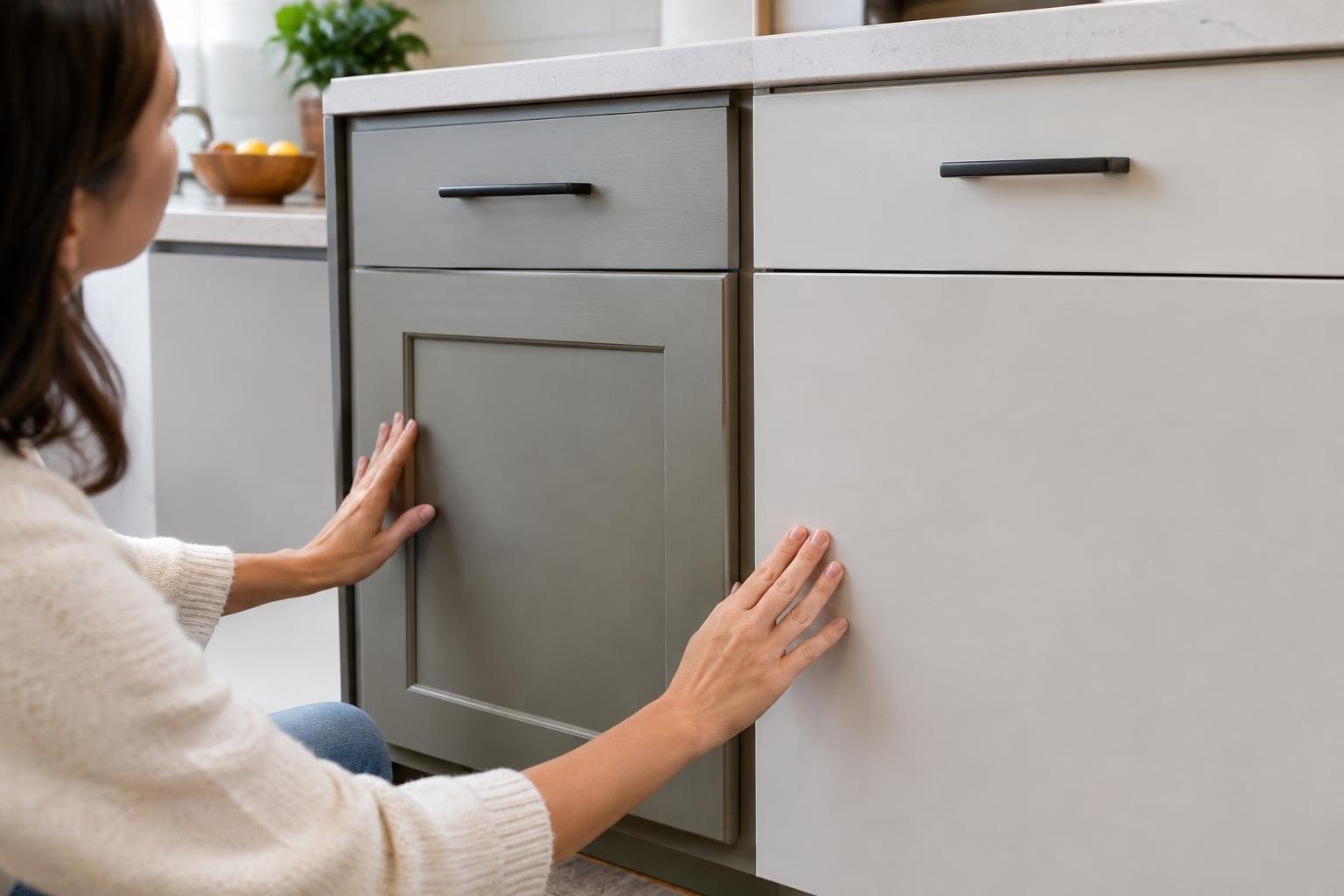
What are framed kitchen cabinets, and what does the style include?
Framed kitchen cabinets are cabinets with a frame attached across the front of the cabinet box. The doors and drawer fronts sit within or over the framed opening, leaving a visible border. This is the defining visual difference from frameless cabinets, whose doors attach directly to the cabinet box.
The frame is not a complete quality grade. Two framed products may differ in box materials, joinery, shelf construction, drawer components, finish, hardware, and whether they arrive assembled. Ask for specifications for the actual product line, not just a label such as “framed,” “premium,” or “durable.”
Framed products are sold for different project types, including residential kitchens and multi-unit housing. Some product lines are offered ready to assemble, and others pre-assembled. Availability and features depend on the specific supplier and product, so verify them in writing.
When might framed cabinets suit your kitchen, and what problems should they solve?
Consider framed cabinets when you like a visible border around cabinet fronts or prefer a familiar, traditional appearance. They can also be a practical option when the product line, sizes, finish, and configuration suit the room and project budget.
Look beyond appearance if you are replacing cabinets because the existing storage is difficult to use. Make a list of recurring problems: not enough room for dishes, awkward corner access, drawers that do not suit your cookware, or doors that conflict with nearby appliances. Those problems are signals to review the layout and storage plan, not evidence that framed construction alone will solve them.
Check the opening and interior dimensions of the specific cabinet. A face frame can reduce the interior access or space available compared with frameless designs. The difference matters when a cabinet must hold a wide item or accept an organizer. Confirm fit using product dimensions and the organizer’s installation requirements before ordering.
Framed vs. frameless kitchen cabinets: what are the tradeoffs?
Framed and frameless cabinets differ in the way their fronts are built. In framed construction, a face frame surrounds the front opening. Frameless, sometimes called full-access construction, has no face frame; the doors mount directly to the cabinet box, producing a more continuous front appearance.
| Consideration | Framed | Frameless |
|---|---|---|
| Front appearance | Visible border around the opening | Minimal visible border and a streamlined front |
| Access and interior | The frame may reduce interior access or usable space | Compare the actual cabinet opening and interior dimensions |
| Installation attention | Plan for accurate alignment and consistent reveals | Careful installation is important so adjacent fronts do not bind |
| Best next step | Inspect frame, box, hardware, and fit | Inspect alignment requirements and fit in the planned layout |
Choose by comparing actual samples and dimensions, not by assuming one construction method is universally stronger or better. A streamlined frameless front may fit a minimalist design. A visible frame may better match a traditional look. In either case, ask how the cabinet is built and installed.
What affects the cost of framed kitchen cabinets?
Cabinet prices should be compared as complete project estimates, not as a price for the frame style by itself. The supplied product information does not establish a universal or location-specific price for framed cabinets. Request a written quote for your actual layout and chosen specifications.
Ask each provider to identify cabinet sizes and quantities, door and finish selections, drawer and hinge hardware, accessories, assembly, delivery, installation, fillers, finished end panels, trim, and removal of old cabinets if needed. Clarify whether countertops, plumbing, electrical work, wall repair, flooring, and appliance changes are excluded or priced separately.
Price can only be meaningfully compared when the scope and product details match. A quote for ready-to-assemble cabinets is not directly comparable to one that includes pre-assembly and installation. Likewise, a quote with different hardware, panels, or cabinet sizes may represent a different product and scope. Ask providers to explain every allowance and exclusion before you decide.
Which factors can change the project scope and final result?
Project scope, product choice, and installation responsibility shape what you need to budget and coordinate. Before asking for estimates, identify the room’s constraints and the result you expect.
- Cabinet configuration: Record cabinet locations and the dimensions needed for the proposed layout. Note openings, corners, finished ends, and any unusual sizes.
- Product and finish: Compare the specific door style, finish, interior, and construction specification rather than relying on a broad style name.
- Hardware and storage: List the drawers, glides, hinges, and interior accessories you want. Confirm which are standard and which are optional.
- Assembly and delivery: Establish whether cabinets arrive assembled or ready to assemble and who handles receiving, inspection, and assembly.
- Installation and adjacent work: Separate cabinet installation from countertop, utility, wall, and floor work. Identify which provider is responsible for each task.
Good measurements and clear responsibility reduce avoidable misunderstandings. If the plan affects plumbing, electrical service, ventilation, or structural components, use appropriately qualified professionals and confirm applicable local requirements.
What cabinet options should you compare besides framed versus frameless?
Ready-to-assemble and pre-assembled describe how cabinets are supplied, not the complete quality of the cabinet. Compare the product specifications and determine who will perform and take responsibility for assembly.
| Supply option | Potential advantage | Questions to resolve |
|---|---|---|
| Ready to assemble (RTA) | May suit buyers prepared to assemble cabinets or arrange assembly separately | What tools, skills, time, and instructions are needed? Who handles assembly problems? |
| Pre-assembled | Cabinets arrive assembled, reducing on-site assembly work | Is assembly included in the quoted price? How are delivery and access handled? |
Some sellers offer framed cabinets in both forms. Verify the exact product, shipment condition, components, and service inclusions; product availability can vary.
Also compare stock availability with any required sizes or options. Do not assume that a listing or advertised selection guarantees every cabinet needed for your layout will be available in the same finish. Confirm the full order and delivery plan before committing.
What should you expect during ordering and installation, and how long can it take?
The schedule depends on your product selection, order and delivery arrangements, site readiness, assembly, and installation scope. The available information does not support a universal installation duration or lead time. Ask for dates tied to your specific order and project.
A useful written schedule identifies when measurements and selections are approved, when the order is expected, who receives and inspects it, when old cabinets are removed, when new cabinets are installed, and how countertop and related work will be coordinated. Include a plan for reporting damaged, missing, or incorrect items.
Before installation, clear the work area and confirm the cabinets, layout, finish, and hardware match the order. The installer should verify fit and alignment as the work proceeds. If other trades or surfaces depend on cabinet placement, agree on handoffs and responsibilities in advance. Ask how changes affect the schedule and how the parties will document approval.
How do you choose a qualified cabinet provider and compare estimates?
Choose a cabinet seller or installer by checking the product, scope, and accountability, not just the headline price. Ask for a written estimate that identifies the cabinet line, sizes, finish, hardware, assembly status, delivery, installation, exclusions, and payment schedule.
For an installer, ask who will measure, assemble, install, and adjust the cabinets. Request relevant project examples and references, and verify insurance and any licensing required for the work in your location. Confirm who is responsible if cabinets arrive damaged, parts are missing, measurements are wrong, or installed doors and drawers need adjustment.
Read warranty documents before ordering. Separate product coverage from labor coverage, and ask how to submit a claim and who will coordinate a repair or replacement. Do not rely on a verbal assurance that the cabinets will last a particular number of years. A product seller makes a lifespan claim for one specific construction configuration, but it is not a guarantee for every framed cabinet. Request the applicable written warranty and supporting product information.
How can you judge construction, hardware, and finish quality?
Cabinet construction and finish matter, but the product label alone cannot tell you how a specific cabinet will perform. Inspect the sample or specification sheet and ask what the frame, box, shelves, drawers, hinges, and glides are made from and how they are joined. Check whether drawers extend as expected and whether the supplied hardware meets your needs.
Look for clear, product-specific answers about cabinet backs, corner support, shelf support, edge treatment, finish care, and replacement parts. One seller highlights corner I-beams, under-mount glides, and inset nickel hinges in its description of a particular framed cabinet. Treat those as features to verify on the exact model, not universal features of framed cabinets.
Ask about moisture exposure and cleaning instructions for the chosen finish. Avoid assuming that “framed” means solid wood, a particular box material, or a certain level of moisture resistance. If the kitchen has a specific exposure or maintenance concern, request the manufacturer’s written care and warranty information.
How can you save money safely on framed cabinets?
Reduce cost by simplifying the design and making informed product comparisons, not by skipping accurate measurements or necessary installation work. Start with the functions you need, then distinguish essential storage from optional accessories or decorative upgrades.
- Compare estimates using the same cabinet layout, finish, hardware, assembly, and installation scope.
- Ask which features are standard and which add to the quote.
- Check whether a ready-to-assemble option makes sense for your skills, time, and assembly plan.
- Confirm the full cabinet order and finish availability before paying a deposit.
- Keep changes in writing, including any change to cost, scope, or timing.
Do not save money by ordering from incomplete measurements or assuming that an installer will correct a design mismatch at no additional cost. If your plan requires changes to utilities or other regulated work, confirm local rules and use qualified professionals. The safe choice is a well-defined scope, not an undocumented shortcut.
Mistakes, red flags, and a practical buying checklist
Use this checklist before signing an order or installation agreement:
- Confirm the cabinet is framed and review a sample or drawing that shows the front style.
- Check the interior opening and dimensions against your planned storage and accessories.
- Get written specifications for the box, shelves, drawers, hinges, glides, finish, and included features.
- Verify whether the product arrives ready to assemble or pre-assembled, and who handles assembly.
- Match the estimate to the same layout, quantity, hardware, delivery, and installation scope.
- Identify excluded work and who coordinates countertops, utilities, removal, and finish repairs.
- Review the delivery plan, warranty, payment terms, change-order process, and problem-resolution contact.
- Confirm local permit and licensing requirements if the project includes work beyond cabinet installation.
Common red flags include vague product descriptions, unclear exclusions, pressure to commit before measurements and scope are settled, and unsupported lifespan promises. Ask for written answers or compare another provider before proceeding.
Explore framed kitchen cabinet options
Cabinet Supply readers can explore cabinet options and compare framed-cabinet choices for a planned kitchen. Review product details and prepare your room dimensions, preferred finish, storage priorities, and questions about assembly and installation before moving forward.
Explore cabinet options at CabinetSupply.com for your next project.
Make a confident choice about framed kitchen cabinets
Framed construction gives cabinet fronts a visible border, while frameless construction offers a more streamlined front without that frame. Neither description is enough to establish the value of a complete kitchen. Check fit, usable space, cabinet specifications, hardware, assembly, installation responsibilities, and written warranty terms.
Use your measurements and project priorities to compare options and ask for a complete, itemized estimate. When you are ready to take the next step, explore Cabinet Supply to review options for your kitchen project.
Explore cabinet options at CabinetSupply.com for your next project.
Frequently asked questions
What are framed kitchen cabinets?
Framed cabinets have a face frame attached to the front of the cabinet box. The doors and drawer fronts are installed in relation to this frame, which creates a visible border and gives the cabinet a traditional appearance.
Are framed kitchen cabinets more durable?
Not automatically. A face frame can add support, but overall performance also depends on the box, joinery, shelves, drawer construction, hardware, finish, assembly, and installation. Compare those details rather than relying on the frame alone.
Should I choose framed or frameless kitchen cabinets?
Framed cabinets suit people who like a visible border around doors and drawers or want a familiar American-style look. Frameless cabinets are worth comparing if you prefer a cleaner, more continuous front and want to assess the available interior access.
Do framed cabinets come assembled?
They can be sold ready to assemble or pre-assembled. Confirm what the price includes, who assembles and installs them, and how delivery, missing parts, adjustments, and warranty issues are handled.
How much do framed kitchen cabinets cost?
There is no reliable price based on the frame style alone. Ask for an itemized estimate covering cabinet sizes and finish, hardware, assembly, delivery, installation, fillers, panels, removal, and any related work.
How long does it take to install framed kitchen cabinets?
A cabinet layout and installation schedule depend on the project scope, product availability, site preparation, and any changes to utilities or surrounding finishes. Get a written schedule that identifies ordering, delivery, installation, and countertop coordination.
What should I ask a cabinet installer before hiring?
Ask for the cabinet specifications, warranty terms, an itemized estimate, references or relevant project examples, proof of required insurance, and a clear explanation of who is responsible for measuring, delivery, installation, and resolving problems.
How long do framed kitchen cabinets last?
The frame by itself does not establish a cabinet’s lifespan. Construction, use, moisture exposure, installation, and maintenance all matter. Treat lifespan claims as product-specific and request the evidence and warranty terms behind them.
People Also Ask
What is a face frame on a kitchen cabinet?
The cabinet front has a frame around the opening, creating a visible border around the doors and drawers. The frame is attached to the cabinet box.
What is the difference between framed and frameless cabinets?
Framed construction has a visible front frame; frameless construction has no face frame, with doors mounted to the cabinet box. The styles differ in appearance and access, so compare actual samples and dimensions.
Are framed cabinets available ready to assemble?
Some framed cabinets are sold ready to assemble, while others are supplied pre-assembled. Confirm the product’s assembly status and whether assembly is included in the project price.
Do framed cabinets have less storage space?
A frame may reduce usable interior space compared with a frameless cabinet. Check the interior opening and test whether your dishes, cookware, or storage accessories fit comfortably.
How can I tell if framed cabinets are good quality?
Do not judge quality by the frame alone. Inspect the cabinet box, shelves, drawer build, glides, hinges, finish, assembly instructions, and warranty.
What should be included in a cabinet estimate?
Compare product specifications, total project scope, assembly, delivery, installation, accessories, and warranty. A price comparison is meaningful only when the estimates cover the same work.
Framed kitchen cabinets are a strong option if you want a visible front border, a familiar cabinet style, and construction choices that can be tailored to your kitchen. The frame alone does not determine quality, price, or lifespan. Compare the cabinet box, drawers, hinges, finish, assembly, warranty, and installation plan, then choose based on how you use your kitchen and what fits your project. Explore cabinet options at CabinetSupply.com for your next project.
Your next step
Explore cabinet options at CabinetSupply.com for your next project.
Last reviewed and updated October 12, 2026 by the CabinetSupple Editorial Team.
Sources
- Framed Kitchen Cabinets | Durable Solutions for Multi Family Housing
- Buy Framed Kitchen Cabinets – RTA & Pre-Assembled | Simply Kitchens
- Framed vs. Frameless Kitchen Cabinets
- Differences Between Framed and Frameless Cabinets
- Framed – In Stock Kitchen Cabinets – The Home Depot
- Framed Kitchen Cabinets Wholesale – RTA Kitchen Cabinets | Cabinetcorp
- Framed Kitchen Cabinets | RTA Cabinet Store
- Shop Framed Kitchen Cabinets Online – Assembled & RTA