
Kitchen cabinet handles may be small, but they affect how cabinets feel to use and how the kitchen looks. The right choice depends on more than a finish or trend: consider whether you prefer knobs or pulls, how the hardware fits your cabinet fronts, and whether the grip feels comfortable. This guide explains how to compare styles, plan replacements, think through price, and avoid common ordering and installation mistakes. It also covers when a simple hardware refresh makes sense and when the cabinets themselves may need attention.
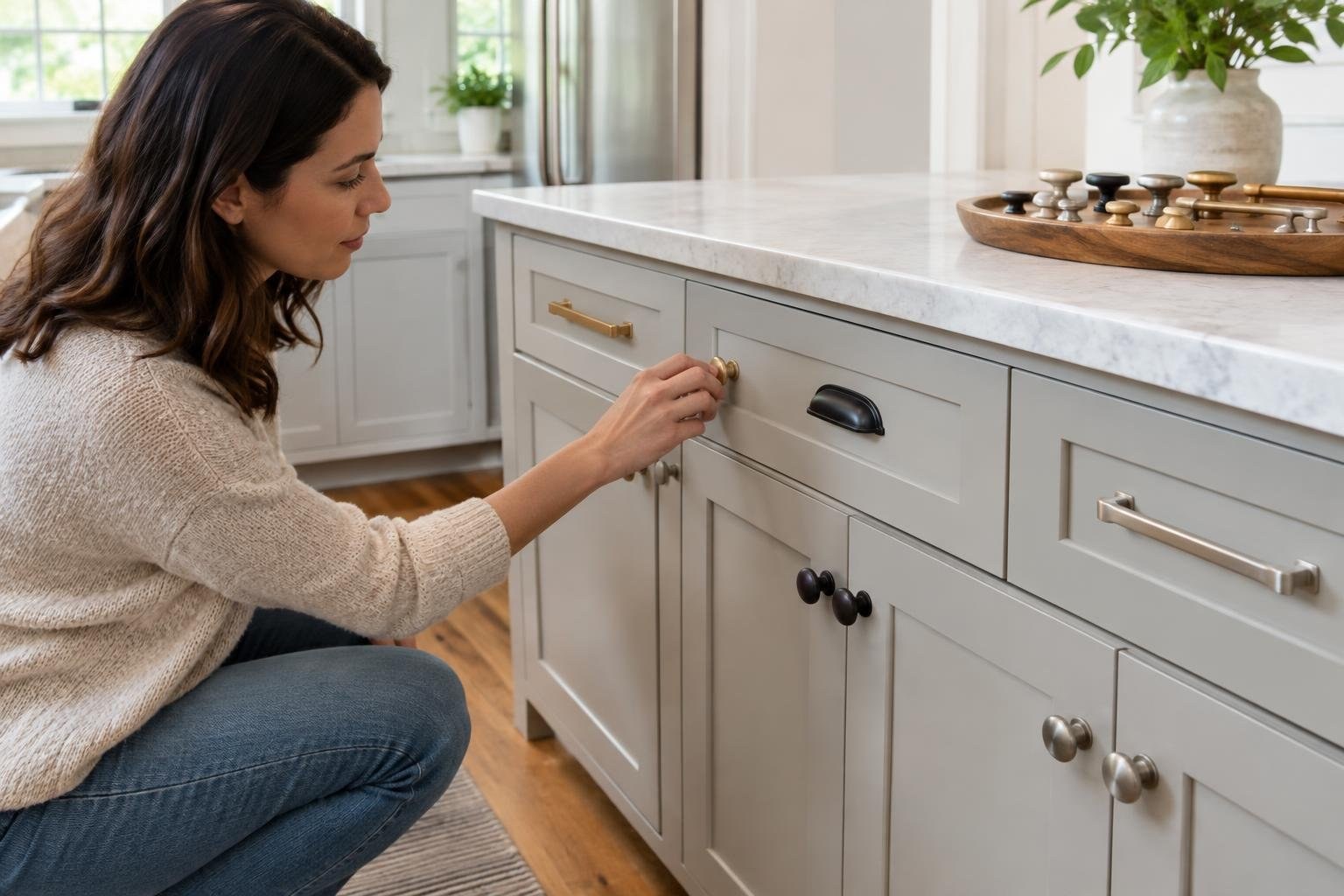
What kitchen cabinet handles do and why the choice matters
Kitchen cabinet handles are the knobs or pulls attached to doors and drawers. They give you a place to grip when opening cabinetry and contribute to the room’s finished appearance. A handle selection includes the product type, size, finish, placement, and the hardware needed to attach it.
Knobs and pulls are the two main choices. Pulls are commonly used on drawers, but they can also serve as door handles. The right answer is not simply a style rule: consider how the cabinet is used, how the hardware feels in your hand, and how it looks with the cabinet fronts. Decorative hardware can add a finishing touch, while a comfortable grip makes routine access easier.
This guide focuses on choosing and replacing handles, not on replacing cabinets. If a hardware update is part of a larger remodel, decide whether the cabinet fronts, layout, and storage work for you before treating new handles as the whole solution.
Signs you may want to replace or rethink your handles
Start by identifying why you are considering a change. A different handle may help when the current grip is uncomfortable, the hardware looks out of step with the kitchen, or you want a coordinated finishing detail. Knobs and pulls are available in varied colors, shapes, and designs, so it is possible to compare several visual directions without changing the cabinets themselves.
However, hardware is not a fix for every cabinet problem. If doors or drawers are damaged, difficult to operate, or otherwise need repair, assess those issues separately. A new handle may change the touchpoint and appearance, but it will not resolve a problem with the cabinet itself. Likewise, if the existing handle is loose, first inspect its attachment and the surrounding cabinet material rather than assuming that a new style is necessary.
Make a short list of the outcome you want: easier grip, a different look, consistency across the room, or replacement of worn or damaged hardware. This helps keep a small update from turning into an unplanned redesign.
Kitchen cabinet handle cost and what a quote should include
For a small hardware project, price depends on the selected products and the amount of work needed. The research available for this guide does not establish a reliable universal price range, so treat any estimate as specific to your chosen products, quantity, and installation scope.
Build a complete count before comparing prices. Tally every door and drawer that needs hardware, and note where you want knobs, pulls, or a mix. Then confirm whether the quoted product price includes the required fasteners and whether installation, delivery, or taxes appear as separate line items. Product listings may specify details such as finish, material, handle type, and included screws, but do not assume every listing includes the same items.
Compare the total for the full set, not just the price of one attractive handle. If the project includes changing hole locations or repairing old holes, ask how that work is priced and who is responsible for the finished cabinet surface. Request the same scope from each provider so that you are comparing like with like.
Factors that affect the project and its price
Several choices shape the project: the number of handles, knob-versus-pull mix, product material and finish, style, and whether the new hardware fits existing holes. A simple replacement using compatible spacing is different from a layout that requires new holes, filling, or refinishing. Check these details before ordering, since a low unit price does not describe the complete job.
- Quantity: Count each door and drawer individually rather than estimating from memory.
- Type and size: Compare the grip, overall dimensions, and screw-hole spacing where applicable.
- Finish and appearance: Check samples against the cabinets and other visible finishes.
- Installation scope: Identify whether the work is a direct replacement or includes repair and new placement.
- Included components: Verify fastener details and any product-specific installation requirements.
These factors help explain why two estimates for what sounds like the same update may not cover the same work.
Knobs, pulls, or a mix: options and tradeoffs
Choose between knobs, pulls, or a combination based on the cabinet fronts, your grip preference, and the look you want. Knobs are compact; pulls offer a longer handhold. Pulls are commonly placed on drawers, but they can also be used on doors. A consistent choice can make a kitchen feel coordinated, while a thoughtful mix can distinguish different cabinet uses or add visual interest.
| Option | What to consider | May suit |
|---|---|---|
| Knobs | Compact appearance and where fingers can grip | Cabinet fronts where a small touchpoint looks and feels right |
| Pulls | Length, projection, orientation, and screw-hole spacing | Drawers or doors where a longer handhold is preferred |
| Mixed hardware | Whether the combination looks deliberate across the room | A layout where different cabinet fronts benefit from different forms |
There is no universally best choice. Compare physical samples where possible, and check the actual dimensions rather than relying on product names such as “small” or “large.”
How to compare finishes, materials, and style
Think of finish as part of the room’s overall palette, not as an isolated product color. Compare the handle with cabinet color, counters, appliances, lighting, and other visible hardware. Consider the handle’s shape and visual weight as well as its finish: a decorative pull can act as an accent, while a simpler shape may keep attention on the cabinets.
Do not make a final decision from a product photograph alone when the exact color matters. A reported buyer experience for a satin-bronze handle described it as darker and more brass-like in person than expected from the image. That single report does not predict how every product will look, but it is a useful reason to inspect a sample or confirm the return terms before buying a large quantity.
Product descriptions can identify material and finish, but terminology varies by product. Read the details for the exact item rather than assuming that a color name guarantees a particular appearance. Check the sample in the kitchen’s own lighting and beside the cabinet surface.
Planning and measuring before you order
Measure before you shop, especially when replacing pulls. Record the distance between existing screw-hole centers and compare it with the product’s listed center-to-center measurement. Also note the handle’s overall length and shape, so it does not look out of proportion on the door or drawer. For a new layout, mark proposed positions on a removable template and check how they look before making holes.
- Make a cabinet-by-cabinet inventory of doors and drawers.
- Record existing hole spacing and note any loose, damaged, or mismatched hardware.
- Decide which fronts will receive knobs and which will receive pulls.
- Check samples for grip, finish, size, and visual balance.
- Confirm the product quantity, fasteners, installation requirements, and return terms before placing the order.
For kitchens with several cabinet styles or unusual fronts, photograph each area and label the measurements. This simple record helps keep a multi-item order consistent and makes it easier to catch a mismatch before installation.
What to expect from ordering through installation
A handle replacement can be straightforward when the new product works with the existing holes and the cabinet fronts are in sound condition. If you are changing placement, plan for careful marking and drilling, and consider whether old holes will remain visible. Follow the product’s installation instructions and check that each handle is secure without damaging the cabinet surface.
Timing depends on the number of pieces, whether hardware is in stock, and whether the job includes new holes or surface repair. Confirm that the hardware is on hand before arranging installation.
For a larger kitchen update, coordinate handle decisions with cabinet and finish selections. Decorative cabinet hardware is often treated as a finishing choice, so deciding early enough to verify size and finish can reduce last-minute substitutions.
DIY or professional installation: how to decide
Whether to install the hardware yourself depends on your comfort with measuring, marking, and drilling accurately. If the project is a direct replacement and the holes align, a capable DIYer may find it manageable by following the product instructions. New holes require more careful layout because a small placement error can be visible across the cabinet fronts.
Consider professional help if you are uncertain about placement, need to repair old holes, have delicate or costly cabinet finishes, or are coordinating the work with a larger renovation. Ask what the installer will do to protect cabinet surfaces, how they will confirm consistent placement, and whether repair work is included.
Get the responsibilities clear before work begins. One quote may cover only installation, while another may include product selection, materials, or correction of existing damage. Do not assume those scopes are equivalent.
Choosing a qualified provider, safety, and warranty questions
For a hardware-only change, homeowners generally do not need a cabinet contractor simply to select a style. If you hire someone for installation, choose a provider whose scope matches the work and whose relevant experience you can evaluate. For a broader remodeling project, check applicable local requirements and confirm who is responsible for any permit-related work. Rules depend on the project and location, so do not rely on a general online guide as a substitute for local confirmation.
Ask a provider to describe the work in writing: product procurement, measurement, installation, hole repair, protection of cabinet surfaces, cleanup, and any exclusions. Request references or examples of comparable work and verify any required licensing and insurance for the work they will perform. Do not assume a decorative hardware product carries a particular warranty; review the product’s own warranty and care information.
For safety, use tools only as directed and do not drill where you cannot confirm what is behind or within the cabinet front. If the work touches electrical, plumbing, structural, or other regulated systems, use appropriately qualified professionals and confirm local requirements.
Ways to control cost without cutting corners
Save money by planning the order carefully rather than choosing hardware on unit price alone. Count accurately, avoid ordering extras without checking the seller’s return terms, and compare complete product specifications. If a finish or size is uncertain, testing one sample may prevent an unsuitable bulk purchase. Some retailers offer in-stock ordering options, but availability and delivery timing should be confirmed for the exact product and location.
Keeping existing hole locations can also avoid extra repair work, provided the replacement hardware fits and the result suits the cabinet. Do not force a size mismatch just to avoid a small amount of additional work; an awkward fit or visible damage can undermine the update.
When comparing providers, ask for a written breakdown and clarify who supplies the handles. The lowest estimate may leave out work another quote includes. Compare the same quantity, products, installation tasks, and repair assumptions before choosing.
Common mistakes and a practical decision checklist
Use this checklist before purchase and again before installation:
- Count every door and drawer that needs hardware.
- Measure existing hole spacing and compare it with the product specification.
- Review the finish and material for the exact product rather than relying on a generic color name.
- Test grip and size against the cabinet front where possible.
- Confirm the quantity, included fasteners, delivery details, return terms, and any warranty information.
- Agree on who will mark, drill, install, repair holes, and clean up.
- Check that the selected knobs, pulls, and finishes look intentional together.
Common mistakes include ordering before measuring, assuming product photos show the finish perfectly, overlooking screws or installation details, and comparing estimates with different scopes. If anything is unclear, pause the order and ask for written clarification. That is usually easier than discovering a mismatch after the hardware arrives.
Make a confident choice for your kitchen
Choosing cabinet handles is a small decision with several connected parts: comfort, style, quantity, measurements, product details, and installation. Compare knobs and pulls in the context of your own cabinet fronts, verify dimensions before ordering, and check a finish in the room rather than relying only on a screen image. If you are hiring help, make sure the written scope describes exactly what is included.
For a hardware refresh that is part of a broader cabinet project, take time to compare the cabinet options as well as the finishing details.
Explore cabinet options at CabinetSupply.com for your next project.
Frequently asked questions
What is the difference between kitchen cabinet knobs and pulls?
Knobs and pulls are the main choices. Knobs offer a compact grip, while pulls provide a longer handhold and can be used on drawers or cabinet doors. Choose based on comfort, appearance, and the cabinet layout.
Can I use pulls on kitchen cabinet doors?
Yes. Pulls are commonly used on drawers, but they can also be installed on cabinet doors. Choose an option that feels comfortable and looks balanced on each cabinet front.
How do I measure for replacement cabinet handles?
Measure the distance between the centers of the existing screw holes, then compare that measurement with the pull’s center-to-center dimension. For new holes, make a placement plan and test it on a template before drilling.
How do I choose a finish for kitchen cabinet handles?
A finish sample or one sample handle is a useful check. Compare it with your cabinet color, appliances, faucet, and lighting in the kitchen, because a product photo may not show the finish exactly as it appears in your room.
What material is best for kitchen cabinet handles?
There is no single best material or finish for every kitchen. Compare the product’s stated material and finish, grip, construction, and care guidance, then choose according to your budget and how you expect to use the hardware.
How much does it cost to replace kitchen cabinet handles?
The total depends on the selected hardware, number of pieces, and whether installation requires new holes or repair of existing ones. Count every door and drawer and compare the complete product and labor scope before deciding.
People Also Ask
How do I measure cabinet handles for kitchen drawers?
Measure from the center of one screw hole to the center of the other and compare that spacing with the pull’s listed center-to-center measurement. Also check the overall length and projection so the handle fits the cabinet front and feels comfortable.
Are knobs or pulls better for kitchen cabinets?
Usually, the practical choice is the one that suits the cabinet front and feels easiest to grip. Knobs and pulls are both common options, and pulls can be used on doors as well as drawers.
Should kitchen cabinet handles match the faucet?
They can coordinate without matching exactly. Compare the shapes, finishes, and visual weight with the cabinet style and other visible hardware, then view samples together in the room before committing.
Can new handles update an older kitchen?
They can be a useful change when the cabinets are in acceptable condition and the goal is to update their appearance or grip. If the cabinet fronts or boxes need work, consider the broader repair or replacement decision separately.
Should I order cabinet handles online without seeing them first?
A sample piece or finish sample is the clearest check. Review it in the kitchen’s lighting and against the cabinet finish, because photographs can differ from how a finish looks in person.
Can I install kitchen cabinet handles myself?
Yes, if you have the right tools and feel confident making accurate, consistent measurements and holes. If the installation involves repairing cabinet fronts, uncertain placement, or a larger remodeling scope, ask an appropriate professional for help.
Kitchen cabinet handles are both practical touchpoints and visible design details. Compare knobs and pulls, confirm the mounting measurements, and assess finishes in your actual kitchen before ordering. Choose hardware that feels comfortable, works with your cabinets, and fits the look you want. Then check that every piece is included and that the installation plan accounts for existing holes and door or drawer movement.
Your next step
Explore cabinet options at CabinetSupply.com for your next project.
Last reviewed and updated October 12, 2026 by the CabinetSupple Editorial Team.
Sources
- Cabinet Handles & Pulls | Modern & Antique Brass Options
- Cabinet Hardware – The Home Depot
- Decorative Cabinet Hardware – Knobs, Pulls & Handles
- Cabinet Hardware: Pulls, Knobs, Hinges & Slides | Lowe’s
- Modern & Gold Cabinet Pulls, Drawer Pulls & Knobs | Goldenwarm
- Cabinet Handles available at MyKnobs.com everyday low prices.
- Amazon.com: Kitchen Cabinet Handles
- Cabinet Handles & Drawer Pulls – Drawer Hardware – IKEA