
Kitchen cabinet accessories can make storage easier to reach and help keep everyday items organized, but the right add-on depends on what your cabinets can accommodate and how you use them. Kitchen cabinet accessories include drawer inserts, roll-out trays, pull-outs, waste pull-outs, lazy susans, plate organizers, and finishing pieces. Before buying, identify the problem you want to solve, measure the cabinet carefully, and compare the full cost and installation requirements. This guide explains the main options, how to assess fit, what can affect price and timing, and when professional help may be useful.
What kitchen cabinet accessories include and why they matter
Kitchen cabinet accessories are components that organize cabinet interiors, make stored items easier to access, or finish the appearance of a cabinet installation. Common examples include drawer inserts, roll-out trays, pull-outs, lazy susans, waste pull-outs, plate organizers, cutlery accessories, and trim pieces. Some products are designed for a particular cabinet type or opening, so the category name alone does not establish that a product will fit your space.
Think of an accessory as a response to a defined problem, not as a required upgrade. If a cabinet is hard to reach, crowded, or being used for the wrong things, first decide what you want to store there and how often you need it. Then compare accessory styles, measurements, and installation needs.
Signs your kitchen may benefit from an accessory
Consider an accessory when your current storage makes a routine task awkward. You may find that items are difficult to reach at the back of a cabinet, utensils are mixed together in a drawer, plates are hard to keep separated, or a base cabinet needs a more convenient way to store waste containers. A narrow unused space may also prompt you to consider a pull-out column, provided the opening can accommodate one.
These are planning cues, not proof that a particular accessory will solve the problem. Before shopping, list the items you want to store, their approximate size, where you use them, and how frequently you reach for them. That list can help distinguish a genuine storage need from an appealing feature that may see little use.
Kitchen cabinet accessory options and tradeoffs
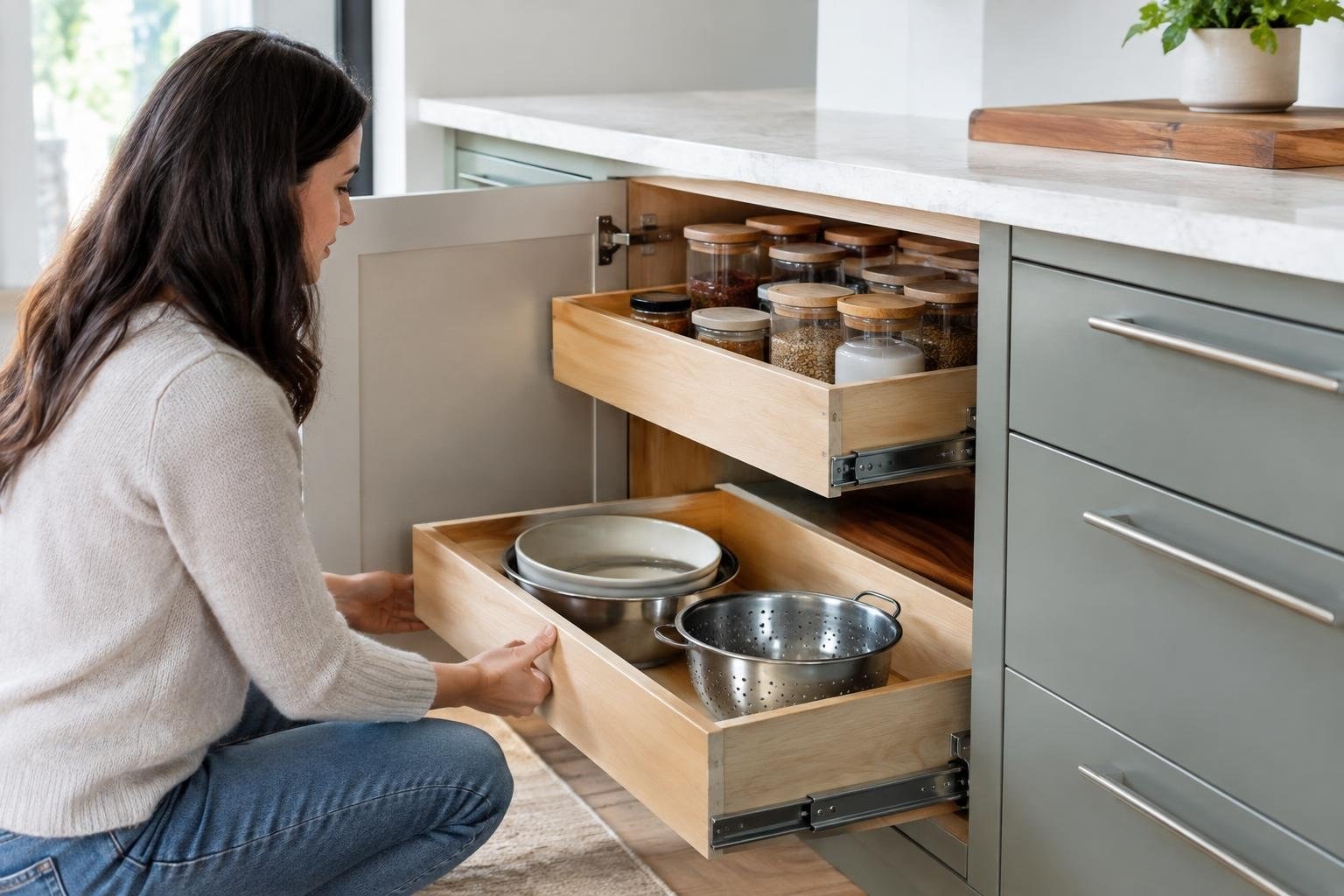
Accessory choices fall into a few practical groups. Drawer inserts and partitions organize utensils, cutlery, and smaller items. Roll-out trays and pull-outs provide a moving storage surface inside a cabinet. Lazy susans offer a rotating format in cabinets designed to accept them. Waste pull-outs keep containers within a cabinet, while plate organizers and other inserts address particular stored items. Molding, trim, and island end caps are finishing components rather than interior organizers.
| Accessory type | Potential use | Check before choosing |
|---|---|---|
| Drawer organizer or insert | Separating cutlery, utensils, or small items | Drawer interior size and the arrangement you need |
| Roll-out tray or pull-out | Creating moving storage within a cabinet | Opening, interior dimensions, slide options, and obstructions |
| Lazy susan | Organizing a cabinet configured for a rotating insert | Cabinet layout and product fit requirements |
| Waste pull-out | Storing waste containers inside a cabinet | Cabinet opening, container needs, and mounting space |
| Narrow pull-out column | Putting a small gap to use for selected items | Available width, configuration, and intended contents |
| Trim or finishing piece | Completing the appearance of cabinet or island details | Style, dimensions, finish, and project scope |
These products are not interchangeable. A drawer insert sorts items already stored in a drawer; it does not add the same type of access as a moving shelf. Likewise, a pull-out’s slide options may vary by product. Some base cabinet accessories are offered with features such as full-extension or soft-close slides, but confirm the exact product’s options and compatibility rather than assuming every model includes them.
How to check fit before ordering
Measure before selecting a product. Record the clear cabinet opening and usable interior dimensions, not just the outside cabinet size. Check the space needed for the accessory to move, including the path through the opening. Note anything that may interfere, such as hinges, plumbing, a drawer, a door, or an adjacent cabinet component.
- Identify which cabinet will receive the accessory and what you intend to store.
- Measure the opening and the interior in the places relevant to the product’s mounting and movement.
- Check the product’s fit requirements and installation instructions, including any required clearances.
- Confirm that doors, drawers, and the accessory can operate without colliding.
- Ask the seller or installer to confirm the fit if measurements or cabinet conditions are unclear.
A small gap can sometimes be planned for a narrow pull-out column, but a filler-sized opening is not automatically suitable for every accessory. Available configurations and sizes vary, so confirm the actual product dimensions before making a purchase.
Cost and pricing considerations
There is no single meaningful price for kitchen cabinet accessories as a group. A quote depends on the selected product, its dimensions and features, how many units are involved, and whether installation or cabinet changes are included.
Ask each seller or installer to separate, where applicable, the accessory, hardware, delivery, installation labor, and any cabinet preparation or repair. Confirm whether the quoted product includes its slides, mounting pieces, or other components required for installation. If you are comparing a basic organizer with a pull-out system, compare the same scope and intended use, not simply the headline price.
- Product and configuration: Different accessory types and arrangements may have different included components.
- Dimensions and quantity: A custom fit or several units can change the amount of product and work involved.
- Hardware choices: Slide features vary by offering and may affect the selected configuration.
- Installation conditions: Cabinet preparation or modifications can add work beyond placing an insert in a drawer.
- Project scope: A single organizer is a different purchase from accessories included in a broader cabinet update.
Factors that affect fit and project complexity
Product fit is only one part of planning. The project may also depend on what the cabinet holds, how often you use it, how the accessory opens, and whether its components are compatible with the cabinet. A pull-out that is convenient in principle may be less useful if the stored items are too tall or too heavy for the intended configuration, or if another door or drawer blocks its movement. Confirm product-specific capacity and use guidance with the manufacturer or seller rather than assuming all accessories perform alike.
For an existing kitchen, inspect the cabinet interior and note its construction and any obstructions before committing. For a new cabinet project, discuss accessories while cabinet sizes and layouts are still being selected. Some accessories are intended for base cabinets, drawers, or particular interior arrangements, so deciding early can help avoid choosing a product that does not match the cabinet plan.
Compare an organizer, a pull-out, and a larger cabinet change
For an existing cabinet, a removable drawer insert may be a simpler choice than a mounted pull-out, while a pull-out can be worth considering when the main issue is reaching items inside a cabinet. This is a practical comparison, not a guarantee that one solution is cheaper or easier in every kitchen. Check whether the accessory is made for the cabinet and whether installation requires fastening or modification.
When shopping, compare products by the problem they solve, the cabinet they fit, what hardware is included, and how they move. Ask whether the accessory is supplied as a complete unit or whether separate pieces are required. Also compare alternatives: rearranging existing contents may be enough; a drawer insert may solve a sorting issue; a roll-out tray may address access; and a cabinet redesign may be appropriate if the underlying layout is the problem.
For coordinated projects, cabinet providers and manufacturers offer collections that combine organizers with finishing pieces such as trim, island end caps, or other cabinet details. That broader selection can be useful during a remodel, but it does not mean every item is needed for every kitchen.
What to expect from ordering through installation
Accessory installation can range from placing an insert in a drawer to mounting a moving unit inside a cabinet. The exact steps depend on the product and cabinet. Before work begins, establish who supplies the accessory, who checks dimensions, whether installation includes cabinet preparation, and who is responsible for correcting a fit problem.
Timing also varies. A product that is in stock and fits an existing cabinet has a different path from an order that depends on a cabinet change or coordinated remodel. Ask for a written schedule that distinguishes product ordering and delivery from installation. If the accessory is part of a larger kitchen project, clarify whether it will be installed with the cabinets or in a later visit.
For installed units, ask how the installer will confirm alignment and movement, protect the surrounding cabinet, and test the door or drawer operation. Request instructions for routine care and a clear explanation of any product or installation warranty.
DIY installation or professional help?
For a loose drawer insert or simple organizer that fits without tools or cabinet changes, a careful reader may be able to handle placement by following the product instructions. Mounted pull-outs and other accessories require more attention to fit and attachment. If you are uncertain about cabinet construction, mounting points, nearby plumbing, or whether installation could affect the cabinet, ask a qualified installer to assess it.
Do not assume that the product will fit because a similar accessory appears in a photograph or because the cabinet is described with a general size. Use the product-specific instructions. For any work involving utilities, structural changes, or unfamiliar tools, do not proceed beyond your competence; consult a qualified professional and confirm applicable local requirements where relevant.
Provider qualifications, safety, permits, and warranties
Accessory installation usually does not, by itself, establish whether a permit is needed. Requirements depend on the scope of the work and local rules. If the project expands to electrical, plumbing, structural, or other regulated work, check with the local authority or a qualified professional before starting.
Credentials and insurance requirements also vary by location and by the work being performed. When hiring, ask for applicable licensing and proof of insurance, relevant installation experience, references, and written warranty terms. Distinguish the product warranty from any workmanship coverage, and ask who handles a defect, missing part, or installation issue.
Get the scope in writing: product model, quantity, dimensions, who supplies it, preparation or modifications, labor, delivery, cleanup, timing, payment terms, and how changes will be approved. Avoid choosing solely on the lowest bid if the proposals do not cover the same work.
Ways to control cost without compromising fit
A focused purchase can save money more safely than selecting the cheapest product without checking fit. Start with the cabinet problem that matters most and prioritize accessories used every day. Check whether an insert or reorganization of existing storage can meet the need before choosing a more involved mounted system. Consider completing only the highest-priority cabinets now and leaving optional additions for later.
Compare equivalent products and written scopes, and ask whether any hardware or installation parts are sold separately. Avoid buying multiple accessories before confirming measurements, return conditions, and installation responsibilities. If the work is part of a remodel, discuss accessories during cabinet planning so the cabinet choice and storage solution can be considered together.
Use the site’s cabinet options as a starting point for considering how storage choices fit into your kitchen plan.
Mistakes, red flags, and a pre-purchase checklist
Before ordering, use this checklist to catch common avoidable problems:
- Buying by appearance alone: A product photo does not confirm fit. Check dimensions and installation instructions.
- Measuring only the cabinet exterior: Confirm the clear opening and usable interior relevant to mounting and movement.
- Ignoring obstructions: Check hinges, plumbing, doors, drawers, and adjacent parts.
- Assuming features are included: Verify slide type, mounting hardware, and other components for the exact model.
- Overfilling a narrow space: Confirm the accessory’s dimensions and intended contents before assigning it a job.
- Skipping the written scope: Confirm product, quantity, delivery, labor, preparation, timing, and warranty terms.
- Choosing an accessory before defining the need: Match the product to what you store and how you use it.
For a larger installation, ask the provider to review the measurements and cabinet conditions before ordering. A brief fit check can prevent a mismatch that is more difficult to address after delivery.
How to choose a qualified cabinet accessory provider
When comparing providers, look for clear answers about fit, compatibility, installation, and responsibility if something does not work as expected. Request a written estimate that identifies the product and quantity, materials or hardware, delivery, labor, any cabinet preparation, schedule, cleanup, payment terms, and warranty coverage. Compare providers on the completeness of their scope and relevant experience, not only on the total.
Ask how measurements will be verified, whether the provider has handled the accessory type and cabinet situation in your project, and how changes are documented. Check references and reviews, confirm applicable licensing and insurance, and make sure you understand who will handle product defects versus installation concerns. If an estimate is vague about dimensions or says only “organizers,” request model details before approving it.
Frequently asked questions
What are kitchen cabinet accessories?
Kitchen cabinet accessories are add-ons that organize or improve access to cabinet interiors and related cabinetry. Examples include drawer organizers, roll-out trays, pull-outs, waste pull-outs, lazy susans, plate organizers, cutlery inserts, and trim or finishing pieces. The best choice depends on what you store and the cabinet dimensions.
How do I know whether an organizer will fit my cabinet?
Start with the cabinet’s usable interior dimensions and the accessory’s installation requirements. Check the opening, interior width and depth, obstructions, hinges, plumbing, and drawer or door movement. Compare those measurements with the product’s fit information before ordering.
Which kitchen cabinet accessories are most useful?
Useful choices depend on what is hard to reach or keep organized. Roll-out trays or pull-outs can make stored items easier to access, while drawer inserts can separate cutlery or utensils. A narrow pull-out column may use a small gap, but confirm its dimensions and intended contents first.
How much do kitchen cabinet accessories cost?
There is no single price that applies to every accessory or installation. Cost depends on the product, cabinet fit, quantity, hardware or slide options, finish, and whether installation or cabinet changes are needed. Compare itemized quotes and confirm what labor and materials include.
Can I add accessories to existing kitchen cabinets?
Many accessories can be added to existing cabinets if the cabinet dimensions, construction, and installation conditions are suitable. Verify fit and mounting requirements first. If the installation requires cabinet modification, or utilities or structural parts may be affected, consult a qualified professional.
How long does it take to install cabinet accessories?
Timing varies with product availability, the number of accessories, installation complexity, and whether cabinet modifications are needed. Ask the seller or installer for a project-specific schedule that includes ordering, delivery, installation, and any follow-up adjustments.
Are soft-close pull-outs worth the added cost?
Not always. Soft-close or full-extension slides can be useful features, but the right choice depends on how the cabinet is used, the accessory’s compatibility, and the total cost. Compare the available slide options and verify what is included before selecting one.
What should I ask an installer before adding cabinet accessories?
A qualified installer should explain how the accessory fits, what cabinet preparation is required, who supplies the product, and what the quote includes. Check relevant experience, references, insurance, written terms, schedule, cleanup, and how installation issues are handled.
People Also Ask
How do you measure a cabinet for a pull-out organizer?
Measure the cabinet opening and usable interior, then check the accessory’s required width, depth, and mounting space. Account for hinges, plumbing, obstructions, doors, and moving parts. Confirm the measurements against the product’s fit details before ordering.
Can a narrow space between cabinets be used for storage?
A narrow pull-out column can be a useful way to use a small gap between cabinets, but it still needs to fit the available space and suit the items you plan to store. Compare dimensions and configurations before treating a filler space as usable storage.
What types of kitchen cabinet organizers are available?
Common options include roll-out trays, drawer organizers, pull-outs, lazy susans, waste pull-outs, plate organizers, and utensil or cutlery inserts. Choose based on the cabinet location, stored items, and access problem you want to address.
What is a waste pull-out cabinet?
A waste pull-out is an accessory designed to keep waste containers within a cabinet. Confirm the cabinet opening, interior space, container arrangement, and installation requirements so the unit fits and remains usable.
Are lazy susans a good use of cabinet space?
A lazy susan can organize items in a cabinet configured to accept that style of accessory. Check the cabinet’s dimensions and layout, along with the product’s fit requirements, before choosing one over shelves or a pull-out.
What is the difference between full-extension and soft-close slides?
Some base cabinet accessories are offered with different slide options, including full-extension and soft-close choices. Availability and compatibility depend on the product, so compare the specific options and what is included before purchase.
Kitchen cabinet accessories are most useful when they solve a specific storage or workflow problem. Start by identifying what is hard to reach, crowded, or difficult to organize, then compare accessories that fit the cabinet and suit the way you use the kitchen. Confirm dimensions, installation requirements, and total project scope before buying. A focused plan can help you choose practical upgrades without paying for features you will not use.
Your next step
Explore cabinet options at CabinetSupply.com for your next project.
Last reviewed and updated November 2, 2026 by the CabinetSupply Editorial Team.
Sources
- Popular Kitchen Cabinet Accessories: 10 Must-Have Add-Ons – Red House Design Build
- Kitchen Cabinet Accessories, Drawer Organizers & Storage | Masterpiece
- Inside Kitchen Cabinet Accessories – The RTA Store
- Cabinet Accessories – The Home Depot
- Base cabinet accessories
- Kitchen Cabinet Accessories | Showplace Cabinetry
- 570+ Kitchen Cabinet Accessories | Organizers & Storage
- Kitchen Cabinet Accessories & Storage | KraftMaid