
Black kitchen cabinets make a strong design choice, but their success depends on more than choosing a dark door. The surrounding wall color, counters, lighting, wood and metal accents, cabinet layout, and finish all shape the result. Black can complement many palettes and natural materials, while adding depth and a sense of luxury. This guide explains how to evaluate the look, compare options, plan a project, and get useful estimates without assuming that every kitchen or budget is the same.
What to know about black kitchen cabinets
Black kitchen cabinets are cabinets with a dark black or near-black visible finish. The color may appear on painted or stained doors, on a cabinet surface, or as part of a larger mixed-color design. The choice concerns appearance, not a particular cabinet construction class: black cabinets may be offered in different styles and configurations.
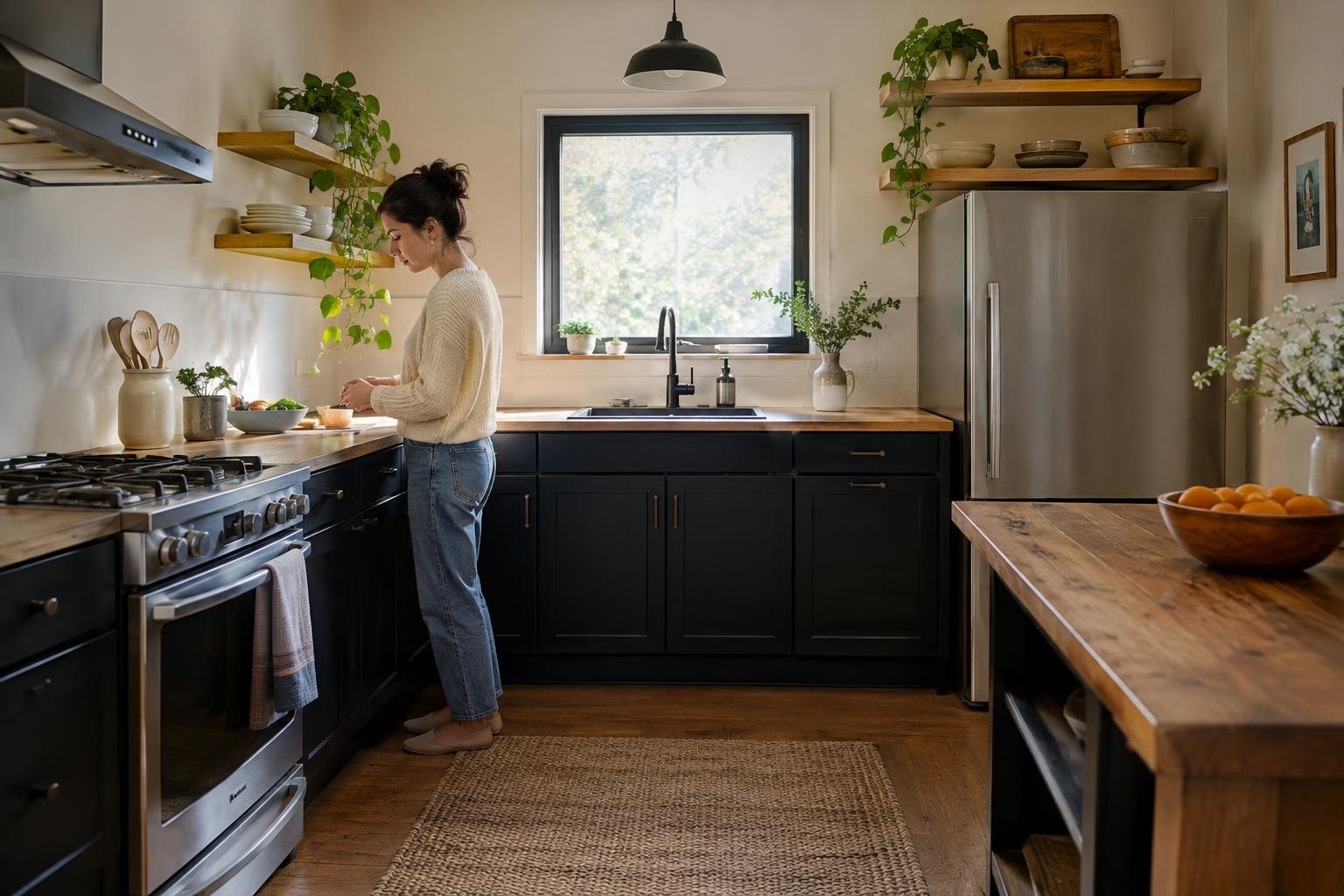
The reason to consider them is their visual flexibility. Black can create depth and a bold focal point, while working alongside natural materials, metallic finishes, and a range of kitchen palettes. Examples include black and white cabinetry with stone surfaces and walnut, or black base cabinets set against white walls and butcher-block counters. These are starting points, not prescriptions; room size, light, and personal preference should guide the final combination.
Do not judge the decision from an isolated door photograph. Look at the cabinet finish with the wall, counter, backsplash, floor, hardware, and lighting selections that will surround it.
Key takeaways before you choose
- They are a design choice, not a cabinet grade. Color alone does not tell you how a cabinet box, drawer, hinge, or finish is made.
- Test the full palette. Compare samples with counters, wall color, flooring, backsplash, and hardware at the same time.
- Consider a partial application. Black lower cabinets, an island, or selected sections can introduce contrast without using the color everywhere.
- Price the actual plan. A standard 10-by-10 example is only a reference configuration, not a substitute for a measured cabinet schedule.
- Specify the finish. Request the exact sample, care instructions, and written product details before ordering.
When should you consider a cabinet change?
Consider black cabinetry when you want a strong visual anchor, are updating a kitchen palette, or are planning a larger remodel in which cabinets, counters, and lighting can be coordinated together. It may also be worth exploring when an existing room feels visually flat and you want more contrast. Those are design prompts, not proof that cabinets need replacement.
Before replacing functioning cabinets for color alone, compare the cost and disruption of the alternatives available for your existing cabinets. Ask whether the current cabinet layout and storage work for you, whether the existing surfaces can be changed, and whether a smaller design update could achieve the desired contrast. Painting, refacing, or replacing may each suit different cabinets and project scopes; get project-specific advice and quotes before deciding.
Warning signs that the project needs broader assessment include a plan that specifies color but not cabinet sizes, unclear responsibility for installation, or a quote that does not identify what is included. Resolve these scope questions before committing.
Black kitchen cabinet cost and estimate considerations
There is no supported universal price for black kitchen cabinets. Color alone cannot determine what your kitchen will cost. A useful estimate needs the cabinet types and dimensions, total list of cabinets, accessories, finish, delivery, and a clear statement of whether assembly, installation, removal, or other remodeling work is included.
Best Online Cabinets describes a 10-by-10 reference as a fixed group of ten cabinets and three accessories, and notes that the real price depends on the sizes selected. It does not establish a price that applies to every kitchen. Treat any standard layout as a comparison aid only, then ask for an estimate based on your own measured plan.
When comparing bids, ask providers to separate cabinet products from installation and other work. Clarify delivery, assembly, old-cabinet removal, countertop work, and any changes to walls or utilities. If those items are not part of a bid, ask who will handle them and how they will be priced. Compare identical scopes, not just bottom-line totals.
Factors that affect the project
Several choices can change the scope and the quote. Cabinet quantity and dimensions matter because a standard reference set may not resemble your layout. Accessories and the selected finish also change what is included in the cabinet order. Delivery and whether the product arrives ready to assemble or assembled are additional comparison points.
Room conditions and design decisions can add coordination needs. Record the locations of doors, windows, appliances, outlets, plumbing, and other fixed elements on the plan you share with providers. Confirm how the cabinets relate to counters, backsplash, flooring, and lighting. The more the design changes after ordering, the more important it is to clarify responsibility, cost, and schedule in writing.
Ask each provider to explain assumptions and exclusions. A quote with a lower total may cover fewer cabinets or omit work that appears in another proposal. Request the same cabinet list and project description from each bidder so you can make a fair comparison.
Options and tradeoffs: color placement, wood, and finish
All-black cabinetry creates a more continuous, dramatic effect. It may suit a kitchen where you want the cabinets to be a strong visual feature. Balance that choice by reviewing the room’s counters, walls, lighting, and other surfaces as one composition.
Black lower cabinets with lighter upper areas can preserve contrast while keeping more of the eye-level space light. A design example combines midnight-black base cabinets with white walls, open shelving, and butcher-block counters. Another route is to use black on an island or selected sections and choose a lighter cabinet color elsewhere.
Black-stained wood offers a different character from a uniform-looking dark surface. Black-stained oak has been shown with tactile wood texture, retaining a visible natural quality within a bold color choice. Ask whether the sample is stained wood, a painted surface, veneer, or another construction before comparing appearance and care.
Matte versus other sheens is a practical sample question. IKEA describes matte black as forgiving with fingerprints and smudges, but that does not establish performance for every manufacturer or surface. Compare the specific finish you intend to buy.
How to plan the color and cabinet selection
Begin with a practical brief: what you want to store, what works poorly today, which appliances and surfaces are staying, and the overall look you want. Then collect measurements and have the proposed cabinet list checked against the room. Accurate dimensions and a complete appliance plan help prevent a color-led design from overlooking everyday use.
Look at each door sample alongside the proposed counter, backsplash, wall color, floor, and hardware. View them in the kitchen under the lighting you normally use, and check at more than one time of day if possible. Compare large samples when available; a small swatch may not communicate how a repeated dark surface will feel across a full run.
For style, decide whether you prefer a crisp contrast, a warmer combination with wood, or a more restrained use of black. Black can be paired with white and gray surfaces, walnut, butcher block, and metallic fixtures. Use those combinations to prompt your own selections rather than copying a finished room without checking the fit in your space.
What to expect: process and timing
Project timelines vary with the products selected, the project’s scope, and the provider’s schedule. Ask for a written sequence that identifies order confirmation, delivery expectations, assembly if needed, installation responsibilities, and any work that must happen before or after the cabinets.
- Define the scope. Decide which cabinets and surfaces are changing and which will remain.
- Measure and plan. Document room dimensions and fixed features, then review the proposed cabinet list and layout.
- Choose and verify products. Confirm finish, sizes, accessories, and whether cabinets arrive assembled or ready to assemble.
- Coordinate the work. Clarify who handles delivery, removal, assembly, installation, and related trades.
- Review the completed scope. Check that the delivered cabinets and agreed work match the written order and resolve questions with the provider.
Do not rely on an informal verbal schedule. Ask how changes, delays, missing parts, or damage will be reported and handled.
How to choose a qualified provider and check safety
Choose a provider by comparing the work they are actually responsible for, not by the cabinet color they can show in a photograph. Ask for a detailed written proposal, an explanation of the cabinet products, and examples of relevant completed work. Contact references if provided, and check that the proposed scope matches your room and priorities.
Before hiring, clarify who measures, orders, receives, assembles, installs, and adjusts the cabinets. Ask how delivery, cleanup, removal, changes, and problems will be handled. Confirm the payment schedule and what triggers each payment. Request the warranty terms in writing and identify which party addresses product defects versus installation issues.
Where licenses, insurance, or permits apply, verify the requirements for your location with the relevant local authority and confirm the provider’s applicable documentation. Do not assume a cabinet-only purchase covers regulated electrical, plumbing, or structural work.
Ways to control cost without cutting corners
Save carefully by narrowing the scope before ordering. Keeping a workable layout, choosing a cabinet list that matches actual storage needs, and avoiding last-minute changes can help keep decisions focused. Compare ready-to-assemble and assembled offers only after confirming the exact products, quantities, accessories, delivery terms, and who is responsible for assembly and installation.
Do not save by skipping measurements, omitting needed accessories from the comparison, or assuming installation is included. Ask whether the quote includes removal and related work, and make sure each provider prices the same scope. A product advertised as in stock or ready to ship does not by itself confirm that every size or component for your plan is available, so verify the exact order and delivery details.
Safety comes first around utilities and structural work. Do not take on electrical, plumbing, or structural changes unless qualified to do so. Confirm responsibilities and local rules before work begins.
Common mistakes and a pre-order checklist
- Choosing black from a photo without checking the real finish in your kitchen.
- Assuming every black cabinet has the same material, surface, construction, or care requirements.
- Using a 10-by-10 reference as if it were a complete estimate for a different room.
- Comparing quotes that include different cabinet counts, accessories, delivery, or installation work.
- Settling the color before coordinating the counter, walls, backsplash, floor, lighting, and hardware.
- Failing to establish who handles measuring, assembly, installation, removal, and issue resolution.
- Making late changes without written approval of the resulting price and schedule.
Before you order: confirm the cabinet schedule and measurements; approve finish samples; check the full palette; read the written scope, exclusions, warranty, and delivery terms; confirm provider responsibilities; and ask how local permit or trade requirements will be verified.
How to make a confident final decision
Black is not a short-term commitment to make from an online image alone. Start with a sample, view it with the other planned finishes, and decide how broadly to use the color. If you are uncertain, compare an all-black plan with a mixed-color layout and ask a provider to price both using clearly defined cabinet lists.
When reviewing product information, keep appearance and construction separate. A dramatic door finish does not explain the box material, drawer construction, hardware, installation, or warranty. Request those details from the seller or provider and compare them in writing. Product specifications and any applicable warranty depend on the specific cabinet, so request them in writing.
For a practical next step, prepare room measurements, a list of appliances and fixed features, photographs, and a short description of what you want to change. Use those details to request comparable options and a clear scope.
Frequently asked questions
Do black kitchen cabinets work in a small kitchen?
Black cabinets can work in a small kitchen when the overall design preserves light and visual openness. Consider black on lower cabinets or an island, lighter walls and counters, and a sample viewed in the room before committing.
Are matte black kitchen cabinets hard to keep clean?
Matte and textured finishes can create a softer, less reflective look. IKEA describes matte black cabinets as particularly forgiving with fingerprints and smudges, but results can vary by product and surface. Ask to see and touch the actual finish.
What colors go well with black kitchen cabinets?
Black pairs with a range of natural materials, metallic finishes, and kitchen palettes. White, gray, wood tones, and warm metallic accents are possible directions; test combinations together because undertones and lighting affect how they look.
How much do black kitchen cabinets cost?
There is no single reliable price for black cabinets based on color alone. Cabinet type, sizes, construction, accessories, layout, delivery, installation, and other remodeling work all influence a project quote. Compare itemized estimates for the same scope.
Can you get black cabinets with a wood grain?
Black-stained oak can retain visible wood texture while giving cabinetry a dark appearance. Painted or other finished surfaces create different looks. Compare real samples and ask the supplier about care, repair, and how the finish is applied.
Should I buy ready-to-assemble or assembled black cabinets?
The right choice depends on the room, budget, desired fit, and who will assemble and install the cabinets. Compare ready-to-assemble and assembled products by the included components, specifications, delivery terms, and installation responsibilities, not just the advertised price.
Is a 10-by-10 kitchen estimate accurate for my remodel?
No. A 10-by-10 kitchen is sometimes used as a reference layout, but a real project may have a different number and size of cabinets, accessories, and installation needs. Request a quote based on measured plans and a defined cabinet list.
People Also Ask
What information should I bring when requesting a cabinet estimate?
Prepare room measurements, a list of appliances and fixed features, photographs, and a short description of what you want to change. Ask providers to price a clearly defined cabinet list against the measured plan.
Should installation be listed separately from cabinet cost?
Ask the provider to state whether assembly, installation, removal, delivery, and other remodeling work are included. Separating cabinet products from installation and other work makes the proposal’s scope clearer.
How can I compare cabinet bids fairly?
Give each provider the same cabinet list and project description. Ask them to explain assumptions and exclusions, including delivery, accessories, removal, and installation, then compare proposals for the same scope.
What details should I confirm before ordering cabinets?
Confirm the cabinet schedule and measurements, finish sample, accessories, written scope, exclusions, warranty, and delivery terms. Also clarify who is responsible for measuring, assembly, installation, and resolving problems.
How should cabinet installation be coordinated with other remodeling work?
Ask for a written sequence covering order confirmation, delivery, assembly if needed, installation, and work that must happen before or after the cabinets. Clarify responsibilities for related trades and changes to the plan.
Black kitchen cabinets can make a room feel dramatic, warm, or quietly modern, depending on the finish and the materials around them. Choose the look by testing samples in your actual kitchen, planning lighting and storage together, and comparing complete project proposals rather than cabinet color alone.
Your next step
Explore cabinet options at CabinetSupply.com for your next project.
Last reviewed and updated November 2, 2026 by the CabinetSupply Editorial Team.
Sources
- Black Kitchen Cabinets are Everywhere—Here are Some Favorites
- 75 Kitchen with Black Cabinets Ideas You'll Love – June, 2026 | Houzz
- Black Kitchen Cabinets – Best Online Cabinets
- 13 Black Kitchen Cabinets That Will Give You Serious Design Inspiration | Architectural Digest
- 23 Kitchens With Beautiful Black Cabinets For a Timeless and Sleek Look
- Black Kitchen Cabinets – Modern & Affordable – IKEA
- Black – Kitchen Cabinets – The Home Depot
- Black Kitchen Cabinets
- Kitchen Cabinet Prices: Costs, Options, and How to Compare Estimates