
Kitchen cabinets without handles replace visible knobs and pulls with a grip shaped into the front, a concealed profile, an edge pull, or a push-to-open mechanism. The result can be a more continuous, uncluttered cabinet surface, but the opening method matters as much as the appearance. Before choosing a style, compare real samples, test how doors and drawers open, and confirm that the mechanism is available with the exact fronts in your cabinet plan.
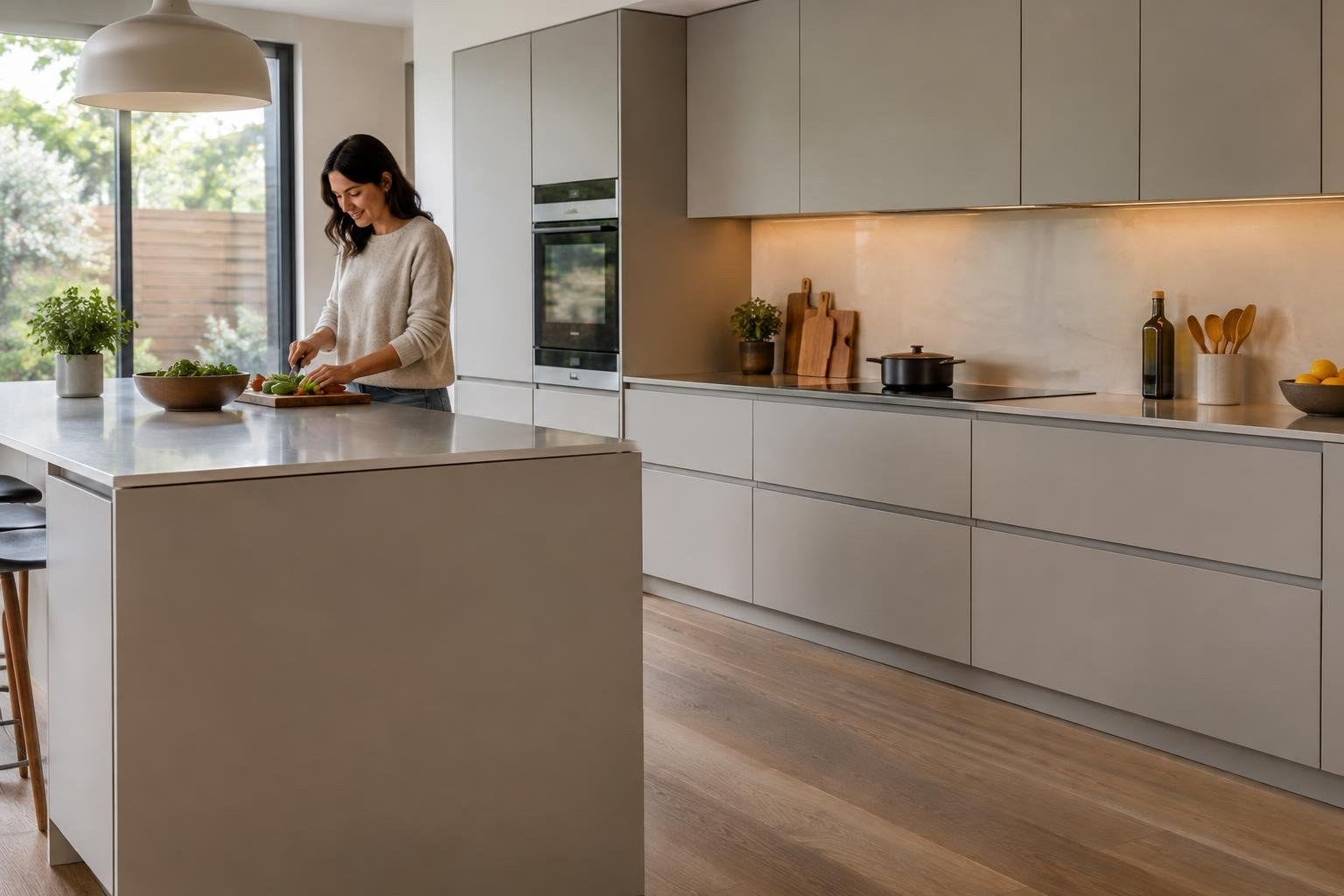
What are kitchen cabinets without handles?
In a handleless kitchen, the cabinet fronts do not rely on traditional knobs or pulls. Instead, the opening point may be a J-shaped groove in the front, an integrated channel or profile, a lip or edge pull, or a push-to-open device. Some descriptions use “handleless” broadly, so ask what the cabinet actually includes rather than assuming every option works the same way.
The design appeal is a more uninterrupted view of the cabinet fronts. Flat fronts can also be planned at different heights, depending on the chosen system and layout. The practical question is whether the opening method feels natural for the people who use the kitchen. Compare doors and drawers separately because their grip positions and opening actions may differ.
When reviewing a plan, mark which method applies to each cabinet run. A clear specification reduces the chance of expecting a groove on one front and receiving a separate profile or push mechanism instead.
When should you consider a handleless design?
Consider handleless cabinets when visible hardware feels visually busy or when you prefer flat, continuous cabinet fronts. Removing separate knobs and pulls changes the appearance of the cabinet surface, which can make the cabinet material, color, and alignment more prominent.
That look is not automatically the right choice. A groove, profile, edge pull, and push mechanism each create a different user experience. If you are choosing cabinets for a kitchen used by several people, invite those users to test samples. Check whether you can find the grip easily, open a drawer without an awkward wrist position, and operate an upper door comfortably.
Pay particular attention to the actual fronts in your plan. A supplier should verify whether the requested grip detail is available for the chosen door style. For example, a back bevel may not be available for every style, and J-shaped grooves may be positioned on a side or bottom edge depending on the door.
Handleless cabinet options and tradeoffs
There is no single handleless opening method. The main options differ in where the hand goes and whether the opening feature is part of the front, part of the cabinet construction, or a separate mechanism.
| Option | How it opens | What to confirm |
|---|---|---|
| J-pull or shaped groove | A shaped recess in the front provides a place to grip. | Groove location, front style compatibility, and how the edge feels in use. |
| Integrated profile or channel | A profile creates an opening point along the cabinet or drawer front. | Where the profile sits, how it looks across adjoining cabinets, and what is included in the cabinet construction. |
| Edge or lip pull | A small projecting or recessed edge provides a grip. | Whether the pull is visibly separate and whether it is specified for every relevant door and drawer. |
| Push-to-open | A push mechanism opens the door or drawer without a conventional grip. | Which fronts use the mechanism and how the action feels on a sample. |
Descriptions are not always used consistently by sellers. Ask for a close-up sample, a drawing, and a written description of the selected system. Do not rely on a mood-board image alone.
What to check in the cabinet fronts and opening system
For this cabinet style, the opening detail is a central product choice. Ask the seller to identify the door and drawer construction, the profile or mechanism, and the finishes shown in the quote. Confirm whether the opening feature is formed into the front or supplied as a separate component.
Request the exact door-style name and a sample that shows the edge or groove. If you are considering a back bevel, ask the supplier to confirm availability for that specific front. Do not assume a detail shown on one door transfers to another style.
Review the complete cabinet specification, not just the visual finish. The estimate should make clear which cabinets receive each opening method and identify any differences between doors, drawers, and tall units. This helps you compare a consistent design rather than an attractive rendering with unspecified details.
Design choices: fronts, heights, and the full kitchen
Handleless cabinets can suit a range of kitchen layouts, including designs with flat fronts and cabinets of varying heights. Choose the opening detail with the whole run in mind. A profile that looks intentional across a row may have a different visual effect when interrupted by a tall unit or a change in cabinet height.
Bring the cabinet plan and samples of nearby finishes into the selection process. Compare how the fronts relate to countertops, backsplash, flooring, and appliances. With fewer separate handles drawing attention, the front surface and the alignment of neighboring doors can become more noticeable. Decide whether you want the fronts to blend into the room or provide contrast.
Do not choose by appearance alone. Include drawers, frequently used doors, and upper cabinets in the sample review. Make sure the grip is accessible and the method is acceptable to everyone who will use the kitchen.
Cost and pricing: how to compare estimates
Request a written quote that identifies the cabinet fronts and the opening method for each door and drawer. A shaped groove, an integrated profile, an edge pull, and a push-to-open mechanism are different specifications, so ask the supplier to describe what is included.
Compare quotes using the same layout, front style, finish, and opening details. Ask for clarification if a proposal does not identify which cabinets use each method or how the selected feature relates to the cabinet fronts.
Factors that affect the project and estimate
When preparing a cabinet plan, identify the layout, front style, finish, and opening method you want to compare. Check that the selected detail is offered with the chosen fronts. An integrated profile, a shaped groove, and a push-to-open mechanism describe different approaches, not interchangeable specifications.
Ask the supplier to show the chosen detail on the plan or a sample. If you change the front style or opening method, review the revised specification before approving it.
Planning and ordering steps
Use a short selection process to keep the cabinet details clear:
- Mark the cabinet runs and drawers on the plan.
- Choose an opening approach and compare samples.
- Ask the supplier to confirm that the detail is available with the selected fronts.
- Review the plan and written specification before approving the order.
Keep the approved plan and specification together so you can refer to the selected opening method for each cabinet.
How to compare cabinet proposals
When comparing cabinet providers, focus on whether the proposed system is clearly described and matched to your plan. Ask which fronts use a shaped groove, profile, edge pull, or push-to-open mechanism, and request a sample or drawing that shows the detail.
Confirm compatibility for the exact door style. For example, a back bevel may not be offered with every style, and a J-shaped groove may be on the side or bottom edge. Ask the supplier to identify the chosen detail in the written specification.
Ways to save without creating avoidable problems
Keep the cabinet layout and front details consistent while comparing options. Test samples before settling on an opening approach, and ask whether a different compatible front or mechanism would better suit your design preference.
- Compare the same opening method and cabinet fronts.
- Ask which features are included in the proposal.
- Confirm compatibility before choosing a detail such as a back bevel.
- Write down the selected opening method for each cabinet run.
Clear specifications make it easier to compare the options you are considering.
Mistakes to avoid: an approval checklist
Before approving a cabinet plan, check that the opening method is identified for doors and drawers, that the selected detail has been confirmed for the chosen front style, and that the drawing shows how it applies across each cabinet run.
- Have I compared the actual opening details using samples?
- Has the supplier confirmed compatibility with the selected door style?
- Does the written specification identify the method for each cabinet run?
If a detail is unclear, ask for a revised drawing or written explanation before approving the plan.
A practical way to make your final choice
For a sleek, low-hardware appearance, compare a J-pull or integrated profile with a push-to-open front. If you want a direct place to grip, focus on groove or edge-pull samples. If you prefer no visible grip, test a push mechanism on the actual style under consideration. These are design choices rather than universal performance rankings.
Review at least one door and one drawer. Check how the selected detail aligns across the planned cabinet run and whether the supplier can provide it for the desired fronts. Ask for a written confirmation of the selected option, plus the applicable product and installation terms.
Explore cabinet options at CabinetSupply.com as you narrow down the cabinet direction for your project.
Final cabinet selection
Kitchen cabinets without handles can create an uncluttered, material-focused appearance, but the best result starts with a clearly specified opening method. Compare the actual fronts, verify compatibility with the selected door style, and make sure the quote describes the same product and work you expect.
When you are ready to continue planning, explore cabinet options at CabinetSupply.com for your next project.
Warranty and installation terms to confirm
Ask for the written warranty terms for the cabinet fronts and selected opening components. Confirm what each warranty covers, how long coverage lasts, and how to make a claim; terms may differ by component.
Ask what installation guidance applies to the specific groove, profile, edge pull, or push-to-open mechanism in your plan. Keep applicable product and installation terms with the approved cabinet specification.
Frequently asked questions
What are kitchen cabinets without handles?
Kitchen cabinets without handles use a built-in grip or a push-to-open mechanism instead of separate knobs or pulls. Common choices include J-pull grooves, integrated profiles, edge pulls, and push-to-open hardware.
Which handleless cabinet style is best?
No single option is best for every kitchen. Compare how each design opens, how it looks with your cabinet fronts, and whether the grip or opening mechanism feels comfortable in person.
Are handleless cabinets truly handleless?
Not necessarily. Some designs form a grip in the door or drawer front, while others use a profile or push-to-open mechanism. Ask which parts are integrated and which are separate components.
What is a J-pull kitchen cabinet?
A J-pull front has a shaped groove that provides a place to grip the door or drawer. Confirm the groove location and ask whether the profile is offered with your selected door style.
How do push-to-open kitchen cabinets work?
Push-to-open doors and drawers use a push mechanism rather than a visible handle. Ask to test the mechanism on the specific cabinet and confirm how it works with the planned fronts.
Do kitchen cabinets without handles cost more?
There is no universal price premium. Request an itemized estimate that identifies the cabinet fronts, opening system, hardware, modifications, installation, and any related work, then compare equivalent specifications.
Can handleless cabinets be used on tall or floor-to-ceiling cabinets?
Yes. Flat-front, handleless cabinets can be planned at different heights, including tall upper cabinets, subject to the room plan and the selected cabinet system.
Can every door style be made handleless?
Ask the supplier to confirm compatibility before ordering. Some features, including a back bevel, may not be offered with every door style.
People Also Ask
What types of kitchen cabinets without handles are available?
The common approaches are a groove shaped into the door or drawer, an integrated cabinet profile, a separate edge or lip pull, and a push-to-open mechanism. The visible result and opening action vary, so compare samples.
What is the difference between J-pull and Gola cabinets?
A J-pull uses a shaped groove as a grip. A Gola-style profile creates a channel associated with the cabinet or drawer construction. Ask a supplier to show where the grip sits on the exact layout you are considering.
Do push-to-open cabinets work without pulls?
Push-to-open fronts have no grip to pull. They open using a push mechanism, so test the action and ask how the system is specified for both doors and drawers.
Why choose a handleless kitchen?
They can give a kitchen a more streamlined appearance by reducing visible hardware. Whether that look is right for you depends on the opening style, the selected fronts, and your preferences for daily use.
What warranty terms should I check for handleless cabinets?
Ask for written warranty terms for the cabinet fronts and opening components. Check what each covers, how long coverage lasts, and how to make a claim; terms may differ by component.
How should I compare quotes for handleless cabinets?
Compare the same cabinet layout and scope across quotes. Have each estimate identify the fronts, opening mechanism, included hardware, installation, and any additional work so you can assess like for like.
Handleless cabinets use different opening details, including shaped grooves, profiles, edge pulls, and push-to-open mechanisms. Compare samples and confirm that the chosen detail is available for your cabinet fronts.
Your next step
Explore cabinet options at CabinetSupply.com for your next project.
Last reviewed and updated November 2, 2026 by the CabinetSupply Editorial Team.
Sources
- Handleless Cabinet Doors for Kitchens: Benefits, Design Tips, & Trends – Cabinetdoors.com
- The Pros and Cons of Handleless Kitchen Design | Harvey Jones
- Handleless Kitchen Cabinets: Sleek Design Ideas | Leicht Queens
- What You Need To Know About Handleless Kitchen Cabinets
- Kitchen Cabinets without Handles – The Ultimate Guide 2026
- The Best 4 Options for Handleless Kitchen Cabinets
- Kitchen Cabinets without Handles | Sleek & Streamlined
- 4 Ways to Do Handleless Kitchen Cabinets – RTA Cabinet Blog