
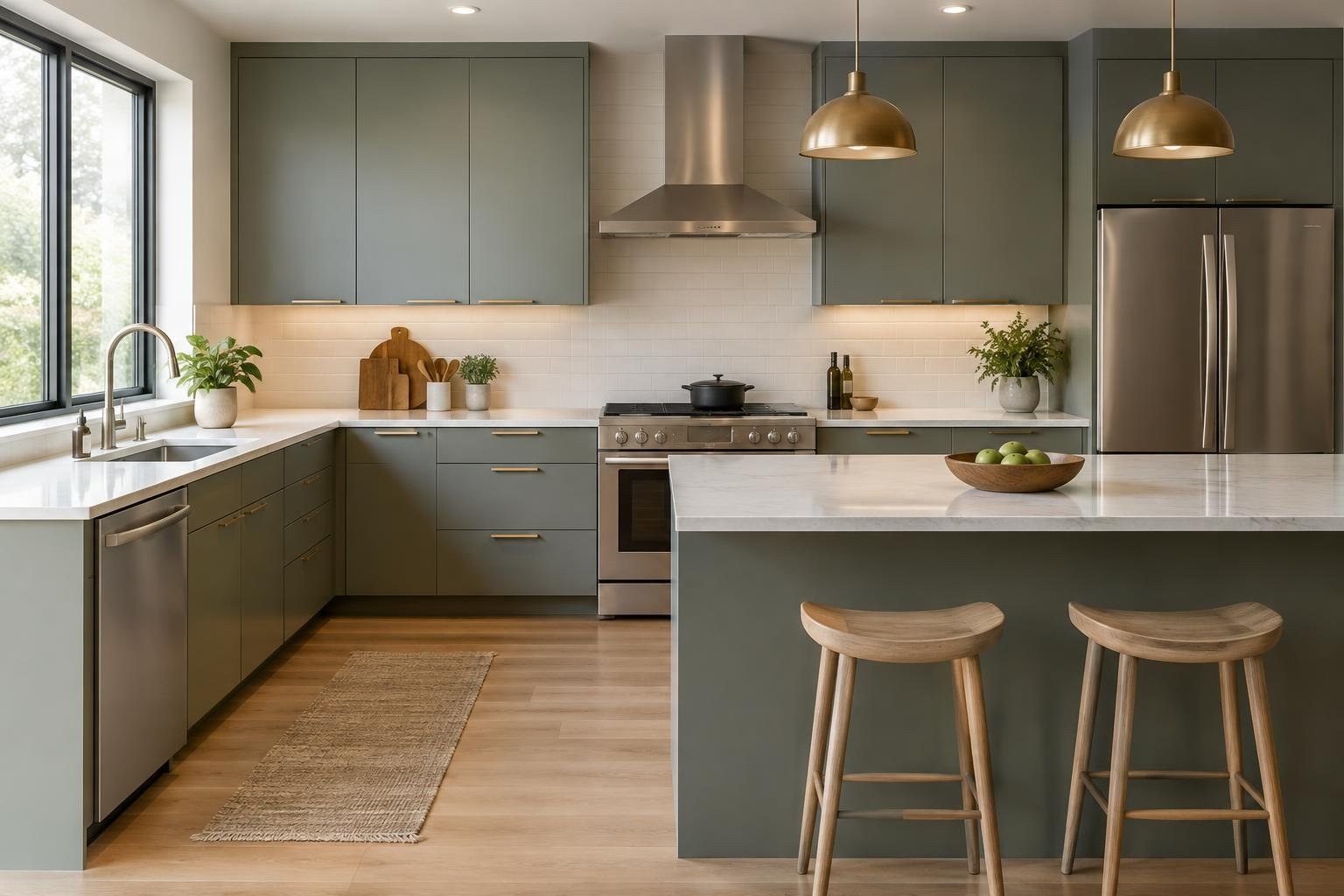
Flat panel kitchen cabinets use smooth, unembellished doors instead of raised or recessed decorative panels. They are a natural fit for modern and contemporary kitchens, but they can also complement transitional spaces when coordinated with the right counters, backsplash, color, and hardware. The key buying decision is not simply whether you like the look: compare the cabinet construction, finish, storage plan, price, and installation scope before ordering.
What flat panel kitchen cabinets are and why the style matters
Flat panel describes the cabinet door’s appearance, not a complete cabinet specification. The door has a plain, smooth face, without the decorative raised or recessed center associated with other common door styles. You may also see the style called a slab door.
This understated face is often chosen for contemporary, modern, and Scandinavian-inspired kitchens. It can also sit comfortably in a transitional kitchen because the simple doors do not dictate the color, countertop, backsplash, or hardware style. Those surrounding choices set much of the room’s character.
Keep three decisions separate while shopping: the door design, the cabinet construction and finish, and the kitchen layout. A visually simple door does not tell you whether the cabinet is stock or made to order, what materials it uses, or whether the storage plan suits your household.
Signs this door style may suit your kitchen
Flat panel cabinets may be worth considering if you want a kitchen with clean, simple lines, or if ornate door details do not fit the room you are planning. Their smooth faces can also appeal to people who prefer fewer grooves and trim details to clean.
Before choosing them, look at the kitchen as a whole. A row of plain cabinet fronts can feel crisp and restrained, but the same simplicity may feel too stark if the room lacks contrast, texture, or visual warmth. A wood-toned finish, a carefully selected backsplash, or distinctive hardware can add character without changing the door profile.
Ask yourself whether the style fits the home, the amount of visual contrast you enjoy, and the way you want the kitchen to feel several years from now. If you are uncertain, compare a full door sample with your intended counter and backsplash rather than judging from a small online image alone.
What the cabinet selection and project process includes
The selection process starts with the room and the work you expect the cabinets to do. Gather basic information about the kitchen, identify appliances and plumbing that must remain or move, and make a list of storage priorities. Then compare door samples, cabinet specifications, and itemized estimates.
- Define the project: Decide whether you are replacing cabinets only or changing the kitchen layout and other finishes too.
- Plan the storage: Note what needs a home, such as cookware, dishes, pantry items, and small appliances. Consider whether drawers, shelves, or pull-out storage would make access easier.
- Choose the door and finish: Compare colors, sheen, hardware, and samples alongside countertop and backsplash choices.
- Review the cabinet package: Confirm cabinet sizes, construction details, accessories, delivery, assembly, installation, and warranty terms.
- Confirm the scope before ordering: Have the responsible provider verify measurements, layout, and the final written selections.
Flat panel doors can be used with different kitchen styles and surrounding design elements. The practical goal is to make the visual choice work with the room’s storage needs and complete scope of work.
Flat panel cabinet cost and what drives the price
The door style alone does not establish a reliable price. Cost depends on the materials, kitchen size, whether the selection is stock or fully custom, and the level of finish or customization. Flat panel doors are not automatically a budget option.
When comparing estimates, request a written breakdown that identifies:
- Cabinet quantity, sizes, and product line.
- Cabinet materials and finish selections.
- Drawers, organizers, pull-outs, panels, fillers, and other included components.
- Delivery, assembly, demolition, disposal, and installation responsibilities.
- Any separately priced countertops, plumbing, electrical work, wall repair, or other remodeling tasks.
- Taxes, payment terms, schedule assumptions, and warranty information.
Do not compare two totals until you know whether the same work and products are included. If a quote is unusually low, ask what it excludes rather than assuming it represents the same cabinet package.
Factors that affect the project and final estimate
Several choices can shift the total even when the door profile stays the same. Material, finish, quantity, the size of the kitchen, and whether you select stock or custom cabinetry all matter. Custom sizing and higher-end finish choices may add cost, so decide which upgrades solve a real need and which are primarily aesthetic.
Project scope is another important comparison. A cabinet-only replacement is not the same purchase as a renovation that changes the layout, counters, backsplash, plumbing, or electrical work. Ask the provider to separate cabinet charges from related work so you can see what is driving the estimate.
Storage features can also affect the package. For example, a pantry plan might include pull-out storage rather than relying only on fixed shelves. Compare the usefulness and price of each accessory against what you store and how you use it; do not assume an attractive add-on is necessary for every kitchen.
Geography, date, local labor conditions, and project details can affect a real-world quote. Obtain current local estimates rather than applying a general price claim to a different location or project.
Options and tradeoffs to compare before buying
| Choice | Potential advantage | What to verify |
|---|---|---|
| Flat panel versus raised or recessed panel | A smooth, unembellished face offers a more streamlined look and can coordinate with a range of kitchen elements. | Check whether the simpler appearance fits your home and desired level of detail. |
| Stock versus custom cabinetry | Stock choices may limit the amount of customization; custom options can allow more tailored selections. | Compare sizes, materials, finishes, lead-time commitments, and complete cost. |
| Ready-to-assemble versus assembled | RTA cabinetry is delivered for assembly, which may suit buyers prepared to take on that work. | Clarify who assembles and installs it, what tools or skills are expected, and how problems are handled. |
| Flat panel with color versus wood tone | Both can maintain the simple door profile while creating different effects in the room. | Review actual samples with counters, backsplash, flooring, and lighting. |
Flat panel cabinetry is not restricted to one decorating scheme. Its streamlined appearance can work in contemporary, transitional, and modern kitchens. The door shape is only one part of the comparison: cabinet construction, fit, finish, and service terms are separate buying decisions.
Finish, appearance, and everyday cleaning
Flat panel doors have a smooth surface that is generally easier to wipe than cabinet fronts with grooves or decorative trim. That can be useful in a working kitchen, where cooking residue and fingerprints may require regular attention. The exact care routine still depends on the chosen finish, so follow the supplier’s cleaning guidance.
Finish selection affects both the look and how much everyday marking you notice. Compare samples in the room and consider how the cabinet color interacts with counters, backsplash, flooring, and lighting. A very dark, light, glossy, or matte surface may create different visual effects; judge the actual sample rather than relying only on a product photograph.
Ask for written care instructions before purchase. Avoid assuming that every smooth finish tolerates the same cleaners, moisture, or abrasion. If you are comparing products, request the finish name and applicable maintenance guidance for each option.
Storage, layout, and design coordination
Plan the interior function as carefully as the visible doors. Make an inventory of what the kitchen must hold, then match storage locations to how you use the room. A pantry, for example, may be easier to organize when frequently used items are accessible; pull-out storage is one option to discuss when reviewing a pantry layout.
Check how cabinet doors and drawers will interact with nearby walls, appliances, corners, and one another. Confirm that the proposed layout accounts for the actual room, not just a visual concept. The provider should verify measurements and identify constraints before the order is finalized.
Think about the full composition too. Flat fronts create a simple visual field, so hardware, counters, backsplash, and color choices become important design partners. Compare these elements together and decide where you want contrast and where you prefer a quieter, coordinated effect.
What to expect, including scheduling and installation
Timing depends on the product, degree of customization, availability, delivery, and what else is happening in the renovation. Do not accept a single vague completion estimate as a full schedule. Ask for milestones covering final measurement, order approval, delivery, assembly if needed, installation, and any related work.
Before work begins, confirm who will remove existing cabinets, prepare the room, coordinate any plumbing or electrical changes, receive and inspect the delivery, assemble RTA units if applicable, and install the cabinets. Establish how schedule changes or damaged and missing items will be documented and resolved.
Keep decisions that affect cabinet size, finish, or layout in writing. Late changes can create confusion about the order and the work sequence. Your provider should explain which decisions must be final before production or ordering and what happens if plans change afterward.
How to choose a qualified cabinet provider
Choose a provider by comparing the scope and the process, not only the total price. Ask who is responsible for measuring, ordering, delivery, assembly, installation, and resolving product or fit issues. If separate businesses handle design, supply, and installation, identify who coordinates them and who is accountable for each part.
Useful questions include:
- What cabinet line, materials, finish, and sizes are included in the estimate?
- Who verifies the final measurements and layout before the order is placed?
- What work is excluded, and how are additional requests priced and approved?
- Who handles demolition, disposal, assembly, installation, and cleanup?
- What are the written schedule, payment terms, and warranty conditions?
- Can you review relevant project examples and speak with references?
- What licensing or insurance is required for the work in this location, and can the provider document applicable coverage?
Check references, reviews, and examples relevant to your type of project. The lowest bid is not necessarily the best value if it excludes essential work or leaves responsibilities unclear.
Permits, qualifications, warranties, and safety
Cabinet door style does not determine whether a project needs permits or what qualifications are required. Requirements depend on the location and the work being performed, particularly if the project includes changes beyond replacing cabinetry. Confirm local requirements with the relevant building department and ask the provider which work they will perform and who is responsible for obtaining approvals.
Do not assume a cabinet supplier’s product warranty covers installation, unrelated remodeling work, or damage caused by another trade. Read the written warranty for coverage, exclusions, claim steps, and time limits, and keep product and installation documents.
For work involving electrical, plumbing, structural changes, or other regulated tasks, use appropriately qualified professionals and verify applicable local rules. Avoid proceeding on informal assurances when the work affects utilities or building conditions.
Ways to reduce cost without creating avoidable risk
You can control costs without choosing an unsuitable product or cutting corners on work that affects safety and fit. Start by comparing more than one complete, itemized estimate and confirming that each covers the same cabinet sizes, materials, finish, accessories, delivery, and installation responsibilities.
- Prioritize must-have storage and remove accessories that do not solve a real problem.
- Compare stock, semi-custom, and custom options against the actual sizing needs of the room.
- Keep the existing layout if it meets your needs, rather than adding scope without a clear benefit.
- Choose a finish and hardware package that fits the budget before approving the order.
- Ask whether assembly or other tasks are excluded, and take on DIY work only when you can complete it safely and correctly.
- Get all changes and added costs approved in writing before work proceeds.
Do not save money by skipping accurate measurement, ignoring local requirements, or accepting unclear installation responsibility. A lower initial quote may not be comparable if important tasks are missing.
Common mistakes, red flags, and a buyer checklist
Use this checklist before placing an order:
- Confirm that the flat panel style suits the kitchen and the look you want.
- Review physical samples with your intended counter, backsplash, and other finishes.
- Verify the kitchen measurements, appliance locations, and proposed cabinet layout with the responsible provider.
- Compare cabinet materials, finish, sizes, storage accessories, and warranty terms.
- Get a complete written estimate that separates cabinets from related work.
- Confirm who handles delivery, assembly, installation, demolition, disposal, and cleanup.
- Request a schedule, written change-order process, and clear payment terms.
- Check applicable local requirements for any plumbing, electrical, or structural work.
Common warning signs include pressure to approve an order before measurements and selections are confirmed, a quote that does not explain exclusions, unclear responsibility for installation, or verbal promises that never appear in the paperwork. Pause and get clarification before committing.
Conclusion
Flat panel kitchen cabinets offer a simple, smooth door design that can work across several kitchen styles and is relatively straightforward to clean. Their appearance alone does not guarantee a particular price, quality level, or storage result. Those depend on the cabinet product, finish, sizing, accessories, and project scope.
Before buying, compare the complete specification and the work behind the estimate. Confirm measurements, check samples with the other kitchen finishes, clarify installation responsibilities, and put schedule, exclusions, and warranty terms in writing. That preparation helps you choose the style for the right reasons and understand what you are paying for.
Explore Cabinet Supply for cabinet options that can help you develop your kitchen plan.
Frequently asked questions
What are flat panel kitchen cabinets?
Flat panel kitchen cabinets have doors with a smooth, simple face and no raised or recessed decorative panel. The style is often called slab-front cabinetry.
Are flat panel cabinets only for modern kitchens?
They can work in contemporary, modern, Scandinavian-inspired, and some transitional kitchens. Their simple surface can pair with different colors, counters, backsplashes, and hardware, so the surrounding selections influence the overall look.
Are flat panel cabinets cheaper than traditional cabinets?
Not necessarily. The door style alone does not determine cabinet quality or price. Cost depends on factors such as cabinet material, kitchen size, stock or custom construction, and finish choices.
Are flat panel cabinets easy to clean?
Smooth door faces are generally easier to wipe than doors with grooves or decorative trim. Follow the cabinet maker’s care instructions and use products appropriate for the specific finish.
What should I compare when buying flat panel cabinets?
Compare the complete cabinet specification, including materials, finish, included components, sizing, delivery, assembly, installation, and warranty terms. A door-style name by itself does not tell you how a cabinet is built.
How long does it take to install flat panel kitchen cabinets?
Timing varies by cabinet type, customization, availability, delivery, and the work included in the project. Ask each provider for a written schedule that distinguishes ordering, delivery, preparation, installation, and completion.
Do flat panel cabinets work in a small kitchen?
They may suit a small kitchen because their clean lines can create a streamlined appearance, but the door style does not increase storage by itself. Plan cabinet sizes, interior storage, and clearances around the actual room.
People Also Ask
Why do flat panel cabinet quotes differ?
Quotes may include different cabinet quantities and sizes, materials, finishes, accessories, delivery, assembly, demolition, disposal, or installation. Compare itemized estimates for the same products and work, and separate cabinet charges from other remodeling tasks.
Can flat panel cabinets look warm and inviting?
Yes. Smooth fronts can be combined with different cabinet colors, countertop materials, backsplashes, and hardware. The overall effect depends on how those elements work together.
Do slab cabinets show fingerprints?
They can, but how noticeable they are depends on the finish. Smooth fronts are generally easier to wipe than doors with grooves or decorative trim; follow the supplier’s care guidance for the specific finish.
Can I get flat panel cabinets in custom sizes?
The door style can be paired with stock, semi-custom, or custom cabinet options. Availability, sizing choices, materials, and project cost depend on the product and supplier.
How should I compare flat panel cabinet samples?
Review physical samples in the room with your intended counters, backsplash, flooring, and lighting. Judge the actual samples rather than relying only on product photographs.
Flat panel kitchen cabinets are defined by their smooth, unembellished doors, but the right choice depends on more than appearance. Compare cabinet construction, finish, storage, price, and the complete installation plan before committing. A well-planned flat panel kitchen can suit modern, Scandinavian-inspired, and transitional spaces, while thoughtful choices about color, hardware, and surrounding materials help the design feel personal rather than stark.
Your next step
Explore cabinet options at CabinetSupply.com for your next project.
Last reviewed and updated November 2, 2026 by the CabinetSupply Editorial Team.
Sources
- Flat Panel Kitchen Cabinets | RTA Cabinet Store
- The Best Guide To Flat Panel Kitchen Cabinets For Homeowners
- Flat Panel Kitchen Cabinets – The Best of Modern Style
- A Complete Guide To Flat Panel Kitchen Cabinets For Modern Kitchen | George Cabinetry
- 75 Beautiful Flat-Panel Kitchen Cabinet Pictures & Ideas | Houzz
- Flat Panel Kitchen Cabinets – Ready-to-Assemble
- Flat Panel Cabinets: The Sleek, Modern Choice for Your Kitchen – RTA Cabinet Blog
- Flat Panel Kitchen Cabinets
- Kitchen Cabinet Trends for 2026: Styles, Colors, and Smart Choices