
Shopping for particle board cabinets can feel confusing because the material name alone does not tell you how the finished cabinet will look, hold up, or suit your room. Particle board cabinets are sold for kitchens and other storage spaces, and the panel can be covered with a finish such as laminate, veneer, or paint. But prolonged water exposure can cause swelling or warping, so product details and room conditions matter. This guide explains what to inspect, which questions to ask, how to compare options, and how to review a quote without relying on a vague label or unsupported lifespan promise.
What Are Particle Board Cabinets?
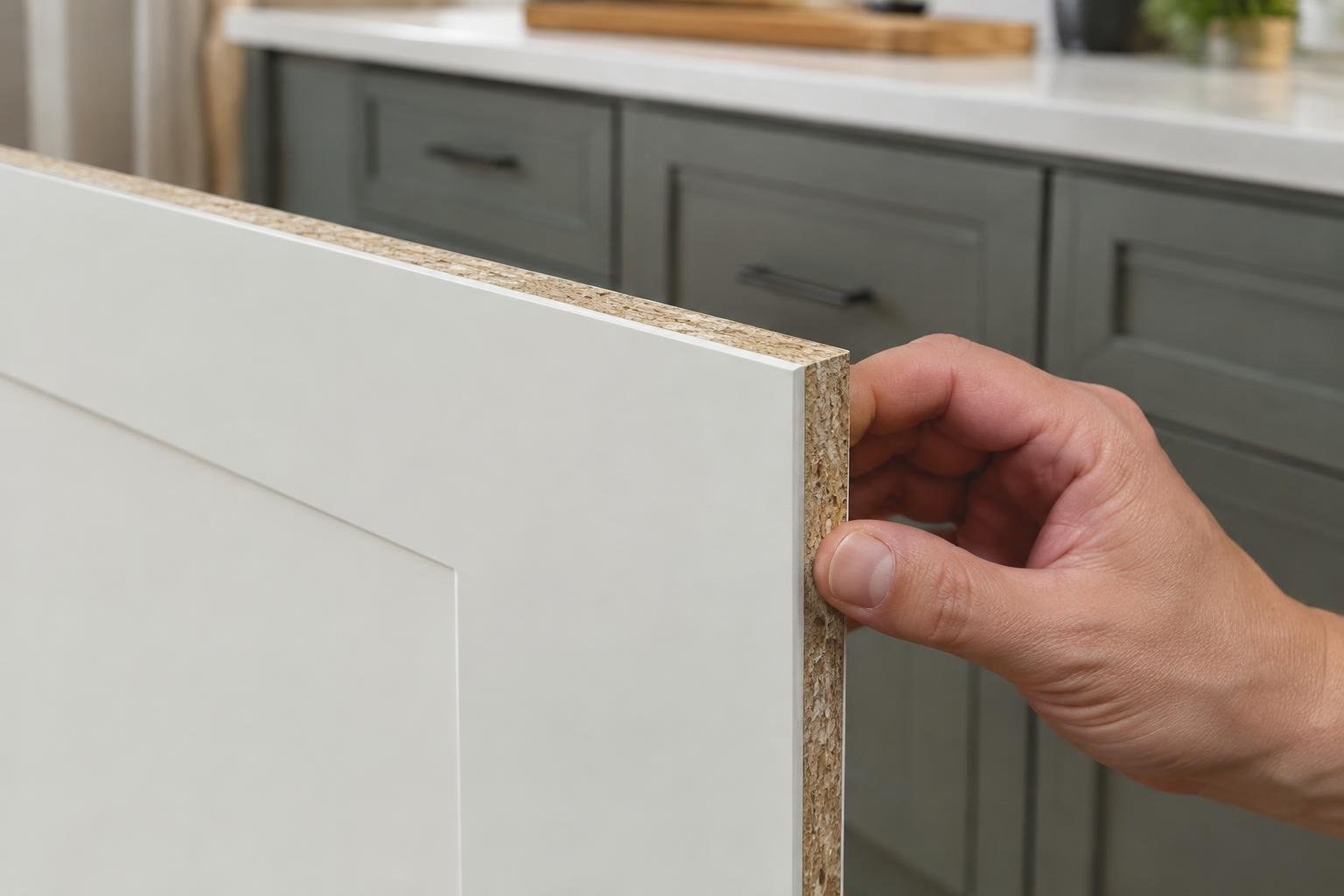
Particle board cabinets are cabinets that use a particle-based panel for one or more components. The material may have a decorative surface, such as laminate, veneer, or paint. Product descriptions and marketing labels do not always make clear which parts use which material, so ask about the cabinet box, shelves, doors, drawer parts, backs, and end panels separately.
Particle board is used for kitchens, wardrobes and closets, bathroom vanities, and office furniture. It is also sold in utility-storage cabinet ranges. That broad availability does not make every product interchangeable: confirm its size, finish, construction, intended use, and care instructions before purchasing.
The key practical concern is moisture. George Cabinetry's article on particle board cabinets says the material can swell or warp when exposed to water for long periods. That makes the product's moisture guidance especially important anywhere a leak, spill, or repeated wetting is plausible. A decorative surface should not be mistaken for proof that the whole cabinet is waterproof.
When Might Particle Board Cabinets Suit Your Project?
Before choosing this material, consider whether it fits your room, expectations, and care habits. Particle board cabinets may be worth comparing if you want a finished panel surface and are reviewing readily available cabinet products. George Cabinetry's article says particle board can be laminated, veneered, or painted for a uniform finish.
Think carefully about the location. A bathroom vanity, kitchen sink base, or cabinet near an appliance that could leak faces a different moisture concern from a dry office storage unit. This does not establish that a particular cabinet will fail in a given location; it means you should ask for the manufacturer's specific use and moisture instructions instead of assuming all particle board products behave alike.
Also consider your plan for the room. Are the cabinet sizes available in the configuration you need? Does the finish work with nearby surfaces? Can you get matching panels or replacement parts if needed? Product listings show that particle board cabinets and related panels are sold through retail channels, but availability of a particular size or finish must be confirmed for the item you select.
Signs a Particle Board Cabinet May Need Repair or Replacement
Look for clues that an existing cabinet needs attention rather than relying on age alone. Visible swelling or warping, damaged panel edges, loose hardware, or doors and drawers that no longer sit properly are reasons to investigate. Water exposure is especially relevant because prolonged contact can swell or distort particle board.
These signs do not prove that a cabinet must be replaced. First identify the source of any moisture and stop it safely. If the problem involves plumbing, electrical connections, a structural concern, or work regulated in your area, use an appropriately qualified professional. Then ask a cabinet provider to assess whether the damage is limited to a finish or edge, affects a panel, or compromises the cabinet's stability.
Do not cover a swollen area with a new finish before understanding what caused it. A cosmetic repair cannot resolve an active leak or restore a panel that no longer holds its shape. Ask for a clear explanation of the repair recommendation and whether a replacement component is available.
Particle Board Cabinet Costs and What a Quote Should Include
Project costs depend on the exact cabinets and work involved, so ask for a written, itemized quote rather than relying on a material label or a general price assumption.
For a useful comparison, make sure each estimate identifies:
- Which cabinet components use particle board and the finish applied to them.
- Cabinet sizes, quantities, interior parts, panels, and any accessories.
- Hardware and any included assembly or installation.
- Delivery, removal of old cabinets, and disposal, if applicable.
- Work that is excluded or priced separately, such as changes to adjacent surfaces or utilities.
- Payment schedule, expected delivery information, and warranty terms.
Do not compare totals until you know whether the bids cover the same products and responsibilities. A low total may leave important labor or materials out of scope. Ask the provider to identify assumptions and exclusions in writing rather than estimating the missing work yourself.
Factors That Affect Product Fit and Project Scope
Several project details can change which cabinet works and what the total quote includes. The number and dimensions of cabinets, available product sizes, finish choice, panels, hardware, delivery, and installation scope all need to be specified. Room conditions matter too: uneven walls, existing plumbing, appliances, and surrounding finishes can affect planning and fit, so share accurate information with the provider before finalizing the order.
Moisture exposure is a material-selection factor, not merely a maintenance detail. Ask whether the cabinet has a stated moisture-resistant version, what that term means for the specific product, and what exposure it can tolerate. George Cabinetry advises considering moisture-resistant particle board in kitchens and bathrooms, but the actual product documentation should guide your decision. Do not interpret “moisture-resistant” as “waterproof.”
Finish and edge treatment also deserve attention. Particle board can be covered with laminate, veneer, or paint, but the finish, edge details, and care instructions vary by product. Review a sample if available and ask how to clean it, what to do about chips, and whether matching repair materials or panels can be obtained.
Options and Tradeoffs: What Should You Compare?
Compare particle board with alternatives based on the exact product specification, not a broad claim that one material is always better. For a fair comparison, ask providers to show the construction details and explain tradeoffs in performance, price, finish, and care for your room.
| Option to compare | Questions to ask | Potential reason to consider it |
|---|---|---|
| Particle board cabinet | Which parts use it? What are the finish and moisture instructions? | You are considering an available product with a finish and configuration that suit the project. |
| Moisture-resistant particle board | What does the product documentation say it resists, and what exposure is still unacceptable? | You want to investigate a specified version for a room where moisture is a concern. |
| Another panel material | What are the exact box, shelf, door, and back materials? How do cost, finish, and care compare? | You want to compare construction or reduce concern about a particular location. |
| Mixed-material plan | Can different materials be specified for cabinets in different locations, and how will visible finishes match? | You want to consider different requirements within one room. |
A discussion in r/kitchenremodel on Reddit suggests using plywood near water, but an online comment is not a product test or a universal design rule. Treat it as a prompt to ask about alternatives, then base the decision on specifications, room conditions, and the provider's written recommendation.
Explore cabinet options at CabinetSupply.com as you compare finishes and configurations for your project.
What to Expect: Ordering, Delivery, and Installation Timing
Start by treating product selection and installation as connected decisions. The process usually begins with confirming the room's dimensions and requirements, choosing a product and finish, reviewing the order details, arranging delivery, and completing assembly or installation according to the product instructions. Confirm the exact process with the seller or installer because cabinet offerings differ.
- Document the room. Record wall lengths, ceiling height, openings, appliance locations, and visible plumbing or electrical constraints. Have a professional verify measurements if a mistake could affect the order.
- Identify the product. Request a specification sheet showing dimensions, materials by component, finish, included parts, and care instructions.
- Review the plan. Confirm cabinet locations, clearances, door and drawer operation, panels, and any work needed before installation.
- Confirm the order and scope. Check quantities, finish, delivery arrangements, installation responsibility, exclusions, and the method for handling changes.
- Inspect at delivery and completion. Compare delivered items with the order, report damage promptly, and check that doors and drawers operate as intended.
Installation timing varies with product availability, room preparation, delivery, assembly, and the installer’s schedule. Ask for separate expected dates for product availability, delivery, installation, and any follow-up adjustment.
How to Choose a Qualified Cabinet Provider
A qualified provider should be willing to explain the product and put project responsibilities in writing. Compare more than the headline price. Ask about experience with the type of cabinets and room, who verifies measurements, who assembles and installs the cabinets, and who is responsible if delivered pieces are damaged or do not fit.
- Can you identify the material used in each cabinet component?
- Can I review the product specifications, finish sample, care instructions, and applicable warranty?
- Who measures the room and confirms the layout before ordering?
- What exactly is included in delivery, installation, removal, cleanup, and disposal?
- What is excluded, and how are changes or unexpected conditions priced?
- Who should I contact about damage, missing parts, alignment, or warranty concerns?
- Can you provide relevant references or examples of similar work?
Check applicable licensing and insurance requirements for your location and the work involved. Verify credentials through appropriate local sources rather than relying only on a sales conversation. Review the contract, payment terms, warranty, and problem-resolution process before committing. The lowest bid is not automatically the best value if it omits important work or leaves responsibility unclear.
Permits, Warranties, and Safe Project Planning
Cabinet shopping does not by itself determine whether a permit or credential is required. Requirements depend on location and on the work being performed. Ask your local building department or an appropriately qualified professional whether the planned work needs permits, particularly if the project changes plumbing, electrical systems, structure, or other regulated building elements.
For product protection, ask for written warranty terms and read the exclusions. Confirm who provides the warranty, which components it covers, how long coverage lasts, how to report a problem, and whether installation or moisture exposure affects coverage. Do not assume a material label guarantees a particular lifespan or outcome.
Follow the product's assembly, fastening, installation, and care instructions. Use suitable professional help for heavy lifting, uncertain wall conditions, utility work, or tasks outside your experience. Do not proceed with unsafe or unqualified plumbing, electrical, or structural work. Keep documentation, order details, and photos of damage or installation concerns in case you need to discuss a problem later.
Ways to Save Without Taking Unnecessary Risks
Save money by improving the decision before the order, not by skipping essential checks. Confirm measurements, product components, finish, delivery, installation responsibility, and exclusions before paying. A clear scope can help prevent avoidable mismatches and surprise charges.
- Compare a few written quotes for the same cabinet configuration and work.
- Ask whether standard product sizes or available finishes can meet your needs before requesting special changes.
- Keep the existing layout if it works for you and changing it would add work, but confirm that existing conditions suit the new product.
- Prioritize the features you will use and ask for the price of optional accessories separately.
- Ask about delivery, removal, and installation charges as separate line items.
- Do not buy extra panels or cabinets until their sizes, finish, and intended locations are verified.
Do not save money by ignoring a leak, concealing damaged panels, skipping required permits, or hiring someone whose qualifications do not suit the work. If the room has a moisture concern, compare appropriate products before ordering instead of assuming a finish will prevent water damage.
Common Mistakes, Red Flags, and a Buyer Checklist
Use this checklist before you order or approve installation:
- Material: Have you confirmed which components use particle board?
- Moisture: Have you reviewed the product's specific limits and considered likely leaks or wetting?
- Finish: Have you checked the actual finish and asked how to clean or repair it?
- Fit: Are dimensions, openings, appliances, and constraints confirmed?
- Scope: Does the quote identify products, delivery, installation, removal, and exclusions?
- Responsibility: Do you know who handles damaged, missing, or incorrectly fitted parts?
- Timing: Have you confirmed product availability, delivery, and installation expectations?
- Protection: Have you reviewed the warranty, care instructions, and any local permit requirements?
Common red flags include pressure to order before measurements are confirmed, vague material descriptions, verbal promises that do not appear in the quote, unclear installation responsibility, and claims that a product is waterproof without documentation. Pause and ask for written clarification when anything material to your decision is ambiguous.
Lifespan, Maintenance, and Repair Decisions
There is no universal lifespan that can be promised for every particle board cabinet. George Cabinetry's article on particle board cabinets gives a 5-to-10-year estimate under normal use, but that should not be treated as a warranty, a prediction for your product, or a comparison with another material. Construction, installation, care, and water exposure differ from one project to another.
To maintain a cabinet, follow the product's own cleaning and care instructions, promptly investigate leaks, and avoid prolonged water exposure. Check edges and surfaces when cleaning so that swelling, warping, or new damage does not go unnoticed. Ask the supplier how to address a chipped finish or damaged panel rather than applying an unapproved coating that could affect the product or warranty.
When you evaluate a repair, ask whether the problem is cosmetic, limited to a replaceable part, or affecting the cabinet's shape or stability. Get a clear explanation of the proposed fix and compare it with replacement if several components are damaged. A professional assessment is appropriate when you are unsure whether a cabinet remains securely installed.
Frequently asked questions
What are particle board cabinets made of?
Particle board cabinets use a panel product rather than solid wood for some cabinet components. The exact parts and construction vary, so ask whether the cabinet box, shelves, doors, and drawer parts use particle board and how exposed edges are finished.
Are particle board cabinets a good choice for a kitchen?
They may be suitable in a dry, well-maintained room when the cabinet is built and installed appropriately. George Cabinetry’s article identifies kitchens, wardrobes, bathroom vanities, and office furniture as common uses, but prolonged water exposure can swell or warp particle board. Ask for the product’s moisture limitations before choosing it for a wet area.
What happens if particle board cabinets get wet?
Particle board can swell or warp after prolonged water exposure, so a leak or repeated wetting is a reason to inspect it. Look for visible swelling, distortion, damaged edge covering, loose hardware, or doors and drawers that no longer align. Have a qualified professional assess damage if you are unsure whether a cabinet remains securely installed.
Do particle board cabinets cost less than other cabinets?
There is no one reliable price for every project. Ask for an itemized quote that identifies cabinet components, finish, hardware, delivery, installation, removal, and any separately priced work. Compare the same scope and product details across estimates rather than comparing only a headline total.
Can I buy particle board cabinets in standard sizes?
Some particle board cabinet products are sold in ready-to-buy retail ranges, while other cabinets may be ordered for a particular design. Availability, sizes, finishes, and project fit differ, so confirm the exact product specifications and whether the pieces work with your room measurements.
How long do particle board cabinets last?
George Cabinetry's article on particle board cabinets gives a general 5-to-10-year lifespan estimate under normal use, but that is not a guarantee for an individual cabinet. Construction, installation, wear, maintenance, and exposure to water can affect how a cabinet performs. Check the actual product warranty and care instructions.
Should I use particle board cabinets near a sink?
Do not assume that one material is automatically right for every cabinet component. Ask the provider to explain available materials and moisture guidance for the specific product, especially for cabinets near plumbing or other potential water sources. Compare written specifications, construction, and warranty terms before deciding.
Can I install particle board cabinets myself?
Yes, but first identify which components use particle board, how exposed edges are protected, and what the product guidance says about assembly and installation. Follow the manufacturer's instructions and use a qualified installer if the plan, wall conditions, or required work are beyond your experience.
People Also Ask
What is particle board used for in cabinets?
Particle board is used in cabinets and furniture, and its panel can be covered with finishes such as laminate, veneer, or paint. The cabinet's specific construction and finish still need to be checked.
Are particle board cabinets waterproof?
Not necessarily. Ask for the moisture guidance for the exact cabinet and consider how likely leaks or repeated wetting are in its location. Prolonged exposure to water can swell or warp particle board.
How do I check whether cabinets will fit my room?
Record wall lengths, ceiling height, openings, appliance locations, and visible plumbing or electrical constraints. Confirm cabinet dimensions and layout against those room details before ordering; have a professional verify measurements if a mistake could affect the order.
Can particle board cabinets look like wood?
A flat, consistent surface finish may be available because particle board can be laminated, veneered, or painted. Ask to see a sample and confirm the finish on the exact product you are considering.
How can I tell if particle board cabinets are damaged?
Inspect for swelling, warping, damaged edges, loose hardware, and misaligned doors or drawers. These are practical reasons to investigate further, especially if the cabinet has been exposed to water.
Is particle board or plywood better for cabinets?
The answer depends on the specific cabinet and the location. Ask the seller or installer which parts use particle board, what its moisture limits are, and whether another material would suit any area with higher water exposure.
Particle board cabinets can be a practical choice when the price, finish, construction, and room conditions fit your needs. Judge the specific cabinet, not just the material label: inspect exposed edges, review the moisture guidance, check how shelves and hardware are made, and compare complete written estimates. If a leak or persistent dampness is likely, ask about alternatives or a mixed-material plan before ordering.
Your next step
Explore cabinet options at CabinetSupply.com for your next project.
Last reviewed and updated November 2, 2026 by the CabinetSupply Editorial Team.
Sources
- Particle Board – In Stock Kitchen Cabinets – The Home Depot
- r/HomeImprovement on Reddit: I screwed up and bought a $22k particle board kitchen, what can I do to protect it?
- White Particle Board Cabinets | The Window Depot
- Particle Board Cabinets – Cost Effective Choice | George Cabinetry
- Particle Board – Kitchen Cabinets – The Home Depot
- Particle Board – Kitchen Cabinet End Panels – The Home Depot
- r/kitchenremodel on Reddit: Cabinets, is Particle Board ok?
- Particleboard Utility Storage Cabinets at Lowes.com