
Tall kitchen cabinets can add pantry storage, house appliances, or create a continuous cabinet wall where a kitchen opens into another room. The right choice depends on the job you need the cabinet to do, the available space, and how the finished unit will relate to the rest of the kitchen. Before choosing a style, map the contents, check the dimensions and surroundings, and compare the complete purchase and installation scope, not just a product photo or cabinet price.
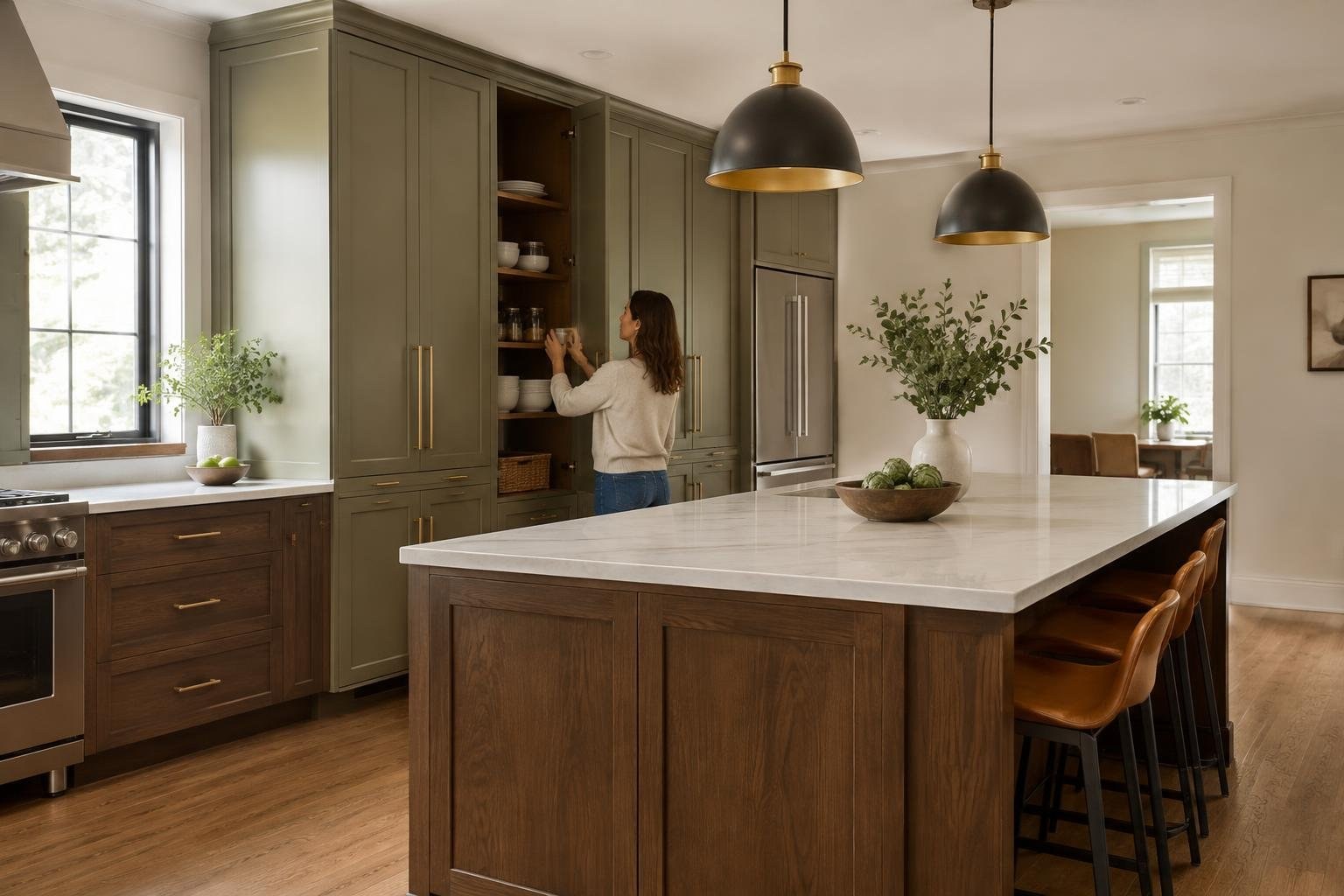
What to know about tall kitchen cabinets
Tall kitchen cabinets are vertical units chosen to suit their location and use rather than a single universal set of dimensions. They can provide pantry storage or form part of a wall that combines storage with an appliance. Base cabinets, by contrast, sit on the floor and commonly support countertops or appliances. Check the exact dimensions of any tall cabinet you are considering, rather than assuming it matches a standard base-cabinet module.
Think of the cabinet as part of the room’s working layout. A full-height unit may put supplies in one place or visually group storage and appliances, but its doors, depth, and position must work with nearby circulation and work areas.
Signs a tall cabinet could solve a storage problem
A tall cabinet may be worth considering when pantry items are scattered across several cabinets, a wall area is not being used effectively, or the kitchen needs storage near an appliance. It can also help organize an open-plan view when several functions are planned together. One documented kitchen project used a tall cabinet wall to combine a refrigerator, pantry storage, and a coat closet while addressing the kitchen’s position near the entry.
Those are possibilities, not automatic reasons to add cabinetry. First identify the problem: insufficient food storage, inconvenient access, a missing place for small appliances, or visual clutter. If the existing layout already stores everyday items well, adding a large cabinet could consume valuable floor or wall space without solving a real need.
Tall kitchen cabinet costs and what to compare
There is no dependable single price for a tall kitchen cabinet in the supplied product information. A useful budget starts with a written, project-specific estimate that separates the cabinet from delivery, assembly or installation, and any additional work required to fit it into the room. Do not treat an advertised cabinet price as the total cost of a finished installation.
When comparing estimates, ask each provider to identify the model or specification, quantity, interior configuration, finish, hardware, and any panels or fillers included. Confirm whether the price includes measurement, delivery, assembly, fitting, cleanup, and removal of old cabinetry if relevant. If one proposal excludes work another includes, compare the scope before drawing conclusions from the totals.
Ask how changes to the layout, product selection, or site conditions could affect the estimate. Request written approval for changes before additional work proceeds.
Factors that affect the cabinet and project
The project is shaped by more than cabinet height. The product’s dimensions and interior, the number of units, how the cabinet meets adjacent cabinets or walls, and whether it has to coordinate with an appliance can all affect the plan. Tall cabinets are selected according to utility and placement, so measurements and intended use matter from the start.
- Space: Measure the wall and note ceiling changes, trim, openings, and nearby cabinets.
- Contents: List the items to store and consider their size, weight, and how often you need them.
- Access: Check whether the doors can open without interfering with a walkway, appliance, or adjacent door.
- Integration: If the cabinet meets an appliance or another storage area, coordinate the dimensions and finished appearance as one layout.
These checks help expose fit questions before you place an order, when changes are easier to discuss.
Options and tradeoffs: pantry, cabinet wall, or single unit
The main choice is not simply tall versus short. Decide between a dedicated pantry cabinet, a group of cabinets arranged as a tall storage wall, or a tall unit coordinated with an appliance. Freestanding or modular storage may suit a different need from built-in cabinetry, but confirm how the specific product is intended to be installed and whether its appearance and dimensions work in the kitchen.
| Option | Potential advantage | Check before choosing |
|---|---|---|
| Dedicated pantry cabinet | Creates a focused place for food and household supplies. | Interior layout, door access, and exact fit. |
| Tall cabinet wall | Can group several storage functions and appliances in one planned run. | Coordination of openings, dimensions, and finished edges. |
| Single tall unit | May add storage without redesigning the entire kitchen. | Whether it fits beside existing cabinets and leaves clear access. |
| Open shelving or existing cabinets | May avoid adding a full-height box where that is not needed. | Whether it provides enough organized, protected storage for your use. |
Product listings describe tall cabinets for pantry storage and other rooms, but listings alone do not establish construction quality or suitability for a particular kitchen. Compare the actual specifications and inspect samples or product details when available.
Comparing ready-to-assemble and installed options
Some tall cabinet products are sold ready to assemble, while other purchasing routes may involve cabinets assembled or configured before delivery. The available source listings include a ready-to-assemble tall cabinet, but they do not establish that one category is universally better. Compare the exact materials and specifications, required assembly, delivery terms, installation responsibility, and support for missing or damaged parts.
A ready-to-assemble option may suit someone prepared to follow the assembly instructions and verify the fit. A more coordinated supply and installation arrangement may be preferable when the cabinet must align with existing cabinetry or an appliance. In either case, confirm who is responsible for measurement, assembly, securing the unit, and correcting fit issues.
Do not assume labels such as “solid wood,” “durable,” or “soft-close” answer every quality question. Review what the claim applies to, the cabinet-box construction, included hardware, finish, and written warranty terms for the actual product.
Planning and measuring before you order
Begin with an inventory, then measure the proposed location and the items around it. Record wall length, ceiling height, trim, openings, the location of neighboring cabinets, and appliance dimensions. Note which way cabinet and appliance doors open. For an appliance integration, verify the manufacturer’s appliance requirements with the cabinet plan rather than relying on a visual estimate.
- Group the items you plan to store and note which are used every day.
- Measure the available area at more than one point if the wall or floor appears uneven.
- Mark nearby doors, windows, appliances, switches, and other features on a simple sketch.
- Check the cabinet’s stated exterior and interior dimensions and shelf arrangement.
- Ask the provider to confirm the layout and installation assumptions before ordering.
Accurate dimensions matter because tall cabinets are chosen according to their placement and intended utility, not a universal standard size. Have a qualified installer verify difficult measurements or room conditions rather than guessing.
What to expect during delivery and installation
Expect the work to involve more than setting a cabinet in place. Depending on the product and project, the sequence may include confirming the measurements, preparing the area, assembling the unit, positioning it, securing it as required by its instructions, fitting it against neighboring surfaces, and adjusting doors. If an appliance is part of the plan, its fit and access need to be coordinated with the cabinet layout.
There is no single reliable installation duration for every tall-cabinet project. Ask the provider for a schedule tied to the actual cabinet, delivery, assembly, site conditions, and any other remodeling work. Confirm when the room must be cleared, whether the kitchen can be used during the work, and who handles packaging or old-cabinet removal.
DIY assembly or installation may be appropriate for a capable person when the product instructions, tools, site, and safe handling needs are manageable. Professional help is sensible when the unit is heavy, the fit is complex, several cabinets must align, or the work affects appliances or other trades. Do not take on electrical, plumbing, or structural work unless qualified to do it.
How to choose a qualified cabinet provider
Choose a provider who can explain the proposed cabinet and its fit in your kitchen, not just show an attractive image. Ask who measures, who orders, who assembles, who installs, and who addresses a problem if a cabinet arrives damaged or does not fit as planned. Request a written scope and schedule.
Useful questions include:
- Which exact cabinet model, dimensions, finish, shelves, and hardware are included?
- Who verifies the room and appliance measurements?
- Does the quote include delivery, assembly, installation, panels, fillers, and cleanup?
- What work is excluded, and how will approved changes be priced?
- What written warranty applies to the product and separately to installation?
- Can you review relevant project examples and contact references?
Compare the complete offers. A low total can reflect a smaller scope or work left to the customer, so it is not automatically the better value.
Permits, warranties, and safe installation
Before work begins, confirm local requirements for permits and regulated work with the appropriate local authority or qualified professional. The supplied information does not establish a universal permit rule for cabinet installation. Requirements can depend on the scope of the remodel and the location.
Ask for written product and installation warranty terms, including what is covered, how to report a problem, and any care or installation conditions. Confirm whether the installer is responsible for attaching and fitting the unit according to the product instructions. Tall cabinets and their contents can be substantial, so follow product guidance for assembly and secure installation; do not improvise fastening methods when the instructions or wall conditions are unclear.
If the project involves moving utilities, changing structure, or other regulated work, have the relevant work assessed and completed by appropriately qualified professionals. Do not assume the cabinet quote includes those trades.
Ways to manage cost without cutting corners
Control cost by solving the storage problem with the smallest suitable scope. A single well-planned pantry unit may be enough; a complete wall of cabinets may be justified when it also organizes appliances and other storage. Decide which interior features are essential before selecting upgrades, and compare comparable products rather than paying for features you will not use.
- Reuse serviceable existing cabinets when they fit the updated plan.
- Keep the layout and appliance locations unchanged when a redesign is not needed.
- Compare ready-to-assemble products with assembled or installed proposals on a complete-scope basis.
- Choose shelf arrangements around real contents instead of adding accessories by default.
- Verify measurements and selections before ordering to reduce avoidable changes.
Save safely: do not skip required installation steps, compromise secure attachment, or attempt unqualified utility work to cut the quote. Ask the provider which adjustments reduce cost without undermining fit, safe use, or the intended storage.
Mistakes, red flags, and a practical checklist
Before committing, use this checklist to catch common planning gaps:
- Purpose: You know what the cabinet will store and can reach the items you use most.
- Fit: The exact cabinet dimensions have been checked against the room and surrounding features.
- Movement: Cabinet and appliance doors can open without an obvious conflict.
- Coordination: Any appliance, adjoining cabinet, panel, or filler has been considered in the same plan.
- Scope: You know who handles measurement, delivery, assembly, installation, and cleanup.
- Price: Quotes list what is included and identify exclusions and change procedures.
- Terms: Product and labor warranty details are in writing.
- Safety: The installer has a clear plan for fitting and securing the unit under its instructions.
Common mistakes include buying from a picture without checking dimensions, choosing an interior that does not fit the stored items, overlooking door movement, and assuming that delivery includes installation. Pause if a provider cannot explain the scope or asks you to proceed without resolving a known fit or safety question.
Designing tall cabinets to suit the kitchen
For design, consider the cabinet alongside the existing doors, colors, counters, flooring, and appliances. A tall run can read as one composed wall, especially when its storage and appliance openings are planned together. Alternatively, a contrasting pantry cabinet can be a deliberate focal point. Look at samples in the room’s lighting and compare the cabinet’s visible sides, door style, and hardware with the rest of the kitchen.
Houzz’s tall-cabinet idea gallery includes kitchens with different cabinet styles and finishes, which can help generate design directions. Treat inspiration images as visual references, not proof that a particular layout will fit your room. Check the measurements and product details independently.
Plan a tall-cabinet project with confidence
Tall kitchen cabinets make the most sense when vertical storage solves a clear problem and the layout supports convenient access. A dedicated pantry can organize supplies; a coordinated cabinet wall can combine several storage functions and an appliance. Before deciding, verify the product dimensions, measure the site, check door movement, compare itemized scopes, and confirm who is responsible for installation and follow-up.
Explore cabinet options at CabinetSupply.com for your next project.
Explore Cabinet Supply to review options as you plan your kitchen.
Frequently asked questions
What are tall kitchen cabinets?
Tall kitchen cabinets are full-height units selected for a particular location and use, such as pantry storage or an integrated appliance wall. Their dimensions are not necessarily standardized like base cabinets, so confirm the measurements and intended function of each unit before ordering.
Are tall cabinets a good choice for a small kitchen?
They can work well in a small kitchen if a tall unit replaces an awkward or underused area and its doors do not obstruct a walkway or nearby work area. Measure the room and think through door swings, access, and what the cabinet will store before deciding.
How tall should kitchen cabinets be?
There is no single best height for every kitchen. The right cabinet height depends on ceiling height, nearby trim and appliances, the intended contents, and how you will reach the upper shelves. Confirm the exact product dimensions and installation requirements before purchase.
How much do tall kitchen cabinets cost?
Costs depend on the cabinet and the work included, so request an itemized quote rather than relying on a cabinet-only price. Compare the cabinet, delivery, assembly or installation, fillers and panels, and any related room or utility work that applies to your project.
Can I add one tall cabinet to my existing kitchen?
A tall cabinet can sometimes be added to an existing kitchen, but the available wall space, adjacent cabinetry, flooring, ceiling, and nearby appliances or utilities all matter. Have the installer assess the site and confirm how the cabinet will be secured and finished at the edges.
What should I store in a tall kitchen cabinet?
Use adjustable shelves for items whose sizes may change, and consider pull-out storage if it makes the cabinet’s contents easier to reach. Check the actual interior layout and hardware rather than assuming every tall cabinet includes the same features.
People Also Ask
What are tall kitchen cabinets used for?
Tall cabinets are useful for organizing food, dishes, or household items in a vertical space, and they can also be part of a larger cabinet wall that integrates storage with appliances. The best use depends on placement and how accessible the contents need to be.
What should I check before buying a tall kitchen cabinet?
Consider the cabinet’s exact width, depth, and height, plus door swing, nearby appliances, wall conditions, and the items you plan to store. A product’s general description does not confirm that it will fit your particular room.
Are adjustable shelves important in pantry cabinets?
Look at whether shelves can be adjusted, whether the door and interior layout suit the contents, and whether the construction and finish meet your needs. Compare specifications and included hardware across the exact models you are considering.
Can a tall cabinet surround a refrigerator?
Yes, if the refrigerator and cabinet are designed and installed to work together. Confirm appliance dimensions, access for service, and the surrounding panels and clearances with the cabinet planner or installer before finalizing the layout.
Can tall cabinets make an open kitchen look more organized?
A tall cabinet can contribute to a more unified view when pantry storage, an appliance, and other storage are arranged as one planned run. That approach requires careful coordination of the cabinet dimensions, openings, and finished edges.
How long does it take to install tall kitchen cabinets?
There is no universal installation timeline supported for every project. Timing depends on the product, delivery, site preparation, assembly, fit adjustments, and whether other renovation work is happening at the same time. Ask for a project-specific schedule.
Tall kitchen cabinets can turn an underused wall into useful pantry, appliance, or household storage, but the best design is not simply the tallest cabinet that fits. Start with what you need to store, check the room and appliance constraints, compare the full project scope, and plan access to shelves you will use often. When you are ready to explore styles and cabinet options, visit CabinetSupply.com.
Your next step
Explore cabinet options at CabinetSupply.com for your next project.
Last reviewed and updated October 15, 2026 by the CabinetSupple Editorial Team.
Sources
- Tall Kitchen Cabinet Ideas – Photos & Ideas | Houzz
- Tall Kitchen Cabinets: Smarter Storage For Organized Cooking
- Discover the Best Tall Kitchen Cabinets in the USA | Elevate Your Kitchen Now
- Harbor Natural_Tall Cabinet – RTA Wood Cabinets
- Tall Kitchen Cabinets: Find The Perfect Tall Cabinets for Your Home
- Tall Kitchen Cabinets | CabinetSelect.com
- Pantry Cabinets – Tall Kitchen Cabinets – IKEA
- Amazon.com: Tall Kitchen Cabinet