
Corner kitchen cabinets can make a difficult junction between two runs of cabinets useful, but the right solution depends on more than the shape of the space. A blind-corner cabinet, rotating shelves, pull-out organizer, corner drawers, or pantry-style unit each offers a different balance of access, capacity, and appearance. Start by listing what you want to store, then compare the cabinet opening, interior design, nearby doors and drawers, and full project quote. This guide explains the main options, what to ask a provider, and how to avoid choosing a corner cabinet that looks good but is frustrating to use.
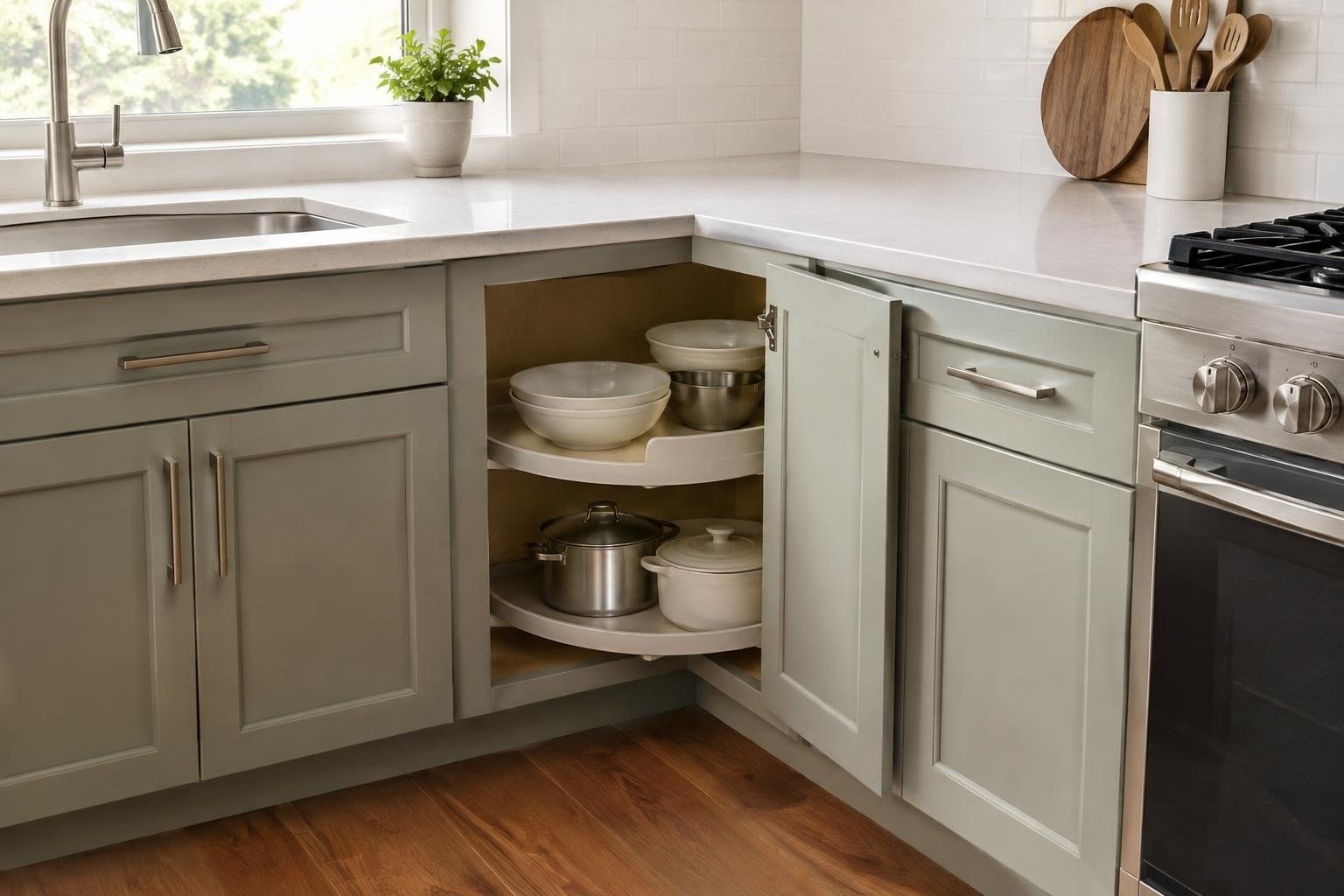
What Are Corner Kitchen Cabinets and Why Does the Choice Matter?
A corner kitchen cabinet is a cabinet designed for the junction between two cabinet runs. Because the corner is harder to reach than a straight run, the cabinet’s opening and interior arrangement matter as much as its exterior dimensions. Common approaches include a blind-corner unit, rotating shelves, pull-out organizers, corner drawers, and pantry-style storage. Upper corners can also be used for display rather than everyday-access storage.
Think of the decision as a fit-and-access problem. What will go inside? Can you reach it without moving other items? Do open doors or drawers interfere with nearby cabinets? Look beyond the label on a product listing and compare its dimensions, opening, organizer, and fit with the adjoining layout.
Signs Your Corner Cabinet May Need a New Layout or Better Storage
A corner cabinet may be worth reconsidering if the existing space is difficult to use, items become buried, or a planned kitchen change leaves you unsure how to handle the corner. These are prompts to review your storage plan, not proof that the cabinet itself must be replaced. Sometimes reorganizing the interior or adding a compatible organizer may address the problem; sometimes the cabinet type or layout is the bigger issue.
- You avoid storing frequently used items in the corner because access is inconvenient.
- Stored items are hard to see or retrieve with the current shelves or opening.
- A renovation changes adjoining cabinet runs, appliances, or the intended use of the space.
- You need a specific kind of storage, such as a place for cookware, pantry goods, or display items.
- Doors, drawers, or proposed organizers seem likely to meet at the corner.
Before choosing a replacement, empty the cabinet and sort its contents. Record what needs regular access, what can be stored farther back, and what should move elsewhere. This simple inventory helps you avoid paying for a large or elaborate cabinet that does not solve the actual storage problem.
Corner Kitchen Cabinet Cost: What to Ask About Pricing
There is no single price that applies to every corner cabinet. The project scope and exact products matter, so compare written estimates rather than using a cabinet category as a price promise. Ask each provider to identify the cabinet, interior organizer, hardware, and installation responsibilities separately.
Request clarity on whether the quote includes delivery, removal of an existing unit, adjustments to adjoining cabinets, finish panels or fillers, and any related countertop or other remodeling work you have requested. An estimate can be hard to compare if one provider includes work that another lists separately.
Have the quote identify the selected model or specifications, dimensions, finish, door style, and organizer. If a choice changes after ordering, ask how the change affects the price and schedule before approving it. Compare equivalent products and scope, not just the final total.
Since the supplied product information covers different corner cabinet and organizer approaches rather than a consistent set of local project prices, treat cost as quote-specific. Ask for an itemized estimate for your measurements and desired configuration.
Factors That Affect the Project and Its Price
Price, fit, and usefulness can change with the cabinet configuration and the work needed to install it. Ask a provider to explain which parts of the proposal drive the total rather than accepting a vague allowance for a “corner cabinet.” Use this list to make estimates easier to compare.
- Cabinet configuration: Identify whether the quote is for a blind-corner cabinet, rotating shelves, pull-out storage, drawers, or a pantry-style unit.
- Interior features: Confirm the organizer type, number and arrangement of shelves, and any special hardware included.
- Dimensions and finish: Check whether the proposal specifies the cabinet size, door style, finish, and any panels or fillers needed to complete the installation.
- Scope of work: Separate the cabinet from delivery, installation, removal, or other kitchen work in the estimate.
- Site fit: Share measurements and information about adjoining cabinets, appliances, doors, and other constraints so the provider can identify possible conflicts.
Ask which assumptions are provisional and what would trigger a change order. A written scope makes it easier to understand the price and decide whether proposed upgrades are worth the added cost.
Corner Cabinet Options: Compare Access, Storage, and Tradeoffs
Corner cabinet options solve different problems. A rotating shelf can bring stored goods around toward the opening; a pull-out organizer brings storage outward; drawers offer a drawer-based arrangement; and a pantry-style cabinet uses the corner for vertical storage. A blind-corner cabinet may suit a layout where part of the cabinet extends behind the adjoining run. Compare the actual opening and organizer rather than assuming two products with similar names work the same way.
| Option | Potential advantage | Check before choosing |
|---|---|---|
| Blind-corner cabinet | Can use space that extends into the corner. | How directly can you reach the stored items? Is an organizer included? |
| Lazy Susan | Rotating shelves can help bring items around for access. | Confirm dimensions, shelf arrangement, and what the shelves can hold. |
| Pull-out organizer | Storage moves toward the opening for retrieval. | Check the opening and movement path against adjoining doors and drawers. |
| Corner drawers | Offer drawer-style organization at the corner. | Review drawer shape, dimensions, and how fronts meet adjacent cabinets. |
| Corner pantry | Provides vertical storage for dry goods and other items. | Assess reach, shelf access, and whether it suits your kitchen plan. |
Organizers such as lazy Susans, tiered pull-outs, and accordion-style drawers are among the approaches used to make corner interiors more functional. Choose one based on what you actually store and how you prefer to reach it.
Design and Storage Planning for Upper and Lower Corners
Corner storage should work with the whole kitchen, not just occupy an unused-looking space. Start with the intended contents and the surrounding layout. A unit that provides plenty of interior room may still be a poor choice if its opening is awkward or its door conflicts with neighboring drawers.
For lower cabinets, consider whether you want to store cookware, serving pieces, pantry goods, or less frequently used items. Compare a rotating shelf or pull-out organizer with the actual opening and your preferred way of retrieving items. If pantry capacity is a priority, a corner pantry can provide vertical storage for dry goods and small appliances, subject to the unit’s fit and access.
For an upper corner, decide whether closed storage or display better serves the room. Glass-front cabinets with interior lighting can make the corner a place to show glassware. A closed upper cabinet can instead organize spices, utensils, or decor. Pair the cabinet’s appearance with the surrounding cabinetry and finishes, but do not let a display feature displace storage you need more often.
Before finalizing a design, check door swings, drawer fronts, nearby appliances, and access routes. Ask the provider to confirm the proposed arrangement on the plan and verify dimensions before ordering.
What the Corner Cabinet Process Includes
The process usually begins with a clear description of the storage problem and a measured review of the kitchen corner. The selected cabinet and organizer then need to be checked against adjacent cabinet runs and any doors, drawers, or appliances that could affect access. Before ordering, review the product specifications and the provider’s written scope.
- List the contents. Separate frequently used items from occasional-use storage and display pieces.
- Record the space. Note the walls, opening, existing cabinet edges, nearby appliances, and any obstructions. Ask the provider to verify product-specific measurements.
- Compare configurations. Review blind-corner, rotating, pull-out, drawer, and pantry approaches where they suit the layout.
- Confirm the proposal. Check dimensions, finish, organizer, installation tasks, delivery, and any related work in writing.
- Prepare and install. Agree who handles removal and preparation, who installs the unit, and how fit and operation will be checked.
Do not order on the basis of a rough visual estimate alone. Small differences in the space or selected product can affect whether the cabinet and its moving parts work with the rest of the kitchen.
What to Expect: Ordering, Installation, and Timing
The schedule depends on the selected product, its availability, the project scope, and whether the cabinet is part of broader kitchen work.
Ask the provider to identify key milestones: measurement confirmation, product selection, order approval, delivery, site preparation, installation, and final adjustments. Clarify what must happen before the installer arrives and whether other work, such as changes to adjoining cabinets or a larger renovation, affects the sequence.
Get the expected timing in writing and ask how the provider will communicate delays or product changes. If you are coordinating other trades or need the kitchen available by a particular date, explain that early and confirm which dates are commitments and which are estimates.
How to Choose a Qualified Cabinet Provider
Choose a provider who can explain how the proposed cabinet fits your kitchen, not only show a product image. Ask for a clear description of the cabinet and organizer, how the opening will work, and what the installation includes. A provider should be willing to confirm dimensions and discuss potential conflicts with adjacent cabinets or drawers.
- Request a written estimate with product details, measurements, scope, exclusions, and payment terms.
- Ask who measures, orders, delivers, installs, and handles adjustments or product issues.
- Review relevant project examples and ask for references where available.
- Ask how changes are documented, priced, and approved.
- Confirm the expected schedule, cleanup responsibilities, and process for addressing concerns.
- Compare the same cabinet configuration and scope across providers.
Do not select a proposal solely because its total is the lowest. A lower quote may describe a different cabinet, organizer, or amount of work. Compare specifications and responsibilities so you understand what you are buying and who is accountable for each step.
Want to explore cabinet options as you plan? Browse cabinet options at CabinetSupply.com and use your measurements and storage goals to guide the comparison.
Permits, Credentials, Warranties, and Safety
Before work begins, confirm what credentials, approvals, and safety measures apply to your specific project and location. Requirements can vary by place and by the work being done, so ask the relevant local authority or a qualified professional whether permits or licensed trades are needed, especially if the project extends beyond replacing a cabinet.
Ask the provider whether the proposed work involves electrical, plumbing, structural, or other regulated changes. Do not attempt work you are not qualified to perform. If the cabinet project is bundled with utility changes or broader remodeling, clarify who is responsible for those tasks and how they will be completed safely.
Review the product and labor warranty terms before approval. Ask what is covered, who handles a claim, how long coverage applies, and whether the cabinet, organizer, hardware, delivery, and installation have separate terms. Get the answers in writing. Do not assume a general verbal assurance covers every component or type of problem.
Ways to Reduce Cost Without Cutting Corners
You can control the scope and make a more informed choice without compromising fit or safety. First, decide what the corner must store and compare only options that meet that need. A simpler configuration may be preferable to a specialized organizer if it provides adequate access for your planned contents.
- Keep existing cabinet runs where they suit the new plan instead of expanding the project without a storage reason.
- Compare a basic interior arrangement with rotating shelves, pull-outs, or corner drawers, and pay for added features only when they solve a real access problem.
- Ask whether a compatible organizer can improve the current cabinet before replacing the whole unit.
- Provide accurate measurements and make selections before ordering to reduce avoidable revisions.
- Compare itemized quotes with matching dimensions, finish, hardware, delivery, and installation scope.
Do not save money by skipping measurement confirmation, accepting unclear responsibilities, or taking on work involving utilities or other hazards without appropriate qualifications. Safe savings come from controlling scope and comparing equivalent proposals, not from leaving critical work undefined.
Mistakes to Avoid and a Pre-Order Checklist
Common planning problems start when shoppers focus on a product photo or exterior size and overlook how the cabinet will be used. A cabinet can be attractive yet inconvenient if its opening, shelves, or moving parts do not match the contents or surrounding layout.
- Choosing by appearance alone: Decide what belongs inside before choosing glass doors, a decorative front, or a display layout.
- Ignoring access: Check how stored items are reached, especially in a blind corner or deep cabinet.
- Skipping fit checks: Confirm product dimensions and how the cabinet meets adjoining runs before ordering.
- Overlooking door and drawer movement: Review nearby fronts and appliances so the planned configuration is usable.
- Accepting a vague estimate: Request cabinet, organizer, delivery, installation, and exclusions in writing.
- Assuming all organizers are alike: Compare the specific organizer and its opening, not just the general product name.
Before you approve the order: confirm the intended contents, measurements, cabinet type, organizer, finish, installation responsibility, warranty terms, schedule, and total scope. If any of these remain unclear, ask for clarification in writing.
Frequently asked questions
What type of corner kitchen cabinet is best?
Common choices include a blind-corner cabinet, a cabinet with a lazy Susan, corner drawers, or a corner pantry. The right option depends on your layout, available opening, and what you want to store. Compare access and usable shelf space, not just the cabinet’s outside dimensions.
Is a lazy Susan better than a blind-corner cabinet?
A lazy Susan uses rotating shelves to make items easier to reach. A pull-out organizer brings stored items toward the opening, while a blind-corner cabinet uses a deeper, less direct space. Check the mechanism, opening, and dimensions against your planned contents before choosing.
Are corner drawers worth it?
Corner drawers can provide direct access to drawer storage, but their shape and dimensions may limit what fits. Compare the drawer layout with the size and type of items you want to store, and confirm how the fronts will meet adjoining cabinets.
How much do corner kitchen cabinets cost?
There is no single dependable price for every corner cabinet. Ask for an itemized quote that identifies the cabinet, organizer, hardware, delivery, installation, and any additional work. Compare the same scope and specifications across estimates.
How long does it take to install a corner kitchen cabinet?
The schedule depends on the selected product, availability, project scope, and whether other kitchen work is involved. Ask the provider to state anticipated delivery and installation milestones in writing, including what could change them.
Can I install a corner cabinet myself?
Possibly, if the cabinet and installation are straightforward and you can measure, level, fasten, and adjust cabinetry accurately. For a fitted kitchen or work involving utilities, structural changes, or uncertain wall conditions, ask a qualified professional to assess the project.
Can a corner kitchen cabinet be used as a pantry?
Often, yes. A corner cabinet can add storage for cookware, pantry items, or smaller kitchen supplies, depending on its design and interior access. Check that the contents you plan to store will fit and remain reachable.
What should I measure before buying a corner cabinet?
Measure the available walls and opening, note adjoining cabinets and obstacles, and record the proposed cabinet and organizer dimensions. Have the installer or supplier confirm the measurements and clearances before ordering.
People Also Ask
What is a blind-corner kitchen cabinet?
A blind-corner cabinet places part of its storage behind an adjoining cabinet run, so the interior may be less direct to access. Compare its opening and any proposed pull-out organizer with the items you plan to keep there.
Can you put a pantry in a kitchen corner?
A corner cabinet can be a practical place for pantry goods or small appliances if the design provides enough usable space and access. A pantry-style corner unit is another option for storing dry goods vertically.
How do you make a corner cabinet look intentional?
Consider the cabinet’s appearance, interior access, and how it meets adjoining doors and drawers. For a display purpose, glass-front doors and interior lighting can make the corner a visual feature; for everyday storage, prioritize convenient access.
How do I choose a corner cabinet organizer?
Measure the opening and surrounding layout, choose the intended contents, and compare the usable interior and access of each option. Confirm the exact product dimensions and installation scope before committing.
Can upper corner cabinets be used for display?
Yes. A corner cabinet may be used for display as well as storage. Glass-front cabinetry with interior lighting is one way to display glassware, while an open or closed upper-corner design can also hold decor or kitchen items.
What should a corner cabinet estimate include?
Ask for an itemized estimate that separates the cabinet and organizer from delivery, installation, and any other requested work. The supplied options include products with different cabinet and storage designs, so compare equivalent specifications rather than relying on a single product label.
A corner cabinet is most useful when its access, interior storage, and surrounding layout suit the way you use the kitchen. Compare the options against what you plan to store, check dimensions and clearances, and get a written quote that spells out the cabinet, organizer, installation, and any related work. A thoughtful choice can turn an awkward junction into practical storage or an intentional display.
Your next step
Explore cabinet options at CabinetSupply.com for your next project.
Last reviewed and updated October 15, 2026 by the CabinetSupple Editorial Team.
Sources
- 24 Corner Cabinet Ideas for Smart Kitchen Design and Storage
- 25 Corner Kitchen Cabinet Ideas For Your Dream Kitchen | George Cabinetry
- 11 Clever Corner Kitchen Cabinet Ideas & Storage Tips
- 26 Corner Kitchen Cabinet Ideas You're Gonna Love
- Amazon.com: Corner Kitchen Cabinet
- Corner Cabinets | Lazy Susan & Blind Corner | Ships Assembled | HDC
- Corner – Kitchen Cabinets – The Home Depot
- 20 Smart Corner Cabinet Ideas for Every Kitchen