
Affordable kitchen cabinets can make a kitchen update possible without paying for a fully custom design, but the lowest listed price does not always equal the lowest project cost. Cabinet style, standard sizing, assembly, delivery, accessories, and installation all affect what you ultimately spend. This guide explains how to compare ready-to-assemble, stock, and more customizable options, what a cabinet quote should include, and how to plan measurements and installation before ordering. Prices below are limited to a published 2026 cabinet-package range; they should not be treated as a complete remodeling estimate.
What affordable kitchen cabinets include
Affordable kitchen cabinets are products positioned to meet a tighter budget, often through standard sizes, limited configurations, or customer assembly. Ready-to-assemble cabinets, usually shortened to RTA, are shipped as components to put together. Stock cabinets are made in standard dimensions and are typically selected from an available range. Some sellers also provide semi-custom options with more choices in sizing or finish.
A cabinet purchase may cover only the cabinet units. Depending on the seller and order, it may or may not include delivery, assembly, installation, fillers, decorative panels, or hardware. Clarify the package boundary before comparing prices. A low cabinet-only quote cannot be compared fairly with a quote that includes installation and finishing pieces.
The goal is not simply to find the cheapest cabinet. It is to find a product and service scope that fit the room, expected use, schedule, and available budget. Several retailers and cabinet sellers advertise affordable styles, colors, and configurations, but the available choices differ by seller and product line.
Signs you may need new cabinets
Cabinet shopping may make sense when existing cabinets no longer meet your storage needs, do not fit a planned layout, or are being replaced as part of a broader kitchen update. A worn appearance alone does not automatically mean you need new cabinets. If the existing units still work for your household, compare less extensive changes such as new hardware or a finish update before committing to replacement.
Consider replacement when your goals require a different cabinet arrangement, more useful storage, or new dimensions that the existing setup cannot provide. First identify the problem you want to solve: insufficient drawers, awkward corners, limited pantry space, or a style that conflicts with other planned finishes. A specific problem statement makes it easier to decide whether new cabinets are necessary and which features deserve budget.
Do not order based only on room photos or a rough estimate. A kitchen can look simple and still have constraints around appliances, doors, windows, utilities, or uneven walls. Record the conditions and have the proposed plan checked before purchase.
Affordable kitchen cabinet costs and pricing
Cabinet prices vary with the kitchen size, cabinet style, finish, product line, and the scope included in the quote. One published 2026 guide gives a budget-friendly range of about $1,260 to $5,100 for a 10-foot run, and approximately $2,300 to $5,100 for a complete 10-by-10 kitchen cabinet package. Treat these as cabinet-package examples, not a guaranteed price or a total kitchen renovation budget.
The same guide notes that style and finish affect the range. Your own quote may differ because the cabinet count and configuration are different, and because sellers may define a “package” differently. Ask whether the amount includes taxes, delivery, assembly, installation, hardware, fillers, toe kicks, end panels, and trim. Check whether countertop work, demolition, disposal, wall repairs, and utility work are excluded.
Request an itemized quote and compare the same layout and product specifications across providers. A per-cabinet price can be misleading if one quote includes a needed panel or drawer option and another does not. Confirm whether estimates are current, how long they remain valid, and what could trigger a change.
What affects the total project cost
Several factors can change the final project amount. The number and dimensions of cabinets affect the quantity purchased. Standard-size stock units may keep choices straightforward when they fit the layout; nonstandard dimensions or extra design flexibility may require a different product tier. Door style, finish, hardware, and storage accessories can also change the selection and quote.
Assembly and installation are separate decisions from cabinet type. RTA may reduce the purchase price, but it requires assembly. Stock cabinets are pre-made in standard sizes and are described as a convenient option for shoppers seeking a quicker turnaround. Neither claim guarantees that a particular order will arrive quickly or cost less after all fees.
Project scope matters too. Delivery access, removal of old cabinets, wall preparation, countertop replacement, and changes around plumbing or electrical can add work beyond buying cabinets. Ask providers to identify assumptions and exclusions in writing. Confirm which party is responsible for checking measurements, coordinating delivery, handling damaged pieces, and resolving fit problems.
Compare cabinet options and tradeoffs
| Option | What it means | Potential benefit | Tradeoff to check |
|---|---|---|---|
| RTA | Cabinets arrive unassembled for the buyer or installer to assemble. | Can be a lower-price purchasing route. | Assembly takes time and must be included in the project plan. |
| Stock | Pre-made cabinets in standard sizes. | Can suit a straightforward layout and provide a convenient option. | Standard dimensions may not fit every room or design. |
| Semi-custom | A product line with additional selection or design flexibility compared with a basic standard range. | May offer a middle ground between standard and custom choices. | Confirm the exact modifications, price, and schedule with the seller. |
| Custom | Cabinets made for a specific plan or dimensions. | May address unusual spaces or specific design requirements. | Request a detailed scope and quote; do not assume it is the right value for every kitchen. |
RTA and stock products are often the first options to compare when affordability is the priority. RTA cabinets are sold for customer assembly, while stock cabinets use standard sizes. These terms do not establish the construction quality of an individual product. Compare specifications, finish, hardware, warranty, and included services rather than assuming a cabinet is well made or poorly made based on its category alone.
Seller ranges can vary. Retail listings include individual RTA units at different prices according to size and shape, while other sellers advertise both RTA and assembled cabinets. Ask for a complete plan and itemized quote instead of comparing isolated cabinet prices.
How to judge cabinet quality on a budget
Low price alone does not tell you how a cabinet is built. Ask the seller for written product specifications, including the cabinet-box material, back construction, shelf details, drawer components, hinges, drawer glides, finish, and warranty terms. Check whether soft-close hardware or other features are standard or optional. If a sales page highlights a material or feature, verify that it applies to every cabinet in your design.
Inspect a sample or display if available. Look at how edges are finished, whether doors and drawers move smoothly, and how the cabinet interior is completed. Check whether exposed ends require a separate finished panel. Ask how replacement parts are handled if a door or component arrives damaged.
Be careful with broad marketing language. A seller may advertise all-plywood boxes, for example, but that does not by itself answer questions about drawer construction, hardware, finish, or installation. Compare the full specifications and warranty rather than treating one construction feature as proof of overall value.
Design choices that balance appearance and function
Affordable does not have to mean visually limited. Cabinet sellers offer a range of sizes, colors, designs, and configurations, including simple white styles, wood-look choices, and more colorful options. Decide first how the cabinets should work with the room’s counters, flooring, backsplash, appliances, and lighting. A sample viewed in a store or on a screen may appear different in your home, so review samples alongside the finishes you plan to keep.
Keep the layout practical. List what needs to be stored and where you use it, then consider whether drawers, shelves, or a dedicated pantry section support that routine. Check that cabinet doors and drawers can open without colliding with nearby appliances, walls, or one another. Do not add organizers or specialty storage solely because they are promoted; confirm the feature solves a real need and fits the budget.
When funds are tight, prioritize a suitable layout and durable everyday operation over decorative upgrades that can be added later. Ask which door, color, hardware, and storage choices change the quote. Confirm whether the selected finish is available throughout the complete cabinet range you need.
Plan the layout and measurements before buying
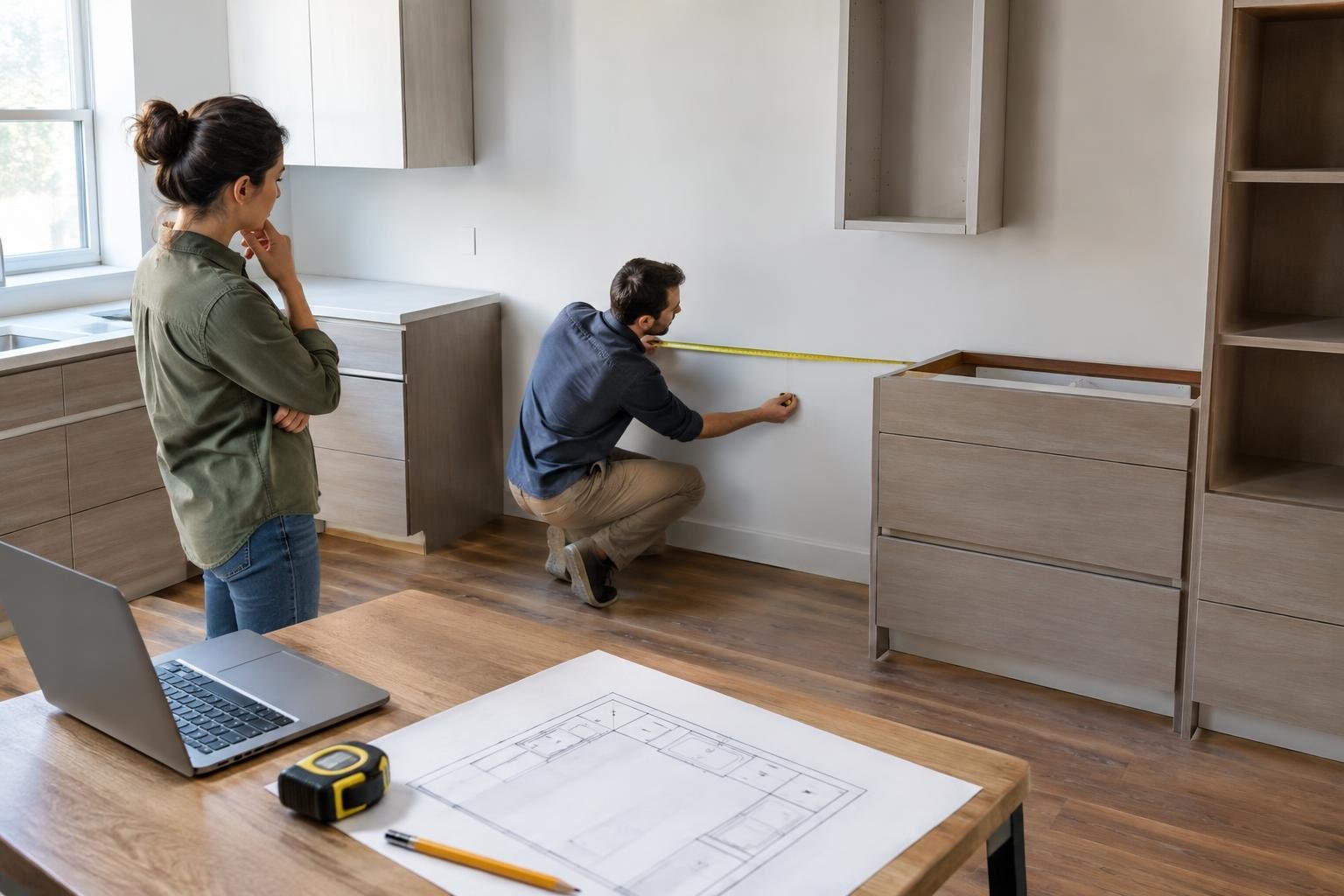
Good measurements are essential because standard cabinet sizes and fixed room conditions must work together. Make a room sketch and note each wall length, ceiling height, doors, windows, and any visible obstructions. Record the location of appliances, sink, plumbing, outlets, switches, heating or ventilation features, and other fixed elements. Include appliance model dimensions when available and note door swings and spaces needed to open drawers.
Measure carefully and verify the plan before placing an order. Walls and floors may not be perfectly straight or level, and a small mismatch can affect cabinet placement or finishing pieces. The cabinet seller or installer should confirm how measurements are taken and who accepts responsibility for checking the final layout.
Ask for a drawing or itemized cabinet list that shows each unit, filler, finished panel, and appliance opening. Check the drawing against the room rather than approving it by appearance alone. Do not move plumbing, electrical, structural elements, or gas connections without qualified help and confirmation of applicable local requirements.
What to expect from ordering through installation
There is no single installation timeline that applies to every affordable cabinet order. Timing depends on product availability, delivery, whether cabinets arrive assembled, the amount of assembly, site readiness, and the installation scope. A stock product may be a convenient choice for a quicker turnaround, but ask the seller for the schedule for your actual order rather than relying on a general product description.
- Finalize the plan: Confirm measurements, product selections, cabinet quantities, and what the quote includes.
- Prepare the site: Agree on who removes existing cabinets, protects the work area, and handles any needed wall or floor preparation.
- Receive and inspect: Check the delivery against the order and promptly document missing or damaged parts.
- Assemble and install: Account for RTA assembly if selected, then complete installation and fitting.
- Finish and review: Confirm doors and drawers operate properly, finished ends are covered as agreed, and open items are recorded.
Get the sequence and expected milestones in writing. Ask how delivery delays, incomplete orders, or damaged cabinets affect the work and who coordinates a replacement.
How to choose a qualified cabinet provider
Choose a seller or installer based on the complete scope, not just the initial price. Ask who measures, who prepares the cabinet plan, who assembles RTA units, who installs, and who handles delivery problems. Review relevant project examples, references, written reviews, and the provider’s experience with the type of cabinet and layout you are considering.
Request an itemized estimate that lists cabinet models or specifications, quantities, panels, fillers, hardware, delivery, assembly, installation, removal, and cleanup where applicable. Ask for exclusions, payment milestones, a schedule, change-order procedures, and warranty information. Find out whether product and installation warranties are separate, who provides each, and how a claim is submitted.
Confirm any required local licensing or insurance for work that involves installation or related trades. Rules differ by location and project scope, so check with the relevant local authority rather than assuming a particular credential or permit is always required. The lowest bid may leave out services or materials that another provider includes. Compare equivalent written scopes before deciding.
Ways to save without creating avoidable problems
Save by simplifying choices that do not affect the way you use the kitchen. Compare standard sizes where they fit, limit upgrades to features you value, and ask whether alternate door styles or finishes change the cost. RTA cabinets may reduce the purchase price, but include assembly time, tools, and any labor you hire in the calculation. Stock cabinets can be a practical alternative when standard dimensions work for the plan.
Keep the existing layout if it meets your needs and changing utilities would add work. Avoid saving money by skipping a measurement check, buying fewer finishing pieces than the plan requires, or choosing a product without clear specifications and warranty terms. Those shortcuts can create fit, appearance, or replacement issues that are difficult to resolve after delivery.
Get more than one comparable quote when possible. Ask each provider to price the same cabinet list, hardware, delivery, assembly, and installation scope. Confirm which items can be selected later and which decisions must be finalized before production or order placement.
Mistakes, red flags, and a pre-order checklist
Before placing an order, use this checklist:
- Write down the kitchen problems the new cabinets need to solve.
- Confirm wall, ceiling, opening, appliance, and utility measurements.
- Review a cabinet drawing and cabinet-by-cabinet order list.
- Verify product specifications, finish, hardware, and warranty terms.
- Identify who handles assembly, delivery, installation, removal, and cleanup.
- Compare quote inclusions, exclusions, schedule, and payment terms.
- Ask how damaged, missing, or incorrect components will be addressed.
- Check local requirements before work involving utilities or other regulated tasks.
Common warning signs include vague product descriptions, an estimate without a defined scope, pressure to approve a plan before measurements are checked, and unclear responsibility for installation or damaged items. Pause and request written answers. If a seller cannot explain what is included, you cannot make a reliable price comparison.
Before demolition or installation, protect the rest of the project by confirming delivery timing and site readiness. Do not schedule dependent work on assumptions that the order will arrive complete or on a particular date unless the provider has confirmed the schedule.
Explore cabinet options
Ready to compare cabinet styles and configurations for your kitchen? Explore Cabinet Supply’s cabinet options as one step in your research. Before choosing, bring your measurements, appliance information, preferred storage features, and budget range so you can evaluate whether the options fit the project you have in mind.
Frequently asked questions
Are ready-to-assemble kitchen cabinets cheaper than assembled cabinets?
Ready-to-assemble (RTA) cabinets arrive in parts for assembly, which can lower the purchase price but requires time, tools, and careful installation. Assembled cabinets arrive put together and may cost more to ship or handle. Compare the full delivered and installed cost, not just the cabinet price.
How much do affordable kitchen cabinets cost?
A 2026 published price guide lists budget-friendly cabinets at about $1,260–$5,100 for a 10-foot run, or roughly $2,300–$5,100 for a 10-by-10 kitchen cabinet package. These are cabinet figures, not a complete remodel quote, and actual prices vary by selections and supplier.
Are stock kitchen cabinets a good option?
Stock cabinets are pre-made in standard sizes, so they can be a convenient, lower-cost choice when the standard dimensions fit your plan. They may offer fewer sizing and finish choices than semi-custom or custom options.
What should I measure before ordering kitchen cabinets?
Measure every wall and obstruction, then confirm the proposed cabinet plan against appliance dimensions, door swings, plumbing, electrical, and other fixed conditions. Have the final plan checked by the seller or installer before ordering.
Can I install affordable kitchen cabinets myself?
It depends on the cabinet package and how much assembly and installation work you can do safely and accurately. RTA cabinets require assembly; professional help may be worthwhile for complex layouts, uneven walls, or work involving utilities. Compare labor and delivery charges in the total project cost.
Can affordable cabinets still look stylish?
Yes. Many sellers offer cabinets in multiple sizes, colors, designs, and configurations, while RTA products are sold as separate units. Confirm that the chosen range has the sizes and finishing pieces needed for your specific layout.
People Also Ask
Why are RTA kitchen cabinets more affordable?
RTA cabinets can cost less to purchase because they arrive unassembled, but assembly and installation take work. Compare product, shipping, tools, labor, and any required finishing pieces before deciding.
What is a reasonable budget for cabinets in a 10-by-10 kitchen?
A published 2026 guide gives a budget cabinet range of about $1,260–$5,100 for a 10-foot run and about $2,300–$5,100 for a 10-by-10 cabinet package. These figures cover cabinets, not every remodeling expense.
When should I choose stock cabinets instead of custom cabinets?
Stock cabinets are available in standard sizes and can suit straightforward layouts where those dimensions fit. A more customizable line may be a better fit if the room needs nonstandard sizes or specific design details.
How can I tell whether inexpensive cabinets are good quality?
Check the cabinet-box material, shelves, drawer construction, hinges, glides, finish, and warranty terms. Ask the seller to identify what is included instead of assuming all products in a price range have the same specifications.
What should a kitchen cabinet estimate include?
Include cabinet purchase, delivery, assembly, installation, fillers, panels, hardware, and any related demolition or repair work. Get each item listed so that quotes can be compared on the same scope.
How long does it take to get and install kitchen cabinets?
The lead time depends on the product and seller, while the work period depends on delivery, assembly, site readiness, and installation scope. Ask for written schedule milestones and confirm how delays or damaged items will be handled.
Affordable kitchen cabinets are a matter of balancing price with fit, construction, storage, and installation. Compare complete, like-for-like quotes, check what each cabinet package includes, and keep enough budget for delivery, assembly, installation, and any related work. A careful plan can help you spend on the features that matter and avoid paying for options you do not need. Explore cabinet options at CabinetSupply.com for your next project.
Your next step
Explore cabinet options at CabinetSupply.com for your next project.
Last reviewed and updated October 15, 2026 by the CabinetSupple Editorial Team.
Sources
- Kitchen Cabinet Kings: Cabinets Up to 50% Less Than Big Box
- Cheap Kitchen Cabinets | Shop online | 80+ Styles In Stock | Best Price|Free Shipping
- Finding Affordable Kitchen Cabinets: Style on a Budget – America's Dream HomeWorks
- Budget-Friendly Kitchen Cabinets: Real 2026 Prices & 12 Ways to Save
- Most Affordable Cabinet Brands To Consider In 2026
- Shop Kitchen Cabinets | Semi-Custom Styles & Free Design
- 10 Best Places To Buy Affordable Kitchen Cabinets – Chowhound
- Kitchen Cabinets – Affordable Kitchen Cabinetry – IKEA