
Contemporary kitchen cabinets can give a room a clean, current look, but the best result depends on more than choosing flat doors. The finish, hardware, storage, layout, and relationship to countertops and appliances all shape how the kitchen looks and works. This guide explains what contemporary style can mean, how to compare options, what to ask about cost and timing, and how to evaluate a cabinet proposal before making a commitment.
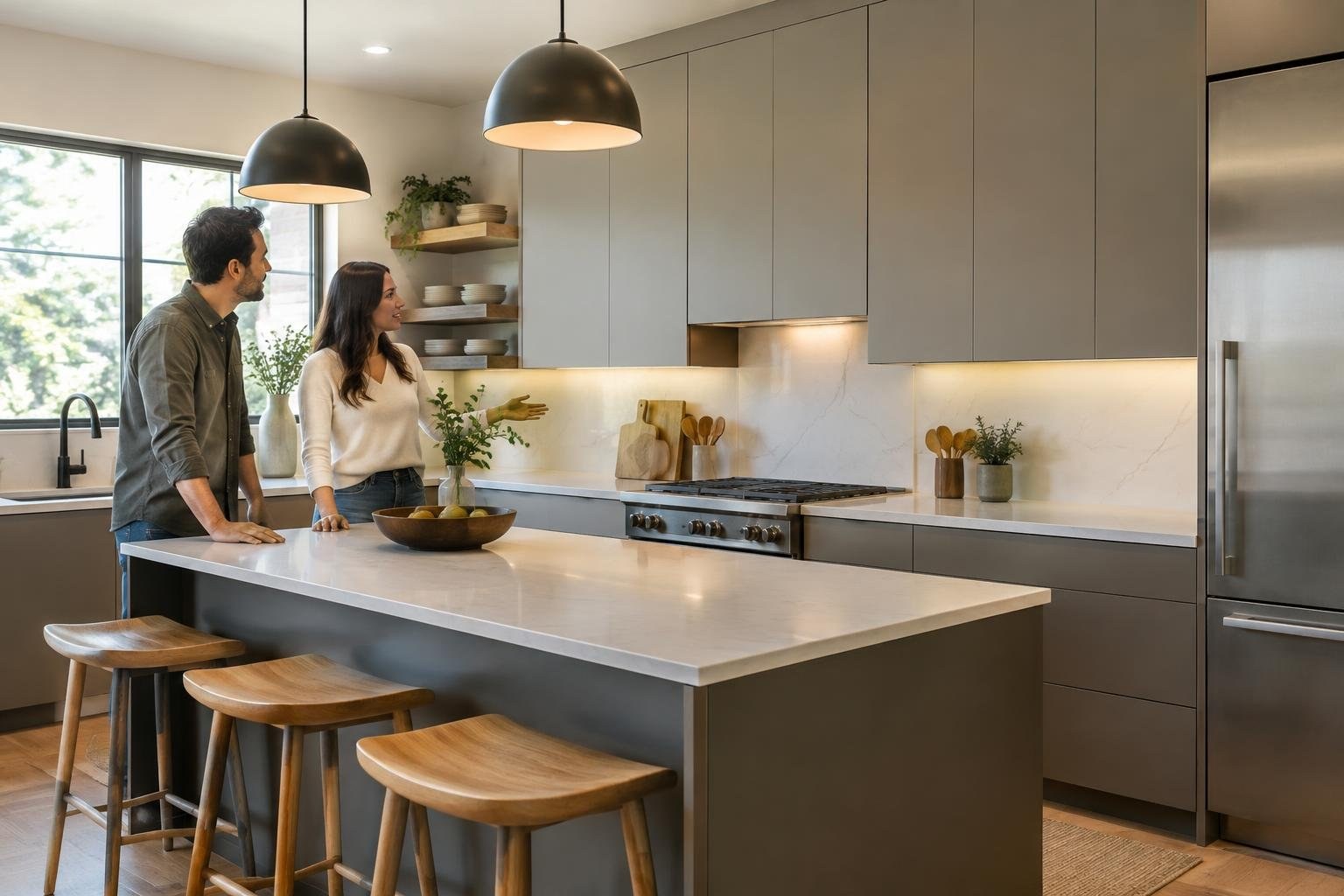
What makes contemporary kitchen cabinets different?
Contemporary describes a design direction rather than one fixed cabinet specification. A useful starting point is simplicity: clean lines, a limited number of competing details, and finishes that work together. Flat-panel doors and neutral colors are common contemporary choices, but the look can also include warm-toned wood and decorative texture.
That flexibility matters when planning. A kitchen can feel contemporary without being entirely white, glossy, or visually stark. Consider the cabinetry alongside the countertop, flooring, backsplash, lighting, and appliances. For example, a warm wood cabinet finish can be paired with a contrasting stone-look island surface to create definition without adding ornate door details. Contemporary kitchen examples also show combinations of flat-panel cabinets, islands, and contrasting surface colors.
Use the word “contemporary” as a conversation starter, not as a complete specification. Bring reference images, identify what you like about them, and translate those preferences into choices a provider can quote: door profile, finish, hardware, cabinet configuration, and any special panels or details.
What does a contemporary cabinet project include?
A cabinet project can include more than choosing new doors. Depending on the scope, it may involve planning cabinet locations and sizes, selecting finishes and storage features, coordinating measurements, ordering the cabinets, removing existing units, installation, adjustments, and coordination with counters or appliances. Confirm which of these tasks your provider is actually including.
Begin with the kitchen as it exists. Record what you want to keep, what does not work, and what must stay in place. Identify appliances, plumbing, electrical outlets, windows, doors, and any areas where people pass through. Bring those details to the design discussion rather than relying on a style image alone.
Ask for the proposal to distinguish cabinet supply from installation and related work. If the project includes demolition, disposal, countertop work, utility changes, or wall repairs, ask who is responsible for each item. A clear scope helps you identify exclusions before they become a surprise.
Signs you may want to update your kitchen cabinets
A style update may be worth considering when the kitchen looks dated to you, the finishes no longer suit the room, or the cabinets do not support the way you want to use the space. Those are design signals, not proof that every cabinet needs replacement. Separate appearance concerns from storage, layout, or condition concerns before choosing a scope.
Make a short problem list. Do you need a different visual style, more accessible storage, a new cabinet arrangement, or a coordinated update to the island? Are the existing cabinets in a condition that merits evaluation before you invest in a new finish or doors? Bring photos and specific examples to a provider so the discussion stays grounded in your needs.
If the layout and cabinets already work, ask whether a more limited change could achieve the desired look. If the room needs a different configuration, compare that possibility with a replacement plan. This guide does not assume one route is right for every kitchen; the decision should follow from the existing conditions and project goals.
What affects the cost of contemporary kitchen cabinets?
There is no dependable single price for contemporary kitchen cabinets without knowing the room, cabinet quantity, selected product, and work included. Request a written quote based on your measurements and selections rather than using a style label as a budget. The available product listings illustrate that contemporary cabinets are offered in different formats, but they do not establish a universal project price.
Ask providers to identify cabinet costs separately from installation and other work. Have them clarify whether the quote includes measurement, delivery, removal and disposal of old cabinets, fillers and finished panels, hardware, countertop coordination, and any wall, floor, plumbing, or electrical work. If an item is excluded, ask whether another contractor must handle it.
Compare proposals on the same cabinet configuration and scope. A lower total may reflect fewer cabinets, different finishes, omitted accessories, or a narrower installation responsibility. Ask what assumptions the estimate uses and how a change in selections or site conditions would be priced.
Project factors that can change the scope
Cabinet style is only one part of the budget and plan. Ask providers to explain how each of these factors affects the proposal:
- Cabinet quantity and configuration: Compare the number, sizes, and arrangement of units, including any island or special storage.
- Door and finish selection: Specify the exact door profile, color, surface, and any contrasting finishes you want quoted.
- Room conditions: Confirm how measurements, uneven walls or floors, and the fit around windows and appliances will be handled.
- Related work: Clarify demolition, disposal, countertop, backsplash, flooring, plumbing, electrical, and appliance coordination.
- Project changes: Ask how revisions after design approval affect cost and timing, and require written approval for changes.
These questions help reveal whether two estimates are actually describing the same project. Avoid treating a broad label such as “contemporary package” as a substitute for itemized selections.
Contemporary cabinet options and tradeoffs
Compare the cabinet choices by fit, finish, and scope, not only by the word “modern.” Contemporary designs are available in different cabinet products and finishes, including laminate and matte or high-gloss options. Simple slab-style doors can create a strong modern effect, while warm wood tones or restrained texture can soften the overall palette.
| Choice | What to compare | Questions to ask |
|---|---|---|
| Flat-panel or slab front | How the clean surface looks with your other finishes | What finish and edge details are included? |
| Neutral or contrasting color | How the palette works with counters, floor, and lighting | Can I review a physical sample in the room? |
| Wood tone or texture | Whether the grain or lined detail supports the desired look | How will the sample coordinate with other wood surfaces? |
| Matte or higher-gloss finish | Appearance under your lighting and your cleaning preferences | What care guidance applies to this specific surface? |
Published contemporary kitchen examples include simple slab fronts, contrasting finishes, warm wood accents, and matte or high-gloss options. They are useful for visual inspiration, but do not establish that a particular finish or product is right for your room. Compare samples and exact product details before ordering.
How to coordinate doors, hardware, and finishes
For a streamlined appearance, compare hardware that is visually simple with hardware that disappears from the front view. Concealed hinges are one option often paired with modern-style cabinets; the final choice should suit the cabinet product and the look you want. Ask the provider which hardware is included and whether the displayed sample matches the quoted specification.
Do not select finishes from an online image alone. A reference photo can help communicate a preference, but colors and surfaces should be considered with the actual room’s lighting and other materials. Gather samples of cabinet finish, countertop, backsplash, and flooring, then compare them together. Decide whether you want a close tonal match, a clear contrast, or one warm accent among quieter surfaces.
Keep practical use in the conversation. Ask how to clean the selected finish and what care information applies to it. Also confirm that hardware, door style, and cabinet configuration are compatible in the exact product being ordered.
Planning storage, appliances, and layout
Before settling on a cabinet plan, make a practical inventory of what needs to fit in the kitchen. Note frequently used cookware, dishes, pantry items, and small appliances, then describe where you would like to use them. Ask the designer or provider to show how the proposed cabinet arrangement addresses that list.
Review the cabinet plan against the room. Check appliance locations, door and drawer operation, windows, entries, and paths through the kitchen. If the plan includes an island, ask how it relates to the surrounding work areas and circulation. Contemporary kitchen examples feature a range of arrangements, including islands, different cabinet colors, and varied countertop combinations; the right arrangement depends on the individual room.
Before approving drawings, verify dimensions and responsibilities with the provider. Confirm who takes final measurements, who checks appliance specifications, and how changes to plumbing or electrical work will be coordinated. Do not undertake regulated utility or structural work yourself unless you are qualified and local requirements allow it.
What to expect from planning through installation
Timing depends on the selections and the work in the proposal. Rather than relying on a general promise, ask for a schedule that names design approval, ordering, delivery, site preparation, installation, and coordination with countertops or other work. Confirm which dates are estimates and what could change them.
- Define the project: Share goals, room information, appliance details, and what you want to retain.
- Review selections and plan: Confirm cabinet configurations, finishes, hardware, and the written scope before approval.
- Prepare the site: Agree who handles removal, disposal, access, and any required work by other trades.
- Install and adjust: Clarify who installs the cabinets and who addresses fit, alignment, and agreed finish details.
- Inspect and close out: Review the completed work against the proposal and document unresolved items before final acceptance.
Ask what happens if a measurement, delivery, or site issue affects the plan. A written schedule and change process make it easier to understand what to expect without assuming every kitchen project follows the same timetable.
How to choose a qualified cabinet provider
Choose a provider who can explain the cabinet plan and the responsibilities attached to it. Review relevant project examples, ask for references where available, and make sure the written estimate describes the specific cabinetry and installation you are considering. Verify licensing or other credentials when required for the work in your area, and ask for proof of insurance where appropriate.
Before signing, ask:
- Who measures, orders, delivers, and installs the cabinets?
- What products, finishes, hardware, and accessories are included?
- What is excluded, and who handles related work?
- What are the payment schedule, expected milestones, and change-order process?
- What warranty terms apply to the cabinets and installation, and how are concerns handled?
- Who is the point of contact if an item arrives damaged or the completed work needs attention?
Compare the answers as carefully as the totals. The lowest bid is not automatically the best fit if it leaves important work or responsibilities undefined. Ask for changes and promises to be recorded in the final written agreement.
Permits, credentials, warranties, and safety
Permit and credential requirements depend on the location and the work involved. Before a project starts, ask the provider which parts may require permits or qualified trades, and confirm the answer with the relevant local authority. Do not assume that a cabinet-only change and a project involving plumbing, electrical, structural, or other regulated work have the same requirements.
Review warranty documents for the actual cabinets and installation services in your proposal. Ask what is covered, what is excluded, how to report an issue, and whether the terms differ between products and labor. Keep the final selections, estimate, change approvals, care guidance, and warranty information together.
For safety, use qualified professionals for work you are not trained or authorized to perform. Confirm who is responsible for coordinating utility changes and making the site ready for installation. Do not rely on a verbal assurance where local rules or written warranty terms matter.
Ways to reduce cost without cutting corners
You can control costs more safely by tightening the scope before ordering, not by skipping important planning. Decide which parts of the room must change and which can remain. Ask for a clear comparison between a focused cabinet update and a larger replacement plan, where appropriate for your existing cabinets and goals.
- Compare proposals using the same cabinet selections and quantities.
- Choose finishes and hardware after reviewing samples and confirming the product details.
- Prioritize storage features you will use rather than adding options without a clear purpose.
- Ask whether a simpler configuration could meet the same functional needs.
- Confirm measurements, appliance details, exclusions, and responsibilities before approval.
- Use written change orders so a late selection change does not remain an informal assumption.
Do not save money by ignoring a fit, safety, or utility concern. Ask the provider to explain any proposed reduction in scope and what it changes. Avoid buying cabinets before confirming dimensions, product specifications, delivery arrangements, and who is responsible for resolving a mismatch.
Common mistakes, red flags, and a buyer checklist
Use this checklist before approving an order or installation plan:
- Have I described the look I want using specific door, finish, and hardware preferences?
- Does the cabinet plan address what I need to store and how I use the kitchen?
- Have I checked the cabinet selections against the countertop, flooring, backsplash, appliances, and lighting?
- Are the measurements and appliance details confirmed by the responsible provider?
- Does the estimate list included work, exclusions, delivery, installation, and disposal responsibilities?
- Are schedule assumptions, payments, warranties, and changes documented?
- Have I confirmed local requirements for any work beyond cabinet installation?
Watch for vague product descriptions, pressure to approve before selections are clear, unclear installation responsibility, and promises that are missing from the written agreement. Treat a dramatic reference image as inspiration rather than a complete specification. Contemporary examples range from high-contrast laminate cabinets to warm wood accents, so focus on translating the parts you like into a precise plan.
Start with a plan that fits your kitchen
Contemporary cabinetry is a visual choice, but a successful project also depends on a clear scope, suitable storage, coordinated finishes, and careful planning. Compare cabinet details and proposals using the same room information, confirm who is responsible for each part of the work, and get important selections and changes in writing.
When you are ready to explore options, browse Cabinet Supply to compare cabinet choices and continue planning your project.
Frequently asked questions
What are contemporary kitchen cabinets?
Contemporary kitchen cabinets typically have a simple, uncluttered appearance. Flat-panel doors, restrained hardware, and neutral or contrasting finishes are common choices, but the style can also include warm wood and textured details. The term does not prescribe one exact layout or material.
Do contemporary cabinets have to be flat-panel?
No. Flat-panel doors are a familiar contemporary choice, but contemporary designs can also use other streamlined door profiles and natural wood finishes. Choose a door and finish combination that suits your room and cleaning preferences.
Are matte or gloss cabinets better for a contemporary kitchen?
There is no single best finish for every kitchen. Compare matte and higher-gloss samples in your own lighting, and consider how visible fingerprints, smudges, and routine cleaning may be on the colors and surfaces you are considering.
How much do contemporary kitchen cabinets cost?
There is no reliable universal price without the project details. Cabinet type, quantity, finish, storage features, layout changes, installation, and related work can all affect a quote. Ask providers to itemize their scope so you can compare like with like.
How long does it take to install contemporary kitchen cabinets?
Timing depends on the selected cabinets, design and ordering process, site conditions, and the work included. Ask for a project schedule that distinguishes design approval, delivery, installation, countertop coordination, and any other work in the proposal.
Can contemporary cabinets look warm rather than stark?
Yes. Contemporary design can use warm wood tones alongside neutral colors and contrasting surfaces. Consider the cabinet sample, countertop, flooring, and lighting together so the overall palette feels deliberate.
Can I update my kitchen to look contemporary without replacing every cabinet?
Sometimes. If the existing layout and cabinets suit your needs, ask a qualified provider whether changing the doors, finish, or hardware is a suitable alternative. Compare the condition of the existing cabinets and the scope of the proposed work before deciding.
What should a cabinet installation quote include?
Ask for a written, itemized proposal that explains cabinet selections, quantities, installation responsibility, schedule, exclusions, payment terms, warranty information, and how changes are approved. Verify any required local credentials and permits for the work involved.
People Also Ask
What makes kitchen cabinets contemporary?
Usually, contemporary cabinets use clean, simple visual lines and restrained details. Flat-panel doors are common, but finish, color, hardware, and how the cabinets relate to the rest of the room also affect the look.
Can contemporary kitchen cabinets include wood?
They can. Contemporary kitchens may combine simple cabinet fronts with warm wood tones, neutral colors, and contrasting countertops. Review samples together in the room instead of choosing each finish in isolation.
What colors work with contemporary kitchen cabinets?
Contemporary cabinets do not require one color palette. Neutral, contrasting, and warm wood finishes can all suit the style. Compare samples with the room’s fixed elements and decide how much contrast you want.
How do I choose storage for contemporary kitchen cabinets?
Start with a list of what you store and how you use the kitchen. Then review cabinet configurations and storage features with a designer or provider, checking that the choices suit the room and the items you need to access.
Should I reface or replace cabinets to get a contemporary look?
Not necessarily. Ask whether your current cabinets are suitable for a finish, door, or hardware update, then compare the scope and outcome with a full replacement proposal. The condition and configuration of the existing cabinets matter to that decision.
What questions should I ask a kitchen cabinet provider?
Ask the provider to explain the cabinet selection, installation scope, schedule, exclusions, and warranty terms in writing. Also confirm who handles measurements, delivery, site preparation, and any coordination with other trades.
Contemporary kitchen cabinets are best chosen as part of a complete room plan, not as a door style alone. Decide what you need to store, compare finishes and cabinet configurations in the actual light of your kitchen, and review a detailed project scope before committing. Explore Cabinet Supply to consider cabinet options for your project.
Your next step
Explore cabinet options at CabinetSupply.com for your next project.
Last reviewed and updated October 12, 2026 by the CabinetSupple Editorial Team.
Sources
- 48 Contemporary Kitchens ideas in 2026
- Contemporary Cabinets Portfolio – Sollera Fine Cabinetry
- 43 Contemporary Kitchens | Contemporary Kitchen Design Ideas | HGTV
- Contemporary Laminate Kitchen Cabinets | Diamond Cabinets
- Shop Modern Kitchen Cabinets Online – Assembled & RTA
- Contemporary – Kitchen Cabinets – The Home Depot
- 75 Beautiful Contemporary Kitchen Pictures & Ideas | Houzz
- Modern Kitchen Cabinets – Contemporary Kitchen Style – IKEA